Kenzaburo Oe - Somersault
Здесь есть возможность читать онлайн «Kenzaburo Oe - Somersault» весь текст электронной книги совершенно бесплатно (целиком полную версию без сокращений). В некоторых случаях можно слушать аудио, скачать через торрент в формате fb2 и присутствует краткое содержание. Жанр: Современная проза, на английском языке. Описание произведения, (предисловие) а так же отзывы посетителей доступны на портале библиотеки ЛибКат.
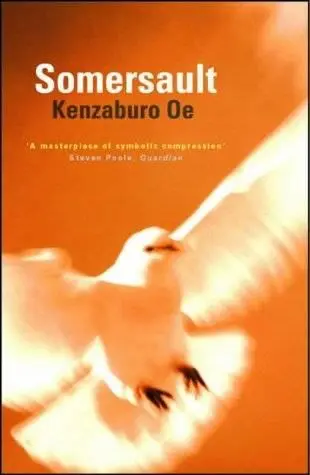
- Название:Somersault
- Автор:
- Жанр:
- Год:неизвестен
- ISBN:нет данных
- Рейтинг книги:4 / 5. Голосов: 1
-
Избранное:Добавить в избранное
- Отзывы:
-
Ваша оценка:
Somersault: краткое содержание, описание и аннотация
Предлагаем к чтению аннотацию, описание, краткое содержание или предисловие (зависит от того, что написал сам автор книги «Somersault»). Если вы не нашли необходимую информацию о книге — напишите в комментариях, мы постараемся отыскать её.
From Publishers Weekly
Nobelist Oe's giant new novel is inspired by the Aum Shinrikyo cult, which released sarin gas in Tokyo 's subway system in 1995. Ten years before the novel begins, Patron and Guide, the elderly leaders of Oe's fictional cult, discover, to their horror, that a militant faction of the organization is planning to seize a nuclear power plant. They dissolve the cult very publicly, on TV, in an act known as the Somersault. Ten years later, Patron decides to restart the fragmented movement, after the militant wing kidnaps and murders Guide, moving the headquarters of the church from Tokyo to the country town of Shikoku. Patron's idea is that he is really a fool Christ; in the end, however, he can't escape his followers' more violent expectations. Oe divides the story between Patron and his inner circle, which consists of his public relations man, Ogi, who is not a believer; his secretary, Dancer, an assertive, desirable young woman; his chauffeur, Ikuo; and Ikuo's lover, Kizu, who replaces Guide as co-leader of the cult. Kizu is a middle-aged artist, troubled by the reoccurrence of colon cancer. Like a Thomas Mann character, he discovers homoerotic passion in the throes of illness. Oe's Dostoyevskian themes should fill his story with thunder, but the pace is slow, and Patron doesn't have the depth of a Myshkin or a Karamazov-he seems anything but charismatic. It is Kizu and Ikuo's story that rises above room temperature, Kizu's sharp, painterly intelligence contrasting with Ikuo's rather sinister ardor. Oe has attempted to create a sprawling masterpiece, but American readers might decide there's more sprawl than masterpiece here.
Somersault — читать онлайн бесплатно полную книгу (весь текст) целиком
Ниже представлен текст книги, разбитый по страницам. Система сохранения места последней прочитанной страницы, позволяет с удобством читать онлайн бесплатно книгу «Somersault», без необходимости каждый раз заново искать на чём Вы остановились. Поставьте закладку, и сможете в любой момент перейти на страницу, на которой закончили чтение.
Интервал:
Закладка:
"When I said this the priest looked shocked and told me the two of us are Gnostic heretics. The religious aficionados there started laughing. My brother hates this-it's literally painful for him, actually: people laughing at something he doesn't understand-and he slammed the desk, scandalizing everyone. We never went back.
"My brother and I both feel that the end of the world is the same as Jesus' crucifixion and resurrection-it's both something that happens at a certain point in time in history and also an event that is always with us. If not, then the inevitable end of the world will have meaning for those who experience it but none for those who died beforehand.
"When my brother and I feel repentance, we feel as if we're seeing the end of the world clearly right in front of our eyes. And we see Patron, look- ing down on the frightening scene at the end of the world, holding our hands as we ascend into heaven. I'm not much of a speaker, and I don't think I can convey what I feel, but if you listen to the composition my brother wrote called 'Ascending to Heaven,' I believe you'll be able to feel the joy of passing away as Patron holds your hand.
"This joy is not an intellectual exercise for my brother. He's a simple soul, but he expresses with great vividness the joy of ascending to heaven. He's able to do this, I think, because at the very moment of composition he's as- cending to heaven hand in hand with Patron."
Ms. Tachibana touched the shoulder of her brother, who didn't have bin- ocular vision and whose eyes, while wide open, were wall-eyed. Her brother picked up a medium-sized cassette recorder he'd had on his lap and, with unexpectedly graceful movements of his surprisingly beautiful fingers, set it in motion.
Until the music actually started, Ogi was anxious. If the music was child- ish, he thought, that would be understandable, but if it turned out to be some- thing incredibly dull that would be even worse. But the low but piercing piano music invited one to smile with unalloyed joy.
When the tape was finished, the bug-faced reporter whose pronounce- ments had been interrupted by Ikuo-now with an even more insectlike, poker-faced look on his face-made the following comment.
"I understand that this music depicts the feeling of having Patron lead one by the hand into heaven, but it's a very short piece, isn't it, taking less than two minutes for the ascent? At any rate, I'm not given any space in the music review section of the paper, but I think it'd be difficult to convince readers if I wrote that a mentally handicapped person had had a mystical experience while he strung together bits of Bach or Mozart."
Ogi watched as Ikuo rose to his feet, as if he were danger incarnate.
"It's obvious that, along with your reference to his being mentally handi- capped, you look down on the composer, Mr. Morio Tachibana. You said he's using bits of Bach or Mozart-well, which is it? And from which works?"
The reporter again ignored Ikuo's questions. Ms. Tachibana's brother, undaunted by Ikuo's earsplitting delivery, looked as if he was straining to hear the reporter's reply.
4
Thus the press conference fizzled to a close. On the way out, Ogi over- heard the dark-skinned reporter speak to Dancer, whom he'd gotten to know, and what he said struck Ogi as entirely reasonable.
"I understand that Patron will be restarting his movement," the reporter said, "but there doesn't seem to be any shared point of view among his fol- lowers. Though I suppose if I put Patron's sermon and the comments of the communal women's group together I can come up with some sort of article."
After seeing the members of the press to the side entrance, and thank- ing the security staff, who, along with Dr. Koga, were about to leave, Ogi stuck his head in the dining hall. The partition was back in place, and in a corner of the wall next to the window there was an upright piano. Ms. Tachibana and her brother had brought over folding chairs and sat facing each other.
Ikuo was standing beside them, talking with Ms. Tachibana's brother.
"That man was an unintelligent, stupid man, wasn't he?" Ikuo said, slowly, pausing between phrases. As proof that his words got through, Ms. Tachibana's brother, one eye fixed on Ikuo's mouth, nodded.
"The newspaper reporter gave his opinion about your music, didn't he? "
Ms. Tachibana added. "Ikuo's saying that that was the opinion of an unintel- ligent, stupid man."
"I could sense that Morio was surprised by how ridiculous that guy's opinions were. Or was he angry? Somehow it seems that way."
"When people laugh at my brother," Ms. Tachibana said, "or show they don't take him seriously, he does get angry, but he just looks like he has a stom- achache. Most people don't realize he's angry."
"Just a moment ago when I saw Morio's expression, it reminded me so much of myself as a child," Ikuo said, with such fervor it took Ogi by sur- prise. "When I got angry it felt like the space between my chest and stomach was being wrung in a knot. It was such a strong feeling that people mis- understood and thought I was crying, and I ended up lashing out at the arro- gant bullies around me, which got me in a lot of trouble."
"Well, I never!" Ms. Tachibana's brother said, with a sigh of criticism.
"Morio knows exactly what you're talking about," Ms. Tachibana said.
"He doesn't do anything violent, but when he's angry it's painful for him, and sometimes he even vomits."
"You don't need to!" Morio said, evidently meaning she didn't need to explain things that far, but it was clear he was wasn't upset.
"That asinine reporter mentioned Bach and Mozart," Ikuo said. "Would you let me listen to that tape again? I want to check to see what part of the piece he means by that."
Morio stood up, took the tape recorder out of a paper bag beside him, placed it on the table, and switched it on. As the music filtered out, Ikuo lis- tened intently. He was silent, but, sensing his request, Morio rewound the tape and played it again.
Ogi was surprised at what happened next. Ikuo pulled a chair out from under the piano that was by the window, sat down, unlocked the keyboard, and played a phrase from the music. His playing was confident, not the hesi- tant touch of someone feeling his way through a piece. After a pause he be- gan to play a short melody that, to Ogi's ears, sounded similar but different.
After this, adding chords as he went, he painstakingly repeated Morio's com- position.
"It's not Bach, and certainly not Mozart either," Ikuo said to Morio, after carefully closing the piano lid. "It's entirely your own music." His quiet voice contrasted with the tone of the piano he'd just played.
"I think so too," Morio said in a low voice, sounding as if he meant to encourage Ikuo more than himself.
Ikuo locked the piano-he'd borrowed the key for this very reason from the building superintendent-and turned his fierce-looking face, all angles and depressions, to gaze out the window. With smooth motions, Ms. Asuka filmed the scene with her video camera, first shooting Ms. Tachibana and Morio, then Ikuo's profile and the large trunk of the wych elm and the ex- panse of lawn. Before her camera turned in his direction, Ogi hurriedly wiped away a tear.
It was getting late, so the three young people-Ogi, Ikuo, and Dancer-re- turned to the office in Seijo, where Dancer put Patron, who was tired and didn't feel like eating anything, to bed, and then they set off for a Chinese restaurant in a narrow street along the Odakyu Line.
Inside the restaurant was a staircase on the left leading to the second floor and a kitchen that jutted out to just below the staircase going off into the back of the restaurant; on the other side of the counter, on the right-hand side, were four tables along the wall. There were no other customers, and the three of them chose the table farthest from the entrance. Ogi and Dancer sat on one side of the table, Ikuo on the other, his bulk overwhelming them.
Читать дальшеИнтервал:
Закладка:
Похожие книги на «Somersault»
Представляем Вашему вниманию похожие книги на «Somersault» списком для выбора. Мы отобрали схожую по названию и смыслу литературу в надежде предоставить читателям больше вариантов отыскать новые, интересные, ещё непрочитанные произведения.





Обсуждение, отзывы о книге «Somersault» и просто собственные мнения читателей. Оставьте ваши комментарии, напишите, что Вы думаете о произведении, его смысле или главных героях. Укажите что конкретно понравилось, а что нет, и почему Вы так считаете.