Kenzaburo Oe - Somersault
Здесь есть возможность читать онлайн «Kenzaburo Oe - Somersault» весь текст электронной книги совершенно бесплатно (целиком полную версию без сокращений). В некоторых случаях можно слушать аудио, скачать через торрент в формате fb2 и присутствует краткое содержание. Жанр: Современная проза, на английском языке. Описание произведения, (предисловие) а так же отзывы посетителей доступны на портале библиотеки ЛибКат.
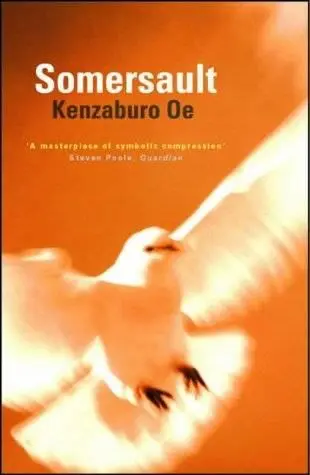
- Название:Somersault
- Автор:
- Жанр:
- Год:неизвестен
- ISBN:нет данных
- Рейтинг книги:4 / 5. Голосов: 1
-
Избранное:Добавить в избранное
- Отзывы:
-
Ваша оценка:
Somersault: краткое содержание, описание и аннотация
Предлагаем к чтению аннотацию, описание, краткое содержание или предисловие (зависит от того, что написал сам автор книги «Somersault»). Если вы не нашли необходимую информацию о книге — напишите в комментариях, мы постараемся отыскать её.
From Publishers Weekly
Nobelist Oe's giant new novel is inspired by the Aum Shinrikyo cult, which released sarin gas in Tokyo 's subway system in 1995. Ten years before the novel begins, Patron and Guide, the elderly leaders of Oe's fictional cult, discover, to their horror, that a militant faction of the organization is planning to seize a nuclear power plant. They dissolve the cult very publicly, on TV, in an act known as the Somersault. Ten years later, Patron decides to restart the fragmented movement, after the militant wing kidnaps and murders Guide, moving the headquarters of the church from Tokyo to the country town of Shikoku. Patron's idea is that he is really a fool Christ; in the end, however, he can't escape his followers' more violent expectations. Oe divides the story between Patron and his inner circle, which consists of his public relations man, Ogi, who is not a believer; his secretary, Dancer, an assertive, desirable young woman; his chauffeur, Ikuo; and Ikuo's lover, Kizu, who replaces Guide as co-leader of the cult. Kizu is a middle-aged artist, troubled by the reoccurrence of colon cancer. Like a Thomas Mann character, he discovers homoerotic passion in the throes of illness. Oe's Dostoyevskian themes should fill his story with thunder, but the pace is slow, and Patron doesn't have the depth of a Myshkin or a Karamazov-he seems anything but charismatic. It is Kizu and Ikuo's story that rises above room temperature, Kizu's sharp, painterly intelligence contrasting with Ikuo's rather sinister ardor. Oe has attempted to create a sprawling masterpiece, but American readers might decide there's more sprawl than masterpiece here.
Somersault — читать онлайн бесплатно полную книгу (весь текст) целиком
Ниже представлен текст книги, разбитый по страницам. Система сохранения места последней прочитанной страницы, позволяет с удобством читать онлайн бесплатно книгу «Somersault», без необходимости каждый раз заново искать на чём Вы остановились. Поставьте закладку, и сможете в любой момент перейти на страницу, на которой закончили чтение.
Интервал:
Закладка:
"I originally worked for an economics trade paper, but soon after I shifted over to a regular newspaper I began covering the story of those men; in my first article I called them the Don Quixote and Sancho Panza of new religions. Using the names the people in the church used at the time, the Prophet, tall and thin, was Don Quixote, while roly-poly Savior was Sancho Panza. But my editor complained that readers would get confused unless I called the founder of the church Don Quixote, so they reversed the names.
"I'm not just saying this to butter you up, but I find it interesting that you also, as Patron's new adviser, are a fairly large-boned man."
Without any indication that he was absorbing this, Kizu asked a ques- tion of his own. "Have you been gathering material on the two men all this time?"
"In our paper I'm mainly the one who covered them."
"I'd like to help you as much as I can," Kizu said, "but I don't have a lot of background knowledge. Could you fill me in on Guide's childhood and the background to his joining the religious movement? I've been asked to take over his job)-only a part of it, of course-but it bothers me that I know next to nothing about my predecessor."
The reporter's dark skin and features put Kizu in mind oiakprasu tengu, a legendary goblin with a crow's beak.
"Guide was born in Nagasaki City," the reporter began, as he stared back at Kizu, "and as an infant survived the atomic bombing. His mother died; his father, an army doctor, was at the front; he was rescued by his uncle, also a physician, who came back for him in the chaos following the bombing. A dramatic sort of childhood, I'm sure you'd agree. His family had been Catholic for generations, and Guide was baptized as an infant. He ended up leaving the church when he was in high school, though, when he read in the paper that a famous Catholic man of letters was granted an audience by Emperor Hirohito. That was enough reason for him to bid Catholicism adieu.
"Guide admitted this was a childish reaction, but at the time he con- cluded that he couldn't continue in his faith. This relates to the dilemma that's been around since the Meiji period, when Christianity swelled in influence at the same time that nationalism came to the fore. You know the old saw: Who is greater, Jesus Christ or the Emperor?
"As a young man, Guide decided that Christ could never have real authority in this country. So he spent the following years cut off from the church, entered the science department at the university, and became obsessed with a new idea-that it was exactly in a country like Japan that Jesus Christ must appear in the Second Coming. Guide started attending Protestant churches with only one goal in mind. When he found a minister who was open to him, he would confront him: Who is greater, Jesus Christ or the Emperor?
"Our country's Emperor was no longer the god people thought he was before and during the war. The new constitution defined him as a symbol of the state, with no actual power. This is what the minister told Guide. Stub- born young man that he was, though, Guide insisted: Who is greater, Jesus Christ or the Emperor? And this led to a falling-out between him and the Protestant church.
"His dream was for Jesus' Second Coming to take place in Japan so he could finally answer the question of who was greater. But since it didn't look like Christ was going to appear, he came up with the radical idea of people creating a substitute with their own hands.
"In Guide's heart, then, someone like Patron was necessary, and from early on he had the idea of creating that sort of figure. I think the explanation for the two of them getting together might lie in this, don't you think?"
"I can see you're a real reporter, since you've cut right to the core of what I've been concerned about. You've given me a lot to think about concerning Guide's background," Kizu honestly admitted.
I
The reporter smiled, a friendly, shy smile.
"Saying I'm a real reporter also points out my weak points. When I in- terviewed Guide he explained things in great detail. He's quite well read and had some interesting ideas. One concerned the nature of symbols, which came from something he'd read by a Jewish scholar. The work he read discussed the Star of David, the symbol of the state of Israel. Some people insist that the Star of David calls to mind the Jewish people's road to the gas chamber and that a new symbol of life would be more fitting for a new country. After re- viewing these arguments, the scholar insisted on the exact opposite interpre- tation. For his generation, the Star of David was a holy symbol born of their suffering and death. And precisely for this reason, it's valuable to light the path toward life and rebuilding. Next, in somewhat cryptic language, he wrote that before ascending to the heights the road descends into the darkest abyss, and what had been a symbol of utter humiliation thus achieves greatness.
"Using this scholar's work as a reference, Guide began to have doubts about whether the symbolic Emperor for Japan and the Japanese defined in the postwar constitution was like the sort of symbol the Jewish scholar had discussed. What Guide and others were searching for was a holy sign or sym- bol for their generation created from suffering and death, something they could hold up as lighting the way to life and regeneration.
"I couldn't write this in my article, but that's what I concentrated on.
Right after I heard this, however, Guide and Patron did their Somersault.
'Everything we've said and done has been one big joke,' they said, as their parting shot. I was thoroughly disappointed, even angry. In other words, with the Emperor greater than Patron, this would be just a repetition of the same old cycle the Japanese people have experienced since the creation of the Meiji constitution.
"After the Somersault I gave up reporting on them. But then, ten years later, suddenly Guide is murdered, which explains why I'm here today. Patron didn't criticize his own actions in the Somersault, though, and even though he says he's starting up the movement again he doesn't seem to have any idea where he's headed. In place of the murdered Guide, you'll be a member of the leadership. What do you think: Has Patron picked up on Guide's ideas about life and regeneration?"
"I have no idea either of the direction Patron's renewed movement will take," Kizu replied. "I started working for Patron simply because a young friend of mine was drawn to him. I've only known Patron for a short while, but I'm very impressed by him. I want him to be resurrected as a spiritual leader, and I plan to do whatever I can to help him. I guess my viewpoint is that of a father who can't just sit by idly and watch his son take on some dangerous task but has to leap in and share the responsibility. Also, Patron asked me to replace the murdered Guide. A strange request, and equally strange for someone like me to accept, but I did, though I don't have the fog- giest idea of what he wants me to do."
"To use Patron's phrase for it, with Guide-his companion in the fall into hell-suddenly taken from him, things must look pretty uncertain for him, now that he's alone. Even so, I imagine it must have been a shock to be told you'd be the new Guide." The reporter's eyes behind his glasses softened somewhat as he smiled.
"From what you've told me, Em convinced that Guide was a religious man," Kizu said. "The words he quoted, too, are in keeping with what I know of him. I also understand the intensity with which Patron considered Guide, through his suffering and death, the holy symbol of this generation. When I consider the ten years following Patron and Guide's Somersault, I think I understand even better both the idea of falling into a dark place before you ascend to the heights and the idea of a symbol of utter humiliation."
Читать дальшеИнтервал:
Закладка:
Похожие книги на «Somersault»
Представляем Вашему вниманию похожие книги на «Somersault» списком для выбора. Мы отобрали схожую по названию и смыслу литературу в надежде предоставить читателям больше вариантов отыскать новые, интересные, ещё непрочитанные произведения.





Обсуждение, отзывы о книге «Somersault» и просто собственные мнения читателей. Оставьте ваши комментарии, напишите, что Вы думаете о произведении, его смысле или главных героях. Укажите что конкретно понравилось, а что нет, и почему Вы так считаете.