Kenzaburo Oe - Somersault
Здесь есть возможность читать онлайн «Kenzaburo Oe - Somersault» весь текст электронной книги совершенно бесплатно (целиком полную версию без сокращений). В некоторых случаях можно слушать аудио, скачать через торрент в формате fb2 и присутствует краткое содержание. Жанр: Современная проза, на английском языке. Описание произведения, (предисловие) а так же отзывы посетителей доступны на портале библиотеки ЛибКат.
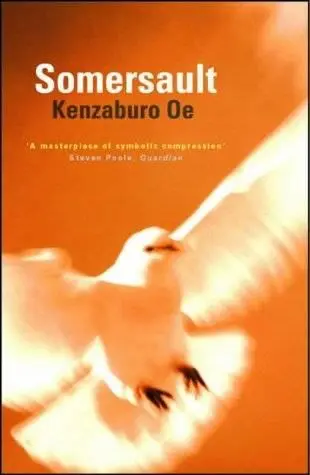
- Название:Somersault
- Автор:
- Жанр:
- Год:неизвестен
- ISBN:нет данных
- Рейтинг книги:4 / 5. Голосов: 1
-
Избранное:Добавить в избранное
- Отзывы:
-
Ваша оценка:
Somersault: краткое содержание, описание и аннотация
Предлагаем к чтению аннотацию, описание, краткое содержание или предисловие (зависит от того, что написал сам автор книги «Somersault»). Если вы не нашли необходимую информацию о книге — напишите в комментариях, мы постараемся отыскать её.
From Publishers Weekly
Nobelist Oe's giant new novel is inspired by the Aum Shinrikyo cult, which released sarin gas in Tokyo 's subway system in 1995. Ten years before the novel begins, Patron and Guide, the elderly leaders of Oe's fictional cult, discover, to their horror, that a militant faction of the organization is planning to seize a nuclear power plant. They dissolve the cult very publicly, on TV, in an act known as the Somersault. Ten years later, Patron decides to restart the fragmented movement, after the militant wing kidnaps and murders Guide, moving the headquarters of the church from Tokyo to the country town of Shikoku. Patron's idea is that he is really a fool Christ; in the end, however, he can't escape his followers' more violent expectations. Oe divides the story between Patron and his inner circle, which consists of his public relations man, Ogi, who is not a believer; his secretary, Dancer, an assertive, desirable young woman; his chauffeur, Ikuo; and Ikuo's lover, Kizu, who replaces Guide as co-leader of the cult. Kizu is a middle-aged artist, troubled by the reoccurrence of colon cancer. Like a Thomas Mann character, he discovers homoerotic passion in the throes of illness. Oe's Dostoyevskian themes should fill his story with thunder, but the pace is slow, and Patron doesn't have the depth of a Myshkin or a Karamazov-he seems anything but charismatic. It is Kizu and Ikuo's story that rises above room temperature, Kizu's sharp, painterly intelligence contrasting with Ikuo's rather sinister ardor. Oe has attempted to create a sprawling masterpiece, but American readers might decide there's more sprawl than masterpiece here.
Somersault — читать онлайн бесплатно полную книгу (весь текст) целиком
Ниже представлен текст книги, разбитый по страницам. Система сохранения места последней прочитанной страницы, позволяет с удобством читать онлайн бесплатно книгу «Somersault», без необходимости каждый раз заново искать на чём Вы остановились. Поставьте закладку, и сможете в любой момент перейти на страницу, на которой закончили чтение.
Интервал:
Закладка:
"You just stated your determination to fight the final battle on earth," the reporter said, "which is a pretty frightening prospect when you think about it. You also said that you possess neither nuclear nor chemical weapons, and I can tell you that those of us in the secular world are thankful to hear that!"
He paused for a moment, apparently expecting laughter, but none of his colleagues laughed.
"Further, you have given us a surprisingly open view of the inner work- ings of your new movement and stated that you plan to restart your religious movement starting with just two hundred people. How can that be enough people to fight this final battle?"
The reporter paused again, waiting for a merry response, but this didn't work out as he'd hoped either. Kizu sensed it had something to do with the attitude of the three men who had earlier applauded.
"I'm assuming that what you told us is based on the principles of the movement you are about to begin," he went on, "but there's something that bothers me. Recently there was another religious group in our country that advocated an Armageddon fight to the finish, a group that committed indis- criminate terrorist acts against ordinary citizens by releasing sarin gas in the Tokyo subway. No one in Japan has forgotten this.
"The founder of this group, Aum Shinrikyo, was trained in India, and at the point where he first declared himself to be the Final Liberated One he had only thirty-five followers. By the next year this had grown to fifteen hundred. Later, a core leadership joined that committed several terrorist acts. The following year, the year their Mount Fuji headquarters was com- pleted, they reached thirty-five hundred followers and became a religious corporation. Two years later they ran candidates in a national election, and even the one billion yen they spent in the effort didn't seem to faze them, so great were their financial resources by this time. Finally, they made con- tacts with sources in the collapsing Soviet Union and purchased some large helicopters, all the while developing the capability to produce seventy tons of sarin.
"So they started with thirty-five people and got to this point in less than ten years. If they'd really been able to carry out their Armageddon battle, the four thousand people killed and injured in the sarin attack on the subway would have been nothing in comparison. The people of Tokyo already know this all too well, wouldn't you agree, that this religious group steadfastly did not compromise-not with Japanese society and not with mankind?
"You were the leader of a religious organization that was also recog- nized as a religious nonprofit organization. You have the experience and, as we've heard today, the faith to be that type of leader. I'm not saying that the Anti-Subversive Act should be applied to your church as you begin a new movement, but as someone whose job it is to report to the public, I don't want to be just a mouthpiece to publicize your group either. We in the media need to be self-critical. At a certain stage of Aum's rapid growth, the media actu- ally helped popularize it; this played well with the boom in interest in super- natural powers that the media also instigated. Even if we knew our articles were nonsense when we wrote them, many people began serious training in order to achieve supernatural powers, then became renunciates, abandoning their studies in college or their positions in society.
"Ten years ago, you yourself, fearing new developments that the radi- cal faction was instigating, abandoned your followers. As the leader you went on national television and revealed that nothing you'd done and said should be taken seriously. And you did your Somersault. This was absolutely neces- sary to abort the plans of the radical faction to take over a nuclear power plant.
And the remnants of this radical faction have now taken your companion captive and killed him.
"This is what we understand from police reports. However, here, at a press conference to announce a gathering to mourn the death of this victim, you make these antisocial pronouncements. What's going on here? I really find it hard to fathom-"
At this point Dancer cut off both the reporter and Patron, who was about to respond, and turned decisively to the assembled members of the media.
"Please consider the gentleman's words as more like a commentary on what Patron said than a question. For the rest of our time, we'd like to have a genuine question-and-answer session. Keep your questions concise, if you would. Since Guide met his untimely end, Patron has been exhausted both mentally and physically, so we'd like to keep this to a maximum of thirty minutes."
"All right, then, I'll rephrase it as a question," the reporter who'd just spoken said, raising his hand. "What do you mean when you say you'll fight the final war with the world? What was the Somersault all about? Its after- effects have not disappeared even after ten years, as we see from this recent tragic turn of events-"
Dancer wasn't about to let Patron take over.
"Why are you asking what the Somersault was all about?" she said.
"Patron and Guide went through that painful experience because the Som- ersault was necessary at that time. And they fell into hell, didn't they? Since you already know all this, I want to ask you how you could possibly ask what the Somersault meant."
The three vigorous young men clapped loudly and Dancer glared at them. To Kizu her stance looked like a mie, one of those frozen dramatic moments in kabuki when the actor assumes an exaggerated pose.
"Then I'll ask a different question," the reporter persisted. "Since the direction you'll be taking your church is toward a final war with the world, how do you differ from Aum Shinrikyo, which preached an apocalyptic vi- sion of Armageddon?"
Dancer looked ready to snap at him again, but Patron, the sleeves of his oversized denim shirt flapping, stopped her. To Kizu this action was yet an- other of Patron's gestures he'd perfected over time.
"In the past," Patron said, "both Guide and I believed that only through our own deaths would we be able to send out a clear message for people to repent. The idea of occupying a nuclear power plant and using it as a nuclear weapon that didn't need a delivery system was based on this. When our shock corps went into action, it would mean that Guide and I were going to die- together with these young people who, through their actions, repented, cleansed their souls, and were headed toward rebirth.
"However, what would we do if-in this suffering world-some people decided that they alone would survive? Realizing that what we'd said and done was being used to justify this erroneous way of thinking, we did the Somersault. This new church we're starting, however, is not at all like that."
At this point Dancer, who was there to support Patron physically, skill- fully took over. The three men seated behind the TV crew seemed about to protest-not at Patron's words but over the reporter's attitude--but Dancer raised her hands to stop both them and the reporters and helped Patron to his feet. By the time Ogi announced that the press conference was over, the two of them had already disappeared down the darkened hallway.
Kizu watched as Ikuo stepped in to smooth things down among the three men as they shouted at the dark-skinned reporter, who had been the sole interlocutor at the press conference. Freed by Ikuo's intervention, the re- porter walked over to talk with Kizu.
11: WAKE MANIA WITHOUT END (II)
1
In the end, the indomitable reporter talked Kizu into going with him to a coffee shop on the road back to the station from the office. The owner of the shop, busy brewing some coffee through a siphon, took their orders and slipped back behind the antique counter, while the reporter turned to Kizu and reintroduced himself.
Читать дальшеИнтервал:
Закладка:
Похожие книги на «Somersault»
Представляем Вашему вниманию похожие книги на «Somersault» списком для выбора. Мы отобрали схожую по названию и смыслу литературу в надежде предоставить читателям больше вариантов отыскать новые, интересные, ещё непрочитанные произведения.





Обсуждение, отзывы о книге «Somersault» и просто собственные мнения читателей. Оставьте ваши комментарии, напишите, что Вы думаете о произведении, его смысле или главных героях. Укажите что конкретно понравилось, а что нет, и почему Вы так считаете.