Alice McDermott - After This
Здесь есть возможность читать онлайн «Alice McDermott - After This» весь текст электронной книги совершенно бесплатно (целиком полную версию без сокращений). В некоторых случаях можно слушать аудио, скачать через торрент в формате fb2 и присутствует краткое содержание. Жанр: Современная проза, на английском языке. Описание произведения, (предисловие) а так же отзывы посетителей доступны на портале библиотеки ЛибКат.
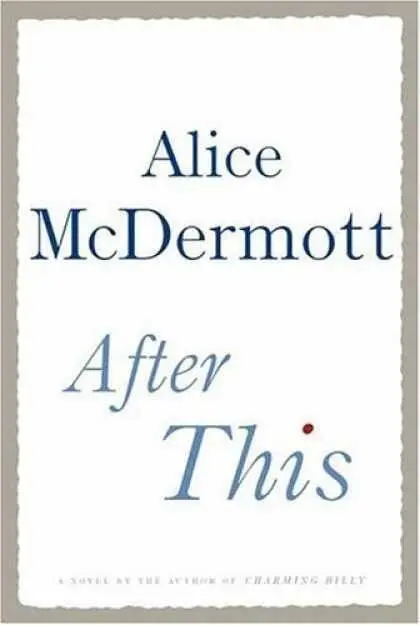
- Название:After This
- Автор:
- Жанр:
- Год:неизвестен
- ISBN:нет данных
- Рейтинг книги:4 / 5. Голосов: 1
-
Избранное:Добавить в избранное
- Отзывы:
-
Ваша оценка:
After This: краткое содержание, описание и аннотация
Предлагаем к чтению аннотацию, описание, краткое содержание или предисловие (зависит от того, что написал сам автор книги «After This»). Если вы не нашли необходимую информацию о книге — напишите в комментариях, мы постараемся отыскать её.
Most fictional family sagas contain a lot of what could be called plain reporting: answers to the questions (who? what? when? where? why?) that are the basic stuff of journalism. But in her family dramas, McDermott has largely refused to provide a helpful framework of dates, genealogies or factual background. Instead, she has focused on the shifting inner lives of her characters, confident that God – or the larger picture – will be found in the details.
The opening of her latest novel, "After This," demonstrates McDermott's technique at its most elliptical and effective. On a blustery April day in Midtown Manhattan, Mary (no last name given) leaves a church (almost certainly St. Patrick's Cathedral) after lighting a candle, as she has done throughout the war, even though the fighting is over. (Since the war in question is clearly World War II, the action must take place, at the earliest, in the spring of 1946). Mary has also prayed: "She was 30, with no husband in sight. A good job, an aging father, a bachelor brother, a few nice friends. At least, she had asked – so humbly, so earnestly, so seriously – let me be content." Outside the church, squinting in the sunlight, Mary meets a friend of her brother's, who unexpectedly asks her to dinner. "At a restaurant," he explains, when she seems confused. "The two of us." Mary agrees, they part, and she goes into Schrafft's for what's left of her lunch hour.
At the counter she exchanges small talk about the weather with a man seated next to her. "Reminds me of some days we had overseas," he says, standing up to pay his bill. Mary watches him walk away: "And here, of all things, was desire again. (She could have put the palm of her hand to the front of his white shirt.)" Mary returns to her office and later goes home to a walk-up apartment in an unnamed borough to prepare lamb chops for her father and brother before her dinner date, which passes pleasantly and ends with a chaste kiss. The next day, when she returns to Schrafft's, the man she met the day before is waiting outside. Reader, she marries him.
This sequence could stand alone as a classic short story in the Joycean, epiphanic mode: an accretion of humdrum moments that gather force and blossom into the transfiguration of a life. Yet such stories seldom cry out for a sequel – does anyone want to know what Gabriel and Gretta Conroy said to each other the morning after "The Dead" concludes? – and McDermott's deft, delicate beginning is a hard act to follow. Mary, so vivid in her first appearance, rapidly fades into careworn motherhood. Fewer than a dozen pages later, she and her husband, John Keane, are taking a rare break from Sunday Mass at a Long Island beach, deserted after the Labor Day weekend, with their three children. John seems stunned by his responsibilities; Mary's pregnancy will only add to them. A hurricane is beginning to churn up the Eastern Seaboard, and the stinging, wind-borne sand drives the family back home. That night, a tree in the Keanes' yard is blown over. The next morning, a neighbor with a chain saw, who also happens to be a registered nurse, appears just in time to help Mary deliver her baby.
Once this hectic episode concludes, McDermott's narrative turns episodic and digressive, and "After This" begins to resemble a photo album with many missing snapshots and pages. Here is John serving on the building committee of St. Gabriel's Parish, helping raise money for a new church and gym. Over there are Mary and her daughter standing in line to see Michelangelo's Pietà in the Vatican pavillion at the 1964 World's Fair. (McDermott, characteristically, omits the 1964 part, leaving that for her readers to deduce.) Here we see the neighbor's teenage daughter going into Manhattan for an abortion, accompanied by the older of the two Keane daughters, who reads "A Farewell to Arms" in the waiting room. And up ahead, Pauline, Mary's old friend from her office days and the Keane family's honorary spinster aunt, is injured in a fall. Strangely, Pauline's mishap and its aftereffects receive far more attention than the major tragedy that befalls Mary and John, registered almost subliminally and barely referred to again.
Each of the Keane children shines briefly before disappearing. Shy, awkward Jacob drops out of St. John's after a year of poor grades and draws an unlucky lottery number for the Vietnam draft. Michael, charming and irreverent, spends most of his time at his upstate college in a seedy saloon. Annie, the bookish child (inspired by one of Pauline's visits to escape into a Faulkner novel while thinking about "the odor of aging female flesh"), goes to study in England and changes her plans because of a young man she meets on a bus. Clare, devoted youngest child and just as devoted Catholic, nonetheless finds a way to break her parents' hearts.
This assembly of splintered stories suggests that McDermott, like Virginia Woolf in "The Waves," has come to care less about her individual characters than about the unseen forces – fate, the zeitgeist, the inexorable progress of time – that shape and trace the patterns of their lives. With no warning or explanation, she provides capsule previews of the deaths of two family members that are jarring not just because they deflate suspense but because they suggest that it's futile to invest much interest in these characters.
Late in the novel, Clare Keane, having finally found a boyfriend during the long summer vacation, returns to her Catholic high school displaying new aplomb and self-confidence: "Of course of course, the teachers, even the nuns told each other, indulgent and naïve. Those who had been at the school when Annie was a student said, with a shrug, Life goes on." And that seems to be the burden and the message of "After This." Life does, irrefutably, go on. But if that's all there is to say about the matter, why bother with art and stories, which defy the limits of birth and death by trying to immortalize the interesting things that happen in between? For all its page-by-page brilliance, "After This" leaves that question hanging.
After This — читать онлайн бесплатно полную книгу (весь текст) целиком
Ниже представлен текст книги, разбитый по страницам. Система сохранения места последней прочитанной страницы, позволяет с удобством читать онлайн бесплатно книгу «After This», без необходимости каждый раз заново искать на чём Вы остановились. Поставьте закладку, и сможете в любой момент перейти на страницу, на которой закончили чтение.
Интервал:
Закладка:
Had they wrested from that stranger, the other Jacob, a blessing for their son, or was it all sentimentality and superstition on her husband’s part-that blood-borne fascination with the dead-that had made him tell her on that first day of her life as a mother, It’s just something I’d like to do? Did the fates howl with laughter at the irony of it all or had some good fortune been secured?
She took Pauline’s empty glass from the counter beside her and dipped it in the soapy water and resolved to think instead (it was how she would get through Jacob’s time in Vietnam) of what could possibly have been better, given all the occasions of her life, than that morning in the hospital with little Jacob in her arms. Our baby grand. The thrill and disbelief of finding herself a mother. Even recalling it now, she could vaguely smell the ether in the air, the particular sweet odor of a newborn’s scalp. And then Michael and Annie and little Clare’s breathless entrance into the world. Mr. Persichetti’s strong arms.
But one moment nudges the other out of the way. It was something to regret. It was something to be grateful for. She rinsed the glass and placed it with the others in the dish drainer. On the win-dowsill above the sink was the small replica of the Pieta in its clear plastic dome-Annie’s Christmas gift to her the year they had seen it. She dried her hands, turned to gather the plates from the kitchen table. There was enough of the roast for the girls’ sandwiches tomorrow. Pauline had been garrulous tonight-the three drinks had done it. She was no thinner than she used to be, but age was making her gaunt, hollowing her cheeks, darkening the circles under her eyes. Mary Keane carried the dishes to the sink. Upstairs, Annie turned a page. Across the hall, her brothers’ room was empty. On the boulevard, the bus behind them lit the rearview mirror above Clare’s head. Pauline presented her cheek to the girl for a kiss and then held up her gloved hand and told John Keane to stay where he was, she could open her own door, thank you.
There were seven people on the bus, all sitting separately, most of them leaning against windows, a few clasping, straight-armed, the back of the seat in front, none of them white. The light inside was a stale and ugly light, too bright, given how dark it was outside. Pauline knew it wasn’t kind to her face, this light, that it lit the fine hairs on her cheek and chin and the powder that clung to them. Turning to the black window, she saw her own reflection more clearly than the neon signs and streetlights they were passing by. She looked older than she believed herself to be.
But how Clare’s skin glowed, and how pleased she had been with the gifts Pauline had brought her today. Even Annie had seemed pleased with the loopy earrings that were certainly not to Pauline’s taste, but that the girl at Lord amp; Taylor had said were just right for teenagers. (“Something for my niece,” Pauline had said, a little white lie that she had been telling salesclerks and strangers for so long now, she no longer noticed it herself, or questioned its meaning. Something for my little niece, for my nephew in college, for my sister’s boy in Vietnam.) She was a black girl, the one behind the counter at Lord amp; Taylor-which wasn’t as nice as it used to be-and Pauline had asked for her advice in defiance of her own expectation that the girl wouldn’t know anything, would most likely respond with a dumb or indignant look, as if puzzled by Pauline’s strange notion that the people behind the counter were supposed to help the people on the other side. (Or so she had put it at dinner tonight, telling the story.) But it turned out the girl was actually quite gracious, looked something like Leslie Uggams, and so added to the pleasure of the nice conversation they’d had (“Something for my niece. A teenager”), and to the satisfaction that Annie had indeed approved of the gift, was the nice story she was able to make out of it all at the dinner table tonight, one that led to all kinds of reminiscence about how gracious salesclerks used to be and remember when you could just say, I think I’ll have it sent?
Beyond the black glass of the window beside her, Pauline saw the blurred strips of neon signs, the dulled nightlights of shuttered storefronts, many of them with black grates across their windows and doors. Nighttime had a different color now, on this familiar route from Nassau to Queens, different from what it had had years ago when streetlights burned a soft yellow, and you could-hadn’t they said it at dinner tonight-feel safe riding the subway at any hour. That was over now. There was a drunk at the back of the bus, muttering angrily to himself. There was a fat Spanish woman nodding to sleep across the aisle. The familiar world was slowly being overrun by strangers. The smell of odd spices drifted into her apartment at all hours now, even clung to her clothes. Courtesy-a man holding a door for you, tipping a hat-was long gone. You could not take it for granted that anyone spoke English.
When she changed at Jamaica, the second bus was empty, its door left open, its engine idling. She sat on it alone for ten minutes, chilled, headachy from the diesel fuel, before she got off to ask the dispatcher if the driver was going to come. “He’s coming,” the man said, waving her away. When she returned to the bus, there were two people sitting in the front and she said to them, with great dignity, “I’ve already waited here twenty minutes and there’s no sign of a driver.” They looked at her impassively-a black woman and a young black man-and then looked over her shoulder to the driver, also black, who was swinging up the stairs. He ducked into his seat and as she turned to hand him her transfer he took his time stowing his things, adjusting his mirrors, taking off his gloves, and then he sat for a second more with both hands on his thighs, staring straight ahead. She had to say, “Here,” and thrust the paper at him. He took it disdainfully, not turning to meet her eye. The other two passengers got up to hand him theirs and he said thank you to both of them. They passed her, going back to their seats, the boy smirking, like good students turning up their noses at the one who had just gotten the reprimand. She was alone here. Middle-aged, aging, a woman alone, making her way between her few safe havens-the Keanes’ house, her office, her own apartment-through the ugly, amber-colored night.
She sat down at the far end of the first long seat, her back to the window, her gloved hand on the silver pole. The air of the bus was still chilled from the door being left open so long. Because the door had been left open for so long, the air inside smelled strongly of diesel fuel. She sat forward, on the edge of the molded plastic and leaned down as he made a wide turn out of the terminal. And then another. Although she knew this route as well as any, she suddenly found herself disoriented and she looked out the far window and then over her shoulder and then heard herself say, shouting at him over the wheeze of the bus, “Don’t you go down Jamaica Avenue?”
He may have said, “Yeah,” his arms moving in wide arcs over the big wheel. He might have said nothing at all. She waited, leaning down to see where they were. Once she recognized something, anything, she would sit back and say, pleasantly enough, “Oh, I’m all turned around,” and the black lady on the other side might say, “Happens to me all the time.” Or the driver might say, “I just made a wrong turn,” apologizing. “We’re back on track now.” But this was no longer the route she knew (they should have passed a Bohack’s by now) and when she asked him, somewhat alarmed, “Is this the Q54?” his answer was once again garbled. She looked to the woman across the aisle, who said, “Huhn huhn,” which she hoped meant yes but could have meant she didn’t know. “I don’t know what ‘huhn huhn’ means,” she said, out loud, but not, she was certain, loud enough for the woman to hear. She looked out again, over her shoulder, and then reached up for the buzzer over her head, fumbling for it with her glove. She stood. “He doesn’t know where he’s going,” she said. She was sick to her stomach from the time she had waited in the cold, and the diesel odor had made her dizzy. She reached for the pole by the door. “You’re not going the right way,” she told him, shouting to be heard over the engine, “I’m getting off.” There was another wide turn, she held on, leaning down now to look through the glass in the door. Where were they? “You’d better let me off,” she said. And in the same moment that she saw the familiar storefront of Green Point Savings go by (and perhaps, recognizing it, relaxed her grip a bit) the bus swung into the curb and the driver pulled the doors open and she felt herself thrown forward and her feet, moving to regain her balance, stepped instead into the well of the stairs. She cried out, lunged forward, missed the handrail and then felt herself collapse, giving in to the fall, the harsh bang of the rubber tread against her hip, against her thighs, her good coat and good skirt, surprised herself at all the noise she made, against the fiberglass and the steel and the oof of her heavy flesh, her arm and her shoulder and her face against the curb. Blind pain, and then there was the feel of the cold air against her stockings, against the bare flesh at the top of her thighs. She struggled to pull down her hem, to cover herself but her arm was pinned, her body immobile. She was aware of voices, none of them urgent, it seemed. Spanish, perhaps laughter, strangers conferring above her in what she hoped was a dream. She would have cried out, if she could. There was dirt in her mouth and the taste of blood. And then a hand, soft and large, calloused, or perhaps it was a glove, touching the good wool of her skirt, pulling its warmth down over her bare legs.
Читать дальшеИнтервал:
Закладка:
Похожие книги на «After This»
Представляем Вашему вниманию похожие книги на «After This» списком для выбора. Мы отобрали схожую по названию и смыслу литературу в надежде предоставить читателям больше вариантов отыскать новые, интересные, ещё непрочитанные произведения.












Обсуждение, отзывы о книге «After This» и просто собственные мнения читателей. Оставьте ваши комментарии, напишите, что Вы думаете о произведении, его смысле или главных героях. Укажите что конкретно понравилось, а что нет, и почему Вы так считаете.