Alice McDermott - After This
Здесь есть возможность читать онлайн «Alice McDermott - After This» весь текст электронной книги совершенно бесплатно (целиком полную версию без сокращений). В некоторых случаях можно слушать аудио, скачать через торрент в формате fb2 и присутствует краткое содержание. Жанр: Современная проза, на английском языке. Описание произведения, (предисловие) а так же отзывы посетителей доступны на портале библиотеки ЛибКат.
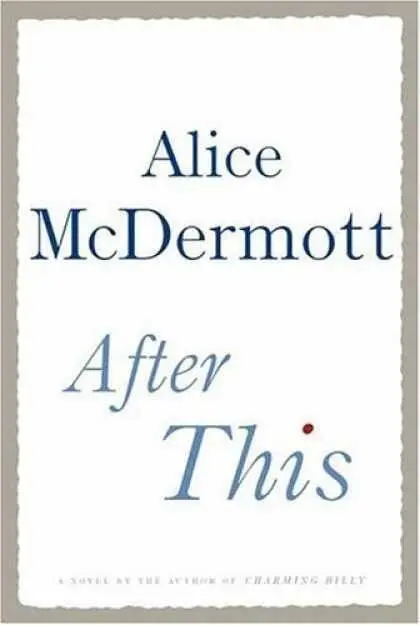
- Название:After This
- Автор:
- Жанр:
- Год:неизвестен
- ISBN:нет данных
- Рейтинг книги:4 / 5. Голосов: 1
-
Избранное:Добавить в избранное
- Отзывы:
-
Ваша оценка:
After This: краткое содержание, описание и аннотация
Предлагаем к чтению аннотацию, описание, краткое содержание или предисловие (зависит от того, что написал сам автор книги «After This»). Если вы не нашли необходимую информацию о книге — напишите в комментариях, мы постараемся отыскать её.
Most fictional family sagas contain a lot of what could be called plain reporting: answers to the questions (who? what? when? where? why?) that are the basic stuff of journalism. But in her family dramas, McDermott has largely refused to provide a helpful framework of dates, genealogies or factual background. Instead, she has focused on the shifting inner lives of her characters, confident that God – or the larger picture – will be found in the details.
The opening of her latest novel, "After This," demonstrates McDermott's technique at its most elliptical and effective. On a blustery April day in Midtown Manhattan, Mary (no last name given) leaves a church (almost certainly St. Patrick's Cathedral) after lighting a candle, as she has done throughout the war, even though the fighting is over. (Since the war in question is clearly World War II, the action must take place, at the earliest, in the spring of 1946). Mary has also prayed: "She was 30, with no husband in sight. A good job, an aging father, a bachelor brother, a few nice friends. At least, she had asked – so humbly, so earnestly, so seriously – let me be content." Outside the church, squinting in the sunlight, Mary meets a friend of her brother's, who unexpectedly asks her to dinner. "At a restaurant," he explains, when she seems confused. "The two of us." Mary agrees, they part, and she goes into Schrafft's for what's left of her lunch hour.
At the counter she exchanges small talk about the weather with a man seated next to her. "Reminds me of some days we had overseas," he says, standing up to pay his bill. Mary watches him walk away: "And here, of all things, was desire again. (She could have put the palm of her hand to the front of his white shirt.)" Mary returns to her office and later goes home to a walk-up apartment in an unnamed borough to prepare lamb chops for her father and brother before her dinner date, which passes pleasantly and ends with a chaste kiss. The next day, when she returns to Schrafft's, the man she met the day before is waiting outside. Reader, she marries him.
This sequence could stand alone as a classic short story in the Joycean, epiphanic mode: an accretion of humdrum moments that gather force and blossom into the transfiguration of a life. Yet such stories seldom cry out for a sequel – does anyone want to know what Gabriel and Gretta Conroy said to each other the morning after "The Dead" concludes? – and McDermott's deft, delicate beginning is a hard act to follow. Mary, so vivid in her first appearance, rapidly fades into careworn motherhood. Fewer than a dozen pages later, she and her husband, John Keane, are taking a rare break from Sunday Mass at a Long Island beach, deserted after the Labor Day weekend, with their three children. John seems stunned by his responsibilities; Mary's pregnancy will only add to them. A hurricane is beginning to churn up the Eastern Seaboard, and the stinging, wind-borne sand drives the family back home. That night, a tree in the Keanes' yard is blown over. The next morning, a neighbor with a chain saw, who also happens to be a registered nurse, appears just in time to help Mary deliver her baby.
Once this hectic episode concludes, McDermott's narrative turns episodic and digressive, and "After This" begins to resemble a photo album with many missing snapshots and pages. Here is John serving on the building committee of St. Gabriel's Parish, helping raise money for a new church and gym. Over there are Mary and her daughter standing in line to see Michelangelo's Pietà in the Vatican pavillion at the 1964 World's Fair. (McDermott, characteristically, omits the 1964 part, leaving that for her readers to deduce.) Here we see the neighbor's teenage daughter going into Manhattan for an abortion, accompanied by the older of the two Keane daughters, who reads "A Farewell to Arms" in the waiting room. And up ahead, Pauline, Mary's old friend from her office days and the Keane family's honorary spinster aunt, is injured in a fall. Strangely, Pauline's mishap and its aftereffects receive far more attention than the major tragedy that befalls Mary and John, registered almost subliminally and barely referred to again.
Each of the Keane children shines briefly before disappearing. Shy, awkward Jacob drops out of St. John's after a year of poor grades and draws an unlucky lottery number for the Vietnam draft. Michael, charming and irreverent, spends most of his time at his upstate college in a seedy saloon. Annie, the bookish child (inspired by one of Pauline's visits to escape into a Faulkner novel while thinking about "the odor of aging female flesh"), goes to study in England and changes her plans because of a young man she meets on a bus. Clare, devoted youngest child and just as devoted Catholic, nonetheless finds a way to break her parents' hearts.
This assembly of splintered stories suggests that McDermott, like Virginia Woolf in "The Waves," has come to care less about her individual characters than about the unseen forces – fate, the zeitgeist, the inexorable progress of time – that shape and trace the patterns of their lives. With no warning or explanation, she provides capsule previews of the deaths of two family members that are jarring not just because they deflate suspense but because they suggest that it's futile to invest much interest in these characters.
Late in the novel, Clare Keane, having finally found a boyfriend during the long summer vacation, returns to her Catholic high school displaying new aplomb and self-confidence: "Of course of course, the teachers, even the nuns told each other, indulgent and naïve. Those who had been at the school when Annie was a student said, with a shrug, Life goes on." And that seems to be the burden and the message of "After This." Life does, irrefutably, go on. But if that's all there is to say about the matter, why bother with art and stories, which defy the limits of birth and death by trying to immortalize the interesting things that happen in between? For all its page-by-page brilliance, "After This" leaves that question hanging.
After This — читать онлайн бесплатно полную книгу (весь текст) целиком
Ниже представлен текст книги, разбитый по страницам. Система сохранения места последней прочитанной страницы, позволяет с удобством читать онлайн бесплатно книгу «After This», без необходимости каждый раз заново искать на чём Вы остановились. Поставьте закладку, и сможете в любой момент перейти на страницу, на которой закончили чтение.
Интервал:
Закладка:
Beside him, Bean said, “Mother of Mercy.” The bright orange lining of her parka set off her pale body like neon. Through the veil of her hair there were her small, conical breasts and the shadows of her nipples, the teardrop-shaped navel carved into her stomach, the tender fuzz of pubic hair. In the mirror above the bar he could see all around her a dozen pale, openmouthed faces, like seraphim and cherubim in parkas and half-assed Halloween costumes, surrounding a Madonna.
Ralph bowed his head and moved his mustache from side to side, laughing. And then he reached into the plastic pumpkin and pulled out a Milky Way. He handed it to her. As she slipped the candy bar into her pocket, Ralph put his hand beneath her ear, lifting her hair as she stepped up on the bar rail to move toward him. Bean was now doing a backbend to see her lovely bare legs rising out of the muddy construction boots, her white, dimpled behind under the hem of the khaki parka, and if the low-grade moan that filled the air wasn’t from him, it was from half a dozen guys in the immediate vicinity, like a muffled howl.
When they broke apart, Ralph casually pulled two beers from the cooler. “You mind?” he asked Michael, as if he were just running out to use the john. Michael said, “I don’t mind.” Caroline, meantime, had bowed her head and let her hair fall over her face. Ralph went around the bar, bottles in hand, and Caroline, now holding her coat tightly closed, turned to meet him.
Because Bean was there Michael asked him if he wanted to help out, but he downed his beer and said he was already helping, he was on the decorating committee and did his own Groucho thing with his eyebrows under the bandanna, and then moved back into the crowd.
Chris volunteered instead. He was wearing a sombrero and se-rape he’d brought home from last year’s spring break and he was repeating halfhearted lines from Cheech and Chong that cracked up a group of girls reaching for their beers. Michael had known Chris since freshman year and it had seemed to him since then that the bulk of his emotional effort had always gone into staying faithful to his girlfriend back in Yonkers. He wasn’t always good at it-there were too many opportunities in the dorms-and his every misstep was followed by hours of banging his head against the cinder-block walls. He hated himself, he loved his girlfriend. He wanted to be faithful. He wanted to get laid. He was breaking up with her. He was marrying her. Now that he was, finally, officially, engaged, he had adopted this jokey, old-fart way of dealing with the women at school. A class-clown kind of thing that struck Michael as terribly sad, the way he shook his shoulders and wiggled his broad backside under the serape, the way they laughed at him and then let their eyes skip over to somebody else.
When Michael looked toward the door, he saw Beverly come in with her own crowd. She was wearing one of those plastic headbands with bobbing alien eyes. Then he heard the door in the back room slam open and a few seconds later Bean was backing a coffin into the bar. He was shouting “Move!” in his dumb-jock way and people were laughing. A couple of other guys were pallbearers and Terry held the far end, bumping it into the doorjamb, the jukebox, the edge of the pool table. Some people ran ahead to grab some chairs and place them in the middle of the room. It was a gray metallic coffin and at first Michael thought it was something they had made in shop. He even turned to Chris to say, “What’s this, an IA project?” But Chris shook his head. “None of those guys is industrial arts,” he said.
Michael turned back as they were struggling to get the chairs under the thing. It wasn’t a gray coffin but black. It was the dirt that made it seem paler.
“They dug that fucking thing up,” Chris said into his ear.
It was wild. Bean, the impresario in his earring and bandanna and long coat, made a big deal of opening the lid, then shutting it, then spinning around to ask, “You want to see? Who wants to see?”
Terry was leaning against one of the tables, hugging himself and laughing. He might have been shivering.
Finally, Bean snapped back the upper half of the lid-flashing white satin-girls screamed as the thing rocked on the chairs, threatening to topple, empty. Now a kind of relieved hysteria took over the room and people began coming to the bar, shaking their heads. Crazy ass, they were saying. Bean was saying he’d found the thing in the basement. He was telling everybody it was where Ralph “really sleeps.”
Terry was white-faced, swaying a little, definitely trembling. With a sudden lurch, he headed toward the bathroom. Michael saw him touch the corner of the coffin as he passed by.
Other people were touching it too, rubbing the dirt, playing with the lid. It had lent its own odor even to the smoky room, something earthy and sharply unnatural at the same time. Beverly came to the bar for a beer and as he handed it to her she said, “Do you think this is funny?” She was smiling a little, as if ready to agree whether Michael said yes or no. He said no, he didn’t think it was funny.
She sipped her beer, looked at the thing over her shoulder. He still wasn’t sure he liked her eyebrows, or the super-short hair, but he liked her eyes and her throat and the shape of her head. He liked the lightness of her, on top of him. The stretch of her spine in the dark.
“You want to go?” he said. And she said, “Yeah.”
He told Chris he was leaving and Chris looked at Beverly, the sombrero pushed back on his head, and said, “Vaya con Dios.”
After the rowdy wedding in Yonkers that June, there would be his annual backyard barbecues-famous for the Gennie Cream Ale he served long after any of them still wanted to drink it. There would be his three kids, one with problems, his tacky affair with another teacher which almost cost him everything, and then didn’t. There’d be the quick cancer at forty-two and the heft of his own coffin as they got him down the steps of his church. The party later, in his backyard once again, where they decided that if they weren’t the middle children born at mid-century to middle-class parents and sent from middling, mid-island high schools to mediocre colleges all across the state, they were close enough.
Michael walked around the bar and took the girl’s hand. It was soft and cold and she pulled back for just a minute as she turned to put down her beer. He recalled that he also liked the way he could feel her bones, rib bones, hip bones, the small bones of her fingers through the smooth skin.
There was a heavy smell of upstate winter in the air-the smell of frozen mud, low clouds, heating oil. There was the faint spill of red neon light on Damien’s narrow steps. They walked through it. He put his arm around her. The alien eyes bobbed in his face. “Dogs,” she said, looking past him. He turned. There were four or five neighborhood dogs along the side of Damien’s back door, where he kept his garbage cans. Michael heard their low growling before he could distinguish what it was they were pulling at. At first he thought it was a dummy, a Halloween dummy from someone’s front porch. They were dragging it a bit, tearing at it. But then he saw that it was too solid and too stiff, no newspaper stuffing, and a pale hand showed beneath a dark sleeve. He wore a suit jacket and pants and a white shirt, no shoes, just like they say. The hair was thin and gray and long enough to catch on the hard mud beneath its head. As they moved closer, they saw there was still flesh on the face, the nose, the chin, the sockets for the eyes, but in the dark it looked more like carved bone. A mutt with wiry haunches was tugging at something that turned out to be the man’s tie, slowly, in jerky stops and starts, the way dogs do, pulling the body into the dim yard.
Читать дальшеИнтервал:
Закладка:
Похожие книги на «After This»
Представляем Вашему вниманию похожие книги на «After This» списком для выбора. Мы отобрали схожую по названию и смыслу литературу в надежде предоставить читателям больше вариантов отыскать новые, интересные, ещё непрочитанные произведения.









Обсуждение, отзывы о книге «After This» и просто собственные мнения читателей. Оставьте ваши комментарии, напишите, что Вы думаете о произведении, его смысле или главных героях. Укажите что конкретно понравилось, а что нет, и почему Вы так считаете.