Alice McDermott - After This
Здесь есть возможность читать онлайн «Alice McDermott - After This» весь текст электронной книги совершенно бесплатно (целиком полную версию без сокращений). В некоторых случаях можно слушать аудио, скачать через торрент в формате fb2 и присутствует краткое содержание. Жанр: Современная проза, на английском языке. Описание произведения, (предисловие) а так же отзывы посетителей доступны на портале библиотеки ЛибКат.
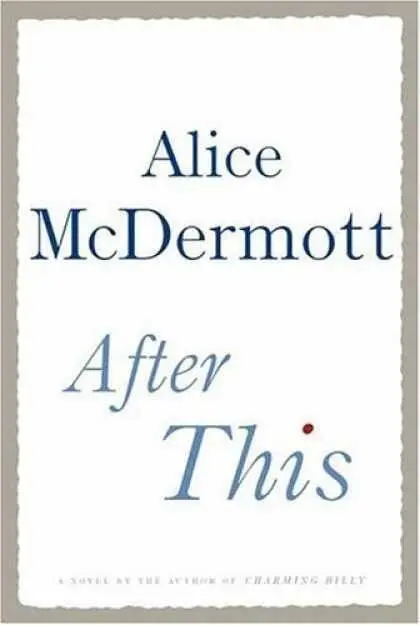
- Название:After This
- Автор:
- Жанр:
- Год:неизвестен
- ISBN:нет данных
- Рейтинг книги:4 / 5. Голосов: 1
-
Избранное:Добавить в избранное
- Отзывы:
-
Ваша оценка:
After This: краткое содержание, описание и аннотация
Предлагаем к чтению аннотацию, описание, краткое содержание или предисловие (зависит от того, что написал сам автор книги «After This»). Если вы не нашли необходимую информацию о книге — напишите в комментариях, мы постараемся отыскать её.
Most fictional family sagas contain a lot of what could be called plain reporting: answers to the questions (who? what? when? where? why?) that are the basic stuff of journalism. But in her family dramas, McDermott has largely refused to provide a helpful framework of dates, genealogies or factual background. Instead, she has focused on the shifting inner lives of her characters, confident that God – or the larger picture – will be found in the details.
The opening of her latest novel, "After This," demonstrates McDermott's technique at its most elliptical and effective. On a blustery April day in Midtown Manhattan, Mary (no last name given) leaves a church (almost certainly St. Patrick's Cathedral) after lighting a candle, as she has done throughout the war, even though the fighting is over. (Since the war in question is clearly World War II, the action must take place, at the earliest, in the spring of 1946). Mary has also prayed: "She was 30, with no husband in sight. A good job, an aging father, a bachelor brother, a few nice friends. At least, she had asked – so humbly, so earnestly, so seriously – let me be content." Outside the church, squinting in the sunlight, Mary meets a friend of her brother's, who unexpectedly asks her to dinner. "At a restaurant," he explains, when she seems confused. "The two of us." Mary agrees, they part, and she goes into Schrafft's for what's left of her lunch hour.
At the counter she exchanges small talk about the weather with a man seated next to her. "Reminds me of some days we had overseas," he says, standing up to pay his bill. Mary watches him walk away: "And here, of all things, was desire again. (She could have put the palm of her hand to the front of his white shirt.)" Mary returns to her office and later goes home to a walk-up apartment in an unnamed borough to prepare lamb chops for her father and brother before her dinner date, which passes pleasantly and ends with a chaste kiss. The next day, when she returns to Schrafft's, the man she met the day before is waiting outside. Reader, she marries him.
This sequence could stand alone as a classic short story in the Joycean, epiphanic mode: an accretion of humdrum moments that gather force and blossom into the transfiguration of a life. Yet such stories seldom cry out for a sequel – does anyone want to know what Gabriel and Gretta Conroy said to each other the morning after "The Dead" concludes? – and McDermott's deft, delicate beginning is a hard act to follow. Mary, so vivid in her first appearance, rapidly fades into careworn motherhood. Fewer than a dozen pages later, she and her husband, John Keane, are taking a rare break from Sunday Mass at a Long Island beach, deserted after the Labor Day weekend, with their three children. John seems stunned by his responsibilities; Mary's pregnancy will only add to them. A hurricane is beginning to churn up the Eastern Seaboard, and the stinging, wind-borne sand drives the family back home. That night, a tree in the Keanes' yard is blown over. The next morning, a neighbor with a chain saw, who also happens to be a registered nurse, appears just in time to help Mary deliver her baby.
Once this hectic episode concludes, McDermott's narrative turns episodic and digressive, and "After This" begins to resemble a photo album with many missing snapshots and pages. Here is John serving on the building committee of St. Gabriel's Parish, helping raise money for a new church and gym. Over there are Mary and her daughter standing in line to see Michelangelo's Pietà in the Vatican pavillion at the 1964 World's Fair. (McDermott, characteristically, omits the 1964 part, leaving that for her readers to deduce.) Here we see the neighbor's teenage daughter going into Manhattan for an abortion, accompanied by the older of the two Keane daughters, who reads "A Farewell to Arms" in the waiting room. And up ahead, Pauline, Mary's old friend from her office days and the Keane family's honorary spinster aunt, is injured in a fall. Strangely, Pauline's mishap and its aftereffects receive far more attention than the major tragedy that befalls Mary and John, registered almost subliminally and barely referred to again.
Each of the Keane children shines briefly before disappearing. Shy, awkward Jacob drops out of St. John's after a year of poor grades and draws an unlucky lottery number for the Vietnam draft. Michael, charming and irreverent, spends most of his time at his upstate college in a seedy saloon. Annie, the bookish child (inspired by one of Pauline's visits to escape into a Faulkner novel while thinking about "the odor of aging female flesh"), goes to study in England and changes her plans because of a young man she meets on a bus. Clare, devoted youngest child and just as devoted Catholic, nonetheless finds a way to break her parents' hearts.
This assembly of splintered stories suggests that McDermott, like Virginia Woolf in "The Waves," has come to care less about her individual characters than about the unseen forces – fate, the zeitgeist, the inexorable progress of time – that shape and trace the patterns of their lives. With no warning or explanation, she provides capsule previews of the deaths of two family members that are jarring not just because they deflate suspense but because they suggest that it's futile to invest much interest in these characters.
Late in the novel, Clare Keane, having finally found a boyfriend during the long summer vacation, returns to her Catholic high school displaying new aplomb and self-confidence: "Of course of course, the teachers, even the nuns told each other, indulgent and naïve. Those who had been at the school when Annie was a student said, with a shrug, Life goes on." And that seems to be the burden and the message of "After This." Life does, irrefutably, go on. But if that's all there is to say about the matter, why bother with art and stories, which defy the limits of birth and death by trying to immortalize the interesting things that happen in between? For all its page-by-page brilliance, "After This" leaves that question hanging.
After This — читать онлайн бесплатно полную книгу (весь текст) целиком
Ниже представлен текст книги, разбитый по страницам. Система сохранения места последней прочитанной страницы, позволяет с удобством читать онлайн бесплатно книгу «After This», без необходимости каждый раз заново искать на чём Вы остановились. Поставьте закладку, и сможете в любой момент перейти на страницу, на которой закончили чтение.
Интервал:
Закладка:
And then, out of the blue, a boy stood up from one of the tables and smacked a full plate of steaming eggs right into Groucho’s face. The impact floored the poor kid, sent his cigar flying. There was a moment’s pause in the general noise and Michael found himself listening for a moan of anger or resentment, but what he heard instead was only the silence of a change in the tide. Suddenly, someone else dove for Harpo and pulled off his wig. He saw it fly into the air, bouncing from hand to hand until somebody else slam-dunked it into the milk dispenser. Chico’s hat, too, was being passed around and when he appeared again among the crowd, he was hog-tied in his own plaid jacket and someone had squirted ketchup and mustard down his shirt. On the other side of the room, some girls were dancing around a dog pile of guys-one of them had Harpo’s horn and was squeezing it in short bursts, like a rising orgasm. Then Harpo scrambled free. He was naked from the waist down, cursing wildly. He ran for the door they’d come in through, hunched over, bare-assed and limping. Chico and Groucho followed, Groucho turning as he ran, the nose and mustache gone, the eggs still stuck to his shirt front and hair. He gave the room the finger and was gone.
It took a few minutes for things to settle down. Someone else had the bicycle horn and blew it intermittently, another guy held up Harpo’s pants and underwear and danced them around a bit. But people were returning to their seats, finishing their coffee, picking up their trays. Michael turned to one of his housemates and said, “What the hell just happened?”
He shrugged. Chris was a good guy. Stocky, already balding, laid-back, and funny. His father taught industrial arts in a Bronx high school and that’s what Chris wanted to do, too. Michael knew he’d be good at it. Everybody’s favorite teacher. Chris had made all the furniture in his room-bed, dresser, desk, bookcase, even the box he kept his dope in, intricately carved with vines and flowers, satyrs and nymphs.
He was going to get married right after graduation and they had a running joke around the house about what his girlfriend had decided was going to be their wedding song: “Time in a Bottle.”
Chris shrugged, his elbows on the table. “The world is full of assholes,” he said, nonplussed. “What are you going to do?” Michael could see him asking his students this very question for the next thirty years.
At Damien’s that night, Michael scanned the room for the short-haired girl, not sure whether he was hoping to see her or not. There were a few people in costumes, mostly masks or crazy hats, nothing too ambitious. Some of the girls wore leotards under their parkas and little ears on their heads-black cats or bunny rabbits. The less shapely ones were kids in flannel pajamas or housewives in bathrobes, curlers in their hair. One kid-every year-in a thrift-store trench coat that he would part to reveal a piece of pink rubber hose glued to a square of brown carpet whenever he caught a girl’s eye.
Ralph still didn’t have any decorations up, but there was a plastic pumpkin filled with candy by the register and every once in a while he lifted it and tossed some candy into the crowd. When Caroline squeezed in beside Michael, she put her elbow on the bar and held out her hand. “Where’s mine?” she asked, coyly, but a little defiantly, too.
Ralph looked her up and down, baring his teeth in that strange grin. “Where’s your costume?” he said. He held the candy away from her, eyeing the turtleneck and jeans beneath her parka. “You’ve got to have a costume to get a treat,” Ralph said slowly, as if explaining something he thought she already understood. She stared at him a second longer and then abruptly turned away. The ends of her long hair briefly clung to Michael’s arm and shoulder as she turned. Then Bean moved in. He was still wearing the earring and the bandanna. He’d be wearing them for the rest of the year.
“Is he going upstairs?” he asked. He had put bits of black and gold paper over his teeth. “To get his nut?”
Michael shrugged. But Bean was watching Ralph behind the bar and didn’t seem to notice. Then he leaned closer, elbowing Michael’s side as if he were the one with the attention problem. “Is he going upstairs tonight?” he asked from behind his hand. “With her?”
Michael turned away from him-the bandanna was tight, digging into his eyebrows. He had a sudden recollection of Pauline’s big face, bearing down on him. “Doesn’t look like it,” he said, and Bean, still watching Ralph, said a breathless, “Fuck.”
And then he took a drag from his bottle of beer and shouted, “Hey, Ralph.” The hoop earring swaying with the effort. “What’s this about ghosts? I hear you got ghosts. You can’t sleep at night cause of the ghosts.” He looked around, noted the attention his voice had drawn. “Or is it because you’re some kind of frigging vampire?”
Ralph was handing beers over the bar to outstretched hands. When he finished, he walked down to where Bean stood. He touched the corner of his mouth, the drooping ends of his dark mustache. “You know, I never came down here when I was a kid,” he said softly. “There was an outside staircase we used. Straight to the second floor. I had it torn off when my folks moved south-it was a fucking death trap, it was so rotten. But when I was a kid, that’s how we went in and out. I never came in here. So I never really knew when the funeral parlor changed over to a bar. I mean, to a kid, it’s all the same. People are talking, somebody’s crying, somebody’s laughing. A fight breaks out. Every once in a while there’s this creepy silence and then everybody starts talking again. All the same. Still is.”
He looked at them all. He seemed to be making an effort to stay interested in his own words. “I had no problem with it. Dead guys, drunks.” He shrugged to show his indifference. “All the same.”
“No ghosts?” Bean said. “No ghosts keeping you up at night, like you said?”
Ralph let his black eyes rest on Bean for a minute. And then he said, “Only you guys.” Michael laughed with the others. Then, as was his way, Ralph leaned forward, squinting through his own smoke. “I listen to you guys, when I’m upstairs,” he said. He had his hands on the bar, a cigarette burning in one of them. “You don’t sound any different from last year or the year before. Or ten years before. Or even when I was a kid trying to go to sleep upstairs and there was a stiff down here in the middle of it all. And next year it won’t sound any different either.”
Bean straightened up at that, pulled himself back. “Fuck, I’m out of here next year,” he said. He looked around as if for corroboration, then pushed at the bandanna that had begun to slip over his eyelid. “I won’t even be here.”
But Ralph only grinned, patiently. The long-suffering professor. “That’s what I’m telling you,” he said, straightening up. “It won’t matter.”
He turned to toss his cigarette into the sink behind the bar, and Bean, his tongue still poking at his cheek, cried out sarcastically, “That’s one hell of a scary story, Ralph,” just as Caroline was squeezing herself between them. She had some of her girlfriends behind her and Michael heard them giggling and whispering, “Oh my God,” before he took in everything else. She squeezed up to the bar, smiling, her parka with its dirty fake fur closed up around her neck, and her hair, except for a few strands that rose and fell with static, tucked down inside it. She said one sharp, “Ralph,” as if she needed to get his attention. Michael looked down at her and then looked back over her shoulder. Her legs were bare from the hem of her parka to the tops of her construction boots. Michael looked back just in time to see her open her coat and say, “Lady Godiva.”
Читать дальшеИнтервал:
Закладка:
Похожие книги на «After This»
Представляем Вашему вниманию похожие книги на «After This» списком для выбора. Мы отобрали схожую по названию и смыслу литературу в надежде предоставить читателям больше вариантов отыскать новые, интересные, ещё непрочитанные произведения.









Обсуждение, отзывы о книге «After This» и просто собственные мнения читателей. Оставьте ваши комментарии, напишите, что Вы думаете о произведении, его смысле или главных героях. Укажите что конкретно понравилось, а что нет, и почему Вы так считаете.