Kiran Desai - The Inheritance of Loss
Здесь есть возможность читать онлайн «Kiran Desai - The Inheritance of Loss» весь текст электронной книги совершенно бесплатно (целиком полную версию без сокращений). В некоторых случаях можно слушать аудио, скачать через торрент в формате fb2 и присутствует краткое содержание. Жанр: Современная проза, на английском языке. Описание произведения, (предисловие) а так же отзывы посетителей доступны на портале библиотеки ЛибКат.
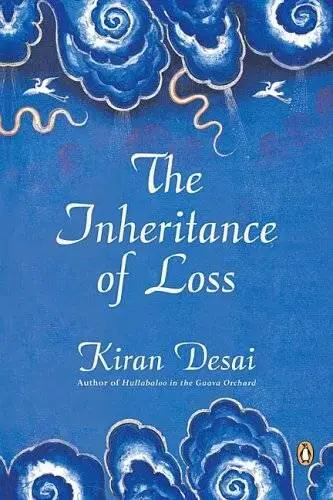
- Название:The Inheritance of Loss
- Автор:
- Жанр:
- Год:неизвестен
- ISBN:нет данных
- Рейтинг книги:3 / 5. Голосов: 1
-
Избранное:Добавить в избранное
- Отзывы:
-
Ваша оценка:
The Inheritance of Loss: краткое содержание, описание и аннотация
Предлагаем к чтению аннотацию, описание, краткое содержание или предисловие (зависит от того, что написал сам автор книги «The Inheritance of Loss»). Если вы не нашли необходимую информацию о книге — напишите в комментариях, мы постараемся отыскать её.
***
Desai's second novel is set in the nineteen-eighties in the northeast corner of India, where the borders of several Himalayan states – Bhutan and Sikkim, Nepal and Tibet – meet. At the head of the novel's teeming cast is Jemubhai Patel, a Cambridge-educated judge who has retired from serving a country he finds "too messy for justice." He lives in an isolated house with his cook, his orphaned seventeen-year-old granddaughter, and a red setter, whose company Jemubhai prefers to that of human beings. The tranquillity of his existence is contrasted with the life of the cook's son, working in grimy Manhattan restaurants, and with his granddaughter's affair with a Nepali tutor involved in an insurgency that irrevocably alters Jemubhai's life. Briskly paced and sumptuously written, the novel ponders questions of nationhood, modernity, and class, in ways both moving and revelatory.
The Inheritance of Loss — читать онлайн бесплатно полную книгу (весь текст) целиком
Ниже представлен текст книги, разбитый по страницам. Система сохранения места последней прочитанной страницы, позволяет с удобством читать онлайн бесплатно книгу «The Inheritance of Loss», без необходимости каждый раз заново искать на чём Вы остановились. Поставьте закладку, и сможете в любой момент перейти на страницу, на которой закончили чтение.
Интервал:
Закладка:
Once, he had been accosted by a Lithuanian Hare Krishna, New York via Vilnius and Vrindavan. A reproachful veggie look accompanied the brochure to the former beef cook. Biju looked at him and had to avert his gaze as if from an obscenity. In its own way it was like a prostitute – it showed too much. The book in his hand had a cover of Krishna on the battlefield in lurid colors, the same ones used in movie posters.
What was India to these people? How many lived in the fake versions of their countries, in fake versions of other people’s countries? Did their lives feel as unreal to them as his own did to him?
What was he doing and why?
It hadn’t even been a question before he left. Of course, if you could go, you went. And if you went, of course, if you could, you stayed…
The park lamps had come on by the time Biju climbed the urine-stinking stone steps to the street, and the lights were dissolving in the gloaming – to look at them made everyone feel like they were crying. In front of the stage-set night-light of the city, he saw the homeless man walking stiffly, as if on artificial legs, crossing with his grocery cart of rubbish to his plastic igloo where he would wait out the storm.
Biju walked back to the Gandhi Café, thinking he was emptying out. Year by year, his life wasn’t amounting to anything at all; in a space that should have included family, friends, he was the only one displacing the air. And yet, another part of him had expanded: his self-consciousness, his self-pity – oh the tediousness of it. Clumsy in America, a giant-sized midget, a bigfat-sized helping of small… Shouldn’t he return to a life where he might slice his own importance, to where he might relinquish this overrated control over his own destiny and perhaps be subtracted from its determination altogether? He might even experience that greatest luxury of not noticing himself at all.
And if he continued on here? What would happen? Would he, like Harish-Harry, manufacture a fake version of himself and using what he had created as clues, understand himself backward? Life was not about life for him anymore, and death – what would even that mean to him? It would have nothing to do with death.
The proprietor of the newly opened Shangri-la Travel in the same block as the Gandhi Café ordered a "nonveg" lunch special each day: lamb curry, dal, vegetable pilau, and kheer. Mr. Kakkar was his name.
" Arre, Biju," he greeted him, for Biju had just been given the task of delivering his food. "Again you saved me from my wife’s cooking, ha ha. We will throw her food down the toilet!"
"Why don’t you give it to that dirty bum," said Biju trying to help the homeless man and insult him at the same time.
"Oh no," he said, "bitch-witch, she is the type, she will coming walking down the road on a surprise visit and catch him eating it, that kind of coincidence is always happening to her, and that will be the end of yours truly."
A minute later, "You are sure you want to go back??" he said alarmed, eyes popping. "You’re making a big mistake. Thirty years in this country, hassle-free except for the bitch-witch, of course, and I have never gone back. Just even see the plumbing," he indicated the sound of the gurgling toilet behind him. "They should put their plumbing on their flag, just like we have the spinning wheel – top-class facility in this country.
"Going back?" he continued, "don’t be completely crazy – all those relatives asking for money! Even strangers are asking for money – maybe they just try, you know, maybe you shit and dollars come out. I’m telling you, my friend, they will get you; if they won’t, the robbers will; if the robbers won’t, some disease will; if not some disease, the heat will; if not the heat, those mad Sardarjis will bring down your plane before you even arrive."
While Biju had been away, Indira Gandhi had been assassinated by the Sikhs in the name of their homeland; Rajiv Gandhi had taken over -
"Only a matter of time. Someone will get him, too," said Mr. Kakkar.
But Biju said: "I have to go. My father…"
"Ah, soft feelings, they will get you nowhere. My father, so long as he was alive, he always told me, ‘Good, stay away, don’t come back to this shitty place.’"
Mr. Kakkar gnashed ice cubes with his teeth, lifting them from his Diet Coke with the help of his ballpoint pen, which had a plane modeled at its rear end.
Nevertheless, he sold Biju a ticket on Gulf Air: New York-London-Frankfurt-Abu Dhabi-Dubai-Bahrain-Karachi-Delhi-Calcutta. The cheapest they could find. It was like a bus in the sky.
"Don’t say I didn’t warn you."
Then he grew more thoughtful. "You know," he said, "America is in the process of buying up the world. Go back, you’ll find they own the businesses. One day, you’ll be working for an American company there or here. Think of your children. If you stay here, your son will earn a hundred thousand dollars for the same company he could be working for in India but making one thousand dollars. How, then, can you send your children to the best international college? You are making a big mistake. Still a world, my friend, where one side travels to be a servant, and the other side travels to be treated like a king. You want your son to be on this side or that side?
"Ah," he said, waggling his pen, "the minute you arrive, Biju, you will start to think of how to get the bloody hell out."
But Biju went to Jackson Heights, and from a store like a hangar he bought: a TV and VCR, a camera, sunglasses, baseball caps that said "NYC" and "Yankees" and "I Like My Beer Cold and My Women Hot," a digital two-time clock and radio and cassette player, waterproof watches, calculators, an electric razor, a toaster oven, a winter coat, nylon sweaters, polyester-cotton-blend shirts, a polyurethane quilt, a rain jacket, a folding umbrella, suede shoes, a leather wallet, a Japanese-made heater, a set of sharp knives, a hot water bottle, Fixodent, saffron, cashews and raisins, aftershave, T-shirts with "I love NY" and "Born in the USA" picked out in shiny stones, whiskey, and, after a moment of hesitation, a bottle of perfume called Windsong… who was that for? He didn’t yet know her face.
While he shopped, he remembered that as a child he’d been part of a pack of boys who played so hard they’d come home exhausted. They’d thrown stones and slippers into trees to bring down ber and jamun; chased lizards until their tails fell off and tossed the leaping bits on little girls; they’d stolen chooran pellets from the shop, that looked like goat droppings but were so, so tasty with a bit of sandy crunch. He remembered bathing in the river, feeling his body against the cool firm river muscle, and sitting on a rock with his feet in the water, gnawing on sugarcane, working out the sweetness no matter how his jaw hurt, completely absorbed. He had played cricket cricket cricket. Biju found himself smiling at the memory of the time the whole village had watched India win a test match against Australia on a television running off a car battery because the transformer in the village had burned out. All over India the crops had been rotting in the fields, the nation’s prostitutes complaining about lack of business because every male in the country had his eyes glued to the screen. He thought of samosas adjoining a spill of chutney coming by on a leaf plate. A place where he could never be the only one in a photograph.
Of course, he didn’t go over his memories of the village school, of the schoolmaster who failed the children unless paid off by the parents. He didn’t think of the roof that flew off each monsoon season or of the fact that not only his mother, but now also his grandmother, were dead. He didn’t think of any of the things that had made him leave in the first place.
Читать дальшеИнтервал:
Закладка:
Похожие книги на «The Inheritance of Loss»
Представляем Вашему вниманию похожие книги на «The Inheritance of Loss» списком для выбора. Мы отобрали схожую по названию и смыслу литературу в надежде предоставить читателям больше вариантов отыскать новые, интересные, ещё непрочитанные произведения.







Обсуждение, отзывы о книге «The Inheritance of Loss» и просто собственные мнения читателей. Оставьте ваши комментарии, напишите, что Вы думаете о произведении, его смысле или главных героях. Укажите что конкретно понравилось, а что нет, и почему Вы так считаете.