Larry McMurtry - Lonesome Dove
Здесь есть возможность читать онлайн «Larry McMurtry - Lonesome Dove» весь текст электронной книги совершенно бесплатно (целиком полную версию без сокращений). В некоторых случаях можно слушать аудио, скачать через торрент в формате fb2 и присутствует краткое содержание. Жанр: Современная проза, на английском языке. Описание произведения, (предисловие) а так же отзывы посетителей доступны на портале библиотеки ЛибКат.
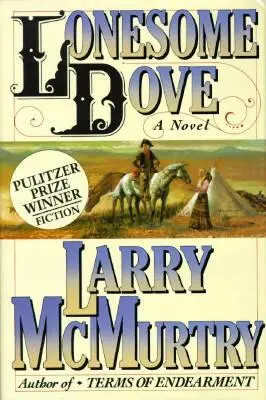
- Название:Lonesome Dove
- Автор:
- Жанр:
- Год:неизвестен
- ISBN:нет данных
- Рейтинг книги:5 / 5. Голосов: 1
-
Избранное:Добавить в избранное
- Отзывы:
-
Ваша оценка:
Lonesome Dove: краткое содержание, описание и аннотация
Предлагаем к чтению аннотацию, описание, краткое содержание или предисловие (зависит от того, что написал сам автор книги «Lonesome Dove»). Если вы не нашли необходимую информацию о книге — напишите в комментариях, мы постараемся отыскать её.
A love story, an adventure, an American epic, Lonesome Dove embraces all the West – legend and fact, heroes and outlaws, whoeres and ladies, Indians and settlers – in a novel that recreates the central American experience, the most enduring of our national myths.
Set in the late nineteenth century, Lonesome Dove is the story of a cattle drive from Texas to Montana – and much more. It is a drive that represents for everybody involved not only a daring, even a foolhardy, adventure, but a part of the American Dream – the attempt to carve out of the last remaining wilderness a new life.
Agustus McCrae and W.F. Call are former Texas Rangers, partners and friends who have shared hardship and danger together without ever quite understanding (or wanting to understand) each other's deepest emotions. Gus is the romantic, a reluctant rancher who has a way with women and the sense to leave well enough alone. Call is a driven, demanding man, a natural authority figure with no patience for weaknesses, and not many of his own. He is obsessed with the dream of creating his own empire, and with the need to conceal a secret sorrow of his own. The two men could hardly be more different, but both are tough, redoubtable fighters who have learned to count on each other, if nothing else.
Call's dream not only drags Gus along in its wake, but draws in a vast cast of characters:
– Lorena, the whore with the proverbial heart of gold, whom Gus (and almost everyone else) loves, and who survives one of the most terrifying experiences any woman could have…
– Elmira, the restless, reluctant wife of a small-time Arkansas sheriff, who runs away from the security of marriage to become part of the great Western adventure…
– Blue Duck, the sinister Indian renegade, one of the most frightening villains in American fiction, whose steely capacity for cruelty affects the lives of everyone in the book…
– Newt, the young cowboy for whom the long and dangerous journey from Texas to Montana is in fact a search for his own identity…
– Jake, the dashing, womanizing ex-Ranger, a comrade-in-arms of Gus and Call, whose weakness leads him to an unexpected fate…
– July Johnson, husband of Elmira, whose love for her draws him out of his secure life into the wilderness, and turns him into a kind of hero…
Lonesome Dove sweeps from the Rio Grande (where Gus and Call acquire the cattle for their long drive by raiding the Mexicans) to the Montana highlands (where they find themselves besieged by the last, defiant remnants of an older West).
It is an epic of love, heroism, loyalty, honor, and betrayal – faultlessly written, unfailingly dramatic. Lonesome Dove is the novel about the West that American literature – and the American reader – has long been waiting for.
Lonesome Dove — читать онлайн бесплатно полную книгу (весь текст) целиком
Ниже представлен текст книги, разбитый по страницам. Система сохранения места последней прочитанной страницы, позволяет с удобством читать онлайн бесплатно книгу «Lonesome Dove», без необходимости каждый раз заново искать на чём Вы остановились. Поставьте закладку, и сможете в любой момент перейти на страницу, на которой закончили чтение.
Интервал:
Закладка:
In fact, none of the cowboys liked him-he would occasionally charge a horse, if his temper was up, and was even worse about men on foot. Once, Needle Nelson had dismounted meaning to idle away a minute or two relieving himself, and the little bull had charged him so abruptly that Needle had had to hop back on his horse while still pissing. All the hands had a fine laugh at his expense. Needle had been so angered that he wanted to rope and cut the bull, but Call intervened. Call thought the bull well made though certainly a peculiar mix of colons, and wanted to keep him.
"Let him be," he said. "We'll need some bulls in Montana."
Augustus had been highly amused. "Good God, Call," he said. "You mean you want to fill this paradise we're going to with animals that look like that?"
"He ain't bad-looking if you don't count his color," Call said.
"Be damned to his color and his disposition too," Needle said. He knew he would be a long time living down having to mount his horse with his dingus flopping.
"Well, I reckon it's time to go," Call said to Deets. "We'll never get there if we don't start."
Deets was not so sure they would get there anyway, but he kept his doubts to himself. The Captain usually managed to do what he meant to do.
"I want you to be the scout," the Captain said. "We got plenty of men to keep the stock moving. I want you to find us water and a good bed ground every night."
Deets nodded modestly, but inside he felt proud. Being made scout was more of an honor than having your name on a sign. It was proof that the Captain thought highly of his abilities.
When they got back to the wagon Augustus was oiling his guns. Lippy fanned himself with his bowler, and most of the other hands were just sitting around wishing it was cooler.
"Have you counted the stock yet?" Call asked Augustus. The man possessed a rare skill when it came to counting animals. He could ride through a herd and count it, something Call had never been able to do.
"No, I ain't got around to that task," Augustus said. "Maybe I will if you tell me what difference it makes."
"It would be useful to know how many we're starting out with," Call said. "If we get there with ninety percent we'll be lucky."
"Yes, lucky if we get there with ninety percent of ourselves," Augustus said. "It's your show, Call. Myself, I'm just along to see the country."
Dish Boggett had been dozing under the wagon. He sat up so abruptly that he bumped his head on the bottom of the wagon. He had had a terrible dream in which he had fallen off a cliff. The dream had started nice, with him riding along on the point of a herd of cattle. The cattle had become buffalo and the buffalo had started running. Soon they began to pour over a cutbank of some kind. Dish saw it in plenty of time to stop his horse, but his horse wouldn't stop, and before he knew it he went off the bank, too. The ground was so far below, he could barely see it. He fell and fell, and to make matters worse his horse turned over in the air, so that Dish was upside down and on the bottom. Just as he was about to be mashed, he woke up, lathered in sweat.
"See what I mean?" Augustus said. "Dish has already cracked his noggin and we ain't even left."
Call got a plate of food and went off by himself to eat. It was something he had always done-moved apart, so he could be alone and think things out a little. In the old days, when he first developed the habit, the men had not understood. Occasionally one would follow him, wanting to chat. But they soon learned better-nothing made Call sink deeper into silence than for someone to come around and start yapping when he wanted to be by himself.
Virtually all his life he had been in the position of leading groups of men, yet the truth was he had never liked groups. Men he admired for their abilities in action almost always brought themselves down in his estimation if he had to sit around and listen to them talk-on watch them drink or play cards or run off after women. Listening to men talk usually made him feel more alone than if he were a mile away by himself under a tree. He had never really been able to take part in the talk. The endless talk of cards and women made him feel more set apart-and even a little vain. If that was the best they could think of, then they were lucky they had him to lead them. It seemed immodest, but it was a thought that often came to him.
And the more he stayed apart, the more his presence made the men nervous.
"It's hard for normal men to relax around you, Call," Augustus told him once. "You ain't never been relaxed yourself, so you don't know what you're missing."
"Pshaw," Call said. "Pea goes to sleep around me half the time. I guess that's relaxed."
"No, that's worn out," Augustus said. "If you didn't work him sixteen hours a day he'd be as nervous as the rest."
When Call had eaten, he took his plate back to Bolivar, who seemed to have decided to go along. He had made no move to leave, at least. Call wanted him along, and yet somehow didn't feel quite right about it. It didn't seem proper that a man with a wife and daughters would go away without even informing them, on a journey from which he might never return. The old pistolero didn't owe the Hat Creek outfit that kind of effort, and Call reluctantly raised the subject with him.
"Bol, we're leaving today," he said. "You can have your wages, if you'd rather."
Bol just looked annoyed, shook his head and didn't say a word.
"I'm glad you're with us, Bol," Augustus said. "You'll make a fine Canadian."
"What is Canada?" Charlie Rainey asked. He had never been sure.
"The land of the northern lights," Augustus said. The heat had caused a dearth of conversation and made him welcome almost any question.
"What's them?" the boy wondered.
"Why, they light up the sky," Augustus said. "I don't know if you can see ' em from Montany. "
"I wonder when we'll see Jake again?" Pea Eye said. "That Jake sure don't keep still."
"He was just here yesterday, we don't need to marry him," Dish said, unable to conceal his irritation at the mere mention of the man.
"Well, I've oiled my guns," Augustus said. "We might as well go and put the Cheyenne nation to flight, if the Army hasn't."
Call didn't answer.
"Ain't you even sorry to leave this place, now that we've made it so peaceful?" Augustus asked.
"No," Call said. "We ought to left right after we come."
It was true. He had no affection for the border, and a yearning for the plains, dangerous as they were.
"It's a funny life," Augustus said. "All these cattle and nine-tenths of the horses is stolen, and yet we was once respected lawmen. If we get to Montana we'll have to go into politics. You'll wind up governor if the dern place ever gets to be a state. And you'll spend all your time passing laws against cattle thieves."
"I wish there was a law I could pass against you," Call said.
"I don't know what Wanz is going to do without us," Augustus said.
25.
IN THE LATE AFTERNOON they strung a rope corral around the remuda, so each hand could pick himself a set of mounts, each being allowed four picks. It was slow work, for Jasper Fant and Needle Nelson could not make up their minds. The Irishmen and the boys had to take what was left after the more experienced hands had chosen.
Augustus did not deign to make a choice at all. "I intend to ride old Malaria all the way," he said, "or if not I'll ride Greasy."
Once the horses were assigned, the positions had to be assigned as well.
"Dish, you take the right point," Call said. "Soupy can take the left and Bert and Needle will back you up."
Dish had assumed that, as a top hand, he would have a point, and no one disputed his right, but both Bert and Needle were unhappy that Soupy had the other point. They had been with the outfit longer, and felt aggrieved.
Читать дальшеИнтервал:
Закладка:
Похожие книги на «Lonesome Dove»
Представляем Вашему вниманию похожие книги на «Lonesome Dove» списком для выбора. Мы отобрали схожую по названию и смыслу литературу в надежде предоставить читателям больше вариантов отыскать новые, интересные, ещё непрочитанные произведения.








Обсуждение, отзывы о книге «Lonesome Dove» и просто собственные мнения читателей. Оставьте ваши комментарии, напишите, что Вы думаете о произведении, его смысле или главных героях. Укажите что конкретно понравилось, а что нет, и почему Вы так считаете.