Larry McMurtry - Lonesome Dove
Здесь есть возможность читать онлайн «Larry McMurtry - Lonesome Dove» весь текст электронной книги совершенно бесплатно (целиком полную версию без сокращений). В некоторых случаях можно слушать аудио, скачать через торрент в формате fb2 и присутствует краткое содержание. Жанр: Современная проза, на английском языке. Описание произведения, (предисловие) а так же отзывы посетителей доступны на портале библиотеки ЛибКат.
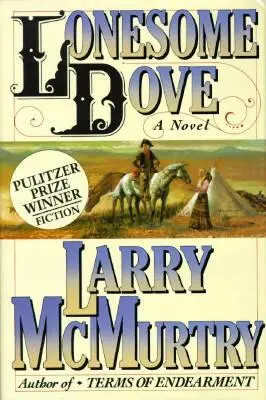
- Название:Lonesome Dove
- Автор:
- Жанр:
- Год:неизвестен
- ISBN:нет данных
- Рейтинг книги:5 / 5. Голосов: 1
-
Избранное:Добавить в избранное
- Отзывы:
-
Ваша оценка:
Lonesome Dove: краткое содержание, описание и аннотация
Предлагаем к чтению аннотацию, описание, краткое содержание или предисловие (зависит от того, что написал сам автор книги «Lonesome Dove»). Если вы не нашли необходимую информацию о книге — напишите в комментариях, мы постараемся отыскать её.
A love story, an adventure, an American epic, Lonesome Dove embraces all the West – legend and fact, heroes and outlaws, whoeres and ladies, Indians and settlers – in a novel that recreates the central American experience, the most enduring of our national myths.
Set in the late nineteenth century, Lonesome Dove is the story of a cattle drive from Texas to Montana – and much more. It is a drive that represents for everybody involved not only a daring, even a foolhardy, adventure, but a part of the American Dream – the attempt to carve out of the last remaining wilderness a new life.
Agustus McCrae and W.F. Call are former Texas Rangers, partners and friends who have shared hardship and danger together without ever quite understanding (or wanting to understand) each other's deepest emotions. Gus is the romantic, a reluctant rancher who has a way with women and the sense to leave well enough alone. Call is a driven, demanding man, a natural authority figure with no patience for weaknesses, and not many of his own. He is obsessed with the dream of creating his own empire, and with the need to conceal a secret sorrow of his own. The two men could hardly be more different, but both are tough, redoubtable fighters who have learned to count on each other, if nothing else.
Call's dream not only drags Gus along in its wake, but draws in a vast cast of characters:
– Lorena, the whore with the proverbial heart of gold, whom Gus (and almost everyone else) loves, and who survives one of the most terrifying experiences any woman could have…
– Elmira, the restless, reluctant wife of a small-time Arkansas sheriff, who runs away from the security of marriage to become part of the great Western adventure…
– Blue Duck, the sinister Indian renegade, one of the most frightening villains in American fiction, whose steely capacity for cruelty affects the lives of everyone in the book…
– Newt, the young cowboy for whom the long and dangerous journey from Texas to Montana is in fact a search for his own identity…
– Jake, the dashing, womanizing ex-Ranger, a comrade-in-arms of Gus and Call, whose weakness leads him to an unexpected fate…
– July Johnson, husband of Elmira, whose love for her draws him out of his secure life into the wilderness, and turns him into a kind of hero…
Lonesome Dove sweeps from the Rio Grande (where Gus and Call acquire the cattle for their long drive by raiding the Mexicans) to the Montana highlands (where they find themselves besieged by the last, defiant remnants of an older West).
It is an epic of love, heroism, loyalty, honor, and betrayal – faultlessly written, unfailingly dramatic. Lonesome Dove is the novel about the West that American literature – and the American reader – has long been waiting for.
Lonesome Dove — читать онлайн бесплатно полную книгу (весь текст) целиком
Ниже представлен текст книги, разбитый по страницам. Система сохранения места последней прочитанной страницы, позволяет с удобством читать онлайн бесплатно книгу «Lonesome Dove», без необходимости каждый раз заново искать на чём Вы остановились. Поставьте закладку, и сможете в любой момент перейти на страницу, на которой закончили чтение.
Интервал:
Закладка:
She didn't miss the fear, either-the fear that someday Gus would be off somewhere and Blue Duck would come back. What had happened had been bad enough, but she knew if he ever got her again it would be worse. Fearing him and missing Gus were mixed together, for Gus was the only person who could protect her from him.
Unlike the girls, Clara seldom asked her any questions. Lorena came to wish that she would. For a while she had an urge to apologize to Clara for not having always been able to be a lady. It still seemed to her a miracle that she had been allowed to stay in Clara's house and be one of the family. She looked for it to go bad in some way, but it didn't go bad. The only thing that changed was that Clara spent more and more time with the horses, and less and less time in the house.
"You came at a good time," she said one day as Lorena was coming in from feeding the hens. It was a task Lorena enjoyed-she liked the way the hens chirped and complained.
"How's that?" Lorena asked.
"I nagged Bob to build this house, and I don't really care about a house," Clara said. "We needed it for the girls, but that wasn't why I built it. I just wanted to nag him into it and I did. The main reason was he wouldn't let me work with the horses, although I'm better with them than he ever was. But he didn't think it fitting-so I thought, All right then, Bob, build me a house. But I'd rather be down with the horses, and now there's nothing to stop me."
Two weeks later, Bob died in the night. Clara went in in the morning to change him, and found him dead. He looked exactly as he had: he just was no longer breathing. He weighed so little by then that she could lift him. Having long concluded that he would die, she had had Cholo bring a pine coffin from town. He had brought it in at night and hidden it from the girls. It was ready.
Clara closed Bob's eyes and sat with her memories for an hour. The girls were downstairs now, pestering Lorena and eating. Now and then she could hear their laughter.
They were happy girls; they laughed often. It pleased Clara to hear them. She wondered if Bob could hear his two lively daughters laughing, as he lay dying. She wondered if it helped, if it made up in any way for her bad tempers and the deaths of the three boys. He had counted so on those boys-they would be his help, boys. Bob had never talked much, but the one thing he did talk about was how much they would get done once the boys got big enough to do their part of the work. Often, just hearing him describe the fences they would build, or the barns, or the cattle they would buy, Clara felt out of sorts-it made her feel very distant from Bob that he saw their boys mainly as hired hands that he wouldn't have to pay. He sees them different, she thought. For her part, she just liked to have them there. She liked to look at them as they sat around the table, liked to watch them swimming and frolicking in the river, liked to sit by them sometimes when they slept, listening to them breathe. Yet they had died, and both she and Bob lost what they loved-Bob his dreams of future work with his sons, she the immediate pleasure of having sons to look at, to touch, to scold and tease and kiss.
It struck her that endings were never as you would expect them to be. She had thought she would be relieved when Bob finally died. She hadn't felt he was part of their life anymore, and yet, now that he was gone, she knew he had been. A silent part, an uncomfortable part, but still there, still her husband, still the girls' father. He had been changed, but not removed.
Now he had gone where her boys had gone. As well as she knew the boys, as much as she loved them, time had robbed her of them. At times she found herself mixing details and events up, not in big ways but in small. In dreams she saw her sons' faces, and when she awoke could not remember which son she had dreamed about. She wondered if she would dream of Bob, and what she would remember if she thought of him in ten years. Their marriage had had few high spots. She had often been happy during it, but not because of anything Bob did. She had had more happiness from horses than from her husband, though he had been a decent husband, better than most women had, from what she could judge.
She didn't cry, but merely felt a wish, now he was gone, that she could somehow escape dealing with the tiresome formalities of death. Someone would have to go for a preacher; there would have to be some kind of funeral. They had no close neighbors, but the two or three closest would still feel they had to come, bring food, pay their respects.
She covered Bob with a clean sheet and went downstairs. Lorena was teaching the girls to play cards. They were playing poker for buttons. Clara stood in the shadows, wishing she didn't have to interrupt their fun. Why interrupt it for a death that couldn't be helped? And yet death was not something you could ignore. It had its weight. It was a dead man lying upstairs, not a man who was sick. It seemed to her she had better not form the practice of ignoring death. If she tried it, death would find a way to answer back-it would take another of her loved ones, to remind her to respect it.
So she walked into the room. Betsey had just won a hand. She whooped, for she loved to beat her sister. She was a beautiful child, with curls that would drive men mad some day. "I won the pot, Ma," she said, and then saw by the grave set of Clara's face that something was wrong.
"Good," Clara said. "A good cardplayer is just what this family needs. Now I have to tell you something sad. Your father's dead."
"Oh, he ain't!" Sally said.
"Honey, he died just now," Clara said.
Sally ran to her, but Betsey turned to Lorena, who was nearer. Lorena was surprised, but she put her arms around the child.
"Could you go get July?" Clara asked Lorena, when the girls had calmed a bit.
July now lived in a little room attached to the saddle shed. It wouldn't do when winter came, but for summer it was all right. He had never felt comfortable in the house with Clara and the girls, and since Lorena had come he felt even more uncomfortable. Lorena seldom spoke to him, and Clara mainly discussed horses, or other ranch problems, yet he felt nervous in their company. Day to day, he felt it was wrong to have taken the job with Clara. Sometimes he felt a strong longing to be back in his old job in Fort Smith, even if Roscoe was no longer alive to be his deputy.
But he had a son now, a baby he saw every day at supper and breakfast. His son was the darling of the ranch. The women and girls passed Martin around as if he belonged to them all; Lorena had developed a rapport with him and took the main responsibility for him when Clara was off with the horses. The baby was happy, and no wonder, with two women and two girls to spoil him. July could hardly imagine what the women would do if he tried to take the baby and raise him in Arkansas. Anyway, such a plan was not feasible.
So he stayed on and did his work, neither truly content nor bitterly discontented. He still dreamed of Elmira and felt an aching sadness when he thought about her.
Despite that ache, the thing that made July least comfortable of all was that he knew he was in love with Clara. The feeling had started even before he knew Elmira was dead, and it grew even when he knew he ought to be grieving for Elmira. He felt guilty about it, he felt hopeless about it, but it was true. At night he thought of her, and imagined her in her room, in her gown. At breakfast and supper he watched her, whenever he thought he could do so without her noticing. He had many opportunities, too, for she seemed to have ceased taking any notice of him at all. He had the sense that she had become disappointed in him, though he didn't know why. And when she did look at him it frightened him. Occasionally, when he caught Clara looking at him, he almost flinched, for he did not imagine that he could hide anything from her. She was too smart-he had the sense that she could figure out anything. Her eyes were mysterious to him-often she seemed to be amused by him, at other times irritated. Sometimes her eyes seemed to pierce him, as if she had decided to read his thoughts as she would read a book. And then, in a moment, she would lift her head and ignore him, as if he were a book she had glanced through and found too uninteresting for further perusal.
Читать дальшеИнтервал:
Закладка:
Похожие книги на «Lonesome Dove»
Представляем Вашему вниманию похожие книги на «Lonesome Dove» списком для выбора. Мы отобрали схожую по названию и смыслу литературу в надежде предоставить читателям больше вариантов отыскать новые, интересные, ещё непрочитанные произведения.









Обсуждение, отзывы о книге «Lonesome Dove» и просто собственные мнения читателей. Оставьте ваши комментарии, напишите, что Вы думаете о произведении, его смысле или главных героях. Укажите что конкретно понравилось, а что нет, и почему Вы так считаете.