Larry McMurtry - Lonesome Dove
Здесь есть возможность читать онлайн «Larry McMurtry - Lonesome Dove» весь текст электронной книги совершенно бесплатно (целиком полную версию без сокращений). В некоторых случаях можно слушать аудио, скачать через торрент в формате fb2 и присутствует краткое содержание. Жанр: Современная проза, на английском языке. Описание произведения, (предисловие) а так же отзывы посетителей доступны на портале библиотеки ЛибКат.
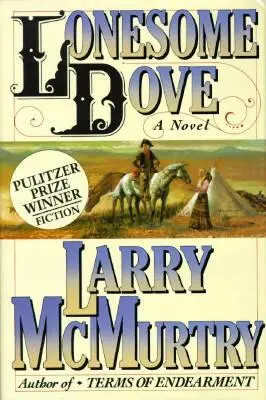
- Название:Lonesome Dove
- Автор:
- Жанр:
- Год:неизвестен
- ISBN:нет данных
- Рейтинг книги:5 / 5. Голосов: 1
-
Избранное:Добавить в избранное
- Отзывы:
-
Ваша оценка:
Lonesome Dove: краткое содержание, описание и аннотация
Предлагаем к чтению аннотацию, описание, краткое содержание или предисловие (зависит от того, что написал сам автор книги «Lonesome Dove»). Если вы не нашли необходимую информацию о книге — напишите в комментариях, мы постараемся отыскать её.
A love story, an adventure, an American epic, Lonesome Dove embraces all the West – legend and fact, heroes and outlaws, whoeres and ladies, Indians and settlers – in a novel that recreates the central American experience, the most enduring of our national myths.
Set in the late nineteenth century, Lonesome Dove is the story of a cattle drive from Texas to Montana – and much more. It is a drive that represents for everybody involved not only a daring, even a foolhardy, adventure, but a part of the American Dream – the attempt to carve out of the last remaining wilderness a new life.
Agustus McCrae and W.F. Call are former Texas Rangers, partners and friends who have shared hardship and danger together without ever quite understanding (or wanting to understand) each other's deepest emotions. Gus is the romantic, a reluctant rancher who has a way with women and the sense to leave well enough alone. Call is a driven, demanding man, a natural authority figure with no patience for weaknesses, and not many of his own. He is obsessed with the dream of creating his own empire, and with the need to conceal a secret sorrow of his own. The two men could hardly be more different, but both are tough, redoubtable fighters who have learned to count on each other, if nothing else.
Call's dream not only drags Gus along in its wake, but draws in a vast cast of characters:
– Lorena, the whore with the proverbial heart of gold, whom Gus (and almost everyone else) loves, and who survives one of the most terrifying experiences any woman could have…
– Elmira, the restless, reluctant wife of a small-time Arkansas sheriff, who runs away from the security of marriage to become part of the great Western adventure…
– Blue Duck, the sinister Indian renegade, one of the most frightening villains in American fiction, whose steely capacity for cruelty affects the lives of everyone in the book…
– Newt, the young cowboy for whom the long and dangerous journey from Texas to Montana is in fact a search for his own identity…
– Jake, the dashing, womanizing ex-Ranger, a comrade-in-arms of Gus and Call, whose weakness leads him to an unexpected fate…
– July Johnson, husband of Elmira, whose love for her draws him out of his secure life into the wilderness, and turns him into a kind of hero…
Lonesome Dove sweeps from the Rio Grande (where Gus and Call acquire the cattle for their long drive by raiding the Mexicans) to the Montana highlands (where they find themselves besieged by the last, defiant remnants of an older West).
It is an epic of love, heroism, loyalty, honor, and betrayal – faultlessly written, unfailingly dramatic. Lonesome Dove is the novel about the West that American literature – and the American reader – has long been waiting for.
Lonesome Dove — читать онлайн бесплатно полную книгу (весь текст) целиком
Ниже представлен текст книги, разбитый по страницам. Система сохранения места последней прочитанной страницы, позволяет с удобством читать онлайн бесплатно книгу «Lonesome Dove», без необходимости каждый раз заново искать на чём Вы остановились. Поставьте закладку, и сможете в любой момент перейти на страницу, на которой закончили чтение.
Интервал:
Закладка:
"That's a dern funny cloud," he said.
"I don't care if it rains," Lorena said. "We got the tent."
"The funny part is, I can hear it," Augustus said. "I never heard a cloud make a noise like that before."
Lorena listened. It seemed she did hear something, but it was a long way off, and faint.
"Maybe it's the wind getting up," she said.
Augustus was listening. "It don't sound like no wind I ever heard," he said, standing up. The horses were looking at the cloud, too. They were acting nervous. The sound the brown cloud made had become a little louder, but was still far away and indefinable.
Suddenly Augustus realized what it was. "Good lord," he said. "It's grasshoppers, Lorie. "I've heard they came in clouds out on the plains, and there's the proof. It's a cloud of grasshoppers."
The horses were grazing on long lead ropes. There were no trees to tie the ropes to, so he had loosened a heavy block of soil and put the lead ropes under it. Usually that was sufficient, for the horses weren't troublesome. But now they were rolling their eyes and jerking at the ropes. Augustus grabbed the ropes-he would have to hold them himself.
Lorena watched the cloud, which came down on them faster than any rain cloud. She could plainly hear the hum of millions of insects. The cloud covered the plain in front of them from the ground far up in the air. It was blotting out the ground as if a coven were being pulled over it.
"Get in the tent," Augustus said. He was holding the terrified horses. "Get in and pile whatever you can around the bottom to keep 'em out."
Lorena ran in, and before Augustus could follow, grasshoppers covered the canvas, every inch. Augustus had fifty on his hat, though he tried to knock them off outside the tent, and more on his clothes. He backed in, hanging to the lead ropes as the horses tried to break free.
"Pull the flaps," he said, and Lorena did. Soon there was just the hole the two ropes fed through. It was dim and dark in the tent, as more and more grasshoppers covered the canvas-insects on top of insects. The hum they made as they spread over the prairie grass was so loud Lorena had to grit her teeth. As the tent got darker, she began to cry and shake-it was just more trouble and more fear, this life.
"It's all right, honey, it's just bugs," Augustus said. "Hang onto me and we'll be fine. I don't think bugs will eat canvas when they've got all this grass."
Lorena put her arms around him and shut her eyes. Augustus peeked out and saw that every inch of the lead ropes were covered with grasshoppers.
"Well, that old cook of Call's that likes to fry bugs will be happy, at least," he said. "He can fry up a damn wagonful tonight."
When the cloud of grasshoppers hit the Hat Creek outfit, they were on a totally open plain and could do nothing but watch it come, in terror and astonishment. Lippy sat on the wagon seat, his mouth hanging open.
"Is them grasshoppers?" he asked.
"Yes, but shut your mouth unless you want to choke on them," Po Campo said. He promptly crawled in the wagon and pulled his hat down and his serape close around him.
The cowboys who saw the cloud while on horseback were mostly terrified. Dish Boggett came racing back to the Captain, who sat with Deets, watching the cloud come.
"Captain, what'lI we do?" he asked. "There's millions of them. What'll we do?"
"Live through it," Call said. "That's all we can do."
"It's the plague," Deets said. "Ain't it in the Bible?"
"Well, that was locusts," Call said.
Deets looked in wonderment as the insects swirled toward them, a storm of bugs that filled the sky and covered the land. Though he was a little frightened, it was more the mystery of it that affected him. Where did they come from, where would they go? The sunshine glinted strangely off the millions of insects.
"Maybe the Indians sent 'em," he said.
"More likely they ate the Indians," Call said. "The Indians and everything else."
Newt's first fear when the cloud hit was that he would suffocate. In a second the grasshoppers covered every inch of his hands, his face, his clothes, his saddle. A hundred were stuck in Mouse's mane. Newt was afraid to draw breath for fear he'd suck them into his mouth and nose. The air was so dense with them that he couldn't see the cattle and could barely see the ground. At every step Mouse crunched them underfoot. The whirring they made was so loud he felt he could have screamed and not been heard, although Pea Eye and Ben Rainey were both within yards. Newt ducked his head into the crook of his arm for protection. Mouse suddenly broke into a run, which meant the cattle were running, but Newt didn't look up. He feared to look, afraid the grasshoppers would scratch his eyes. As he and Mouse raced, he felt the insects beating against him. It was a relief to find he could breathe.
Then Mouse began to buck and twist, trying to rid himself of some of the grasshoppers, and almost ridding himself of Newt in the process. Newt clung to the saddle horn, afraid that if he were thrown the grasshoppers would smother him. From the way the ground shook he knew the cattle were running. Mouse soon stopped bucking and ran too. When Newt risked a glimpse, all he saw was millions of fluttering bugs. Even as he raced they clung to his shirt. When he tried to change his reins from one hand to another he closed his hand on several grasshoppers and almost dropped his rein. It would have been a comfort if he could have seen at least one cowboy, but he couldn't. In that regard, running through a bug cloud wasn't much different than running in rain: he was alone and miserable, not knowing what his fate might be.
And, as in the rainstorms, his misery increased to a pitch and then was gradually replaced by fatigue and resignation. The sky had turned to grasshoppers-it seemed that simple. The other day it had turned to hailstones, now it was grasshoppers. All he could do was try and endure it-you couldn't shoot grasshoppers. Finally the cattle slowed, and Mouse slowed, and Newt just plodded along, occasionally wiping the grasshoppers off the front of his shirt when they got two or three layers deep. He had no idea how long a grasshopper storm might last.
In this case it lasted for hours. Newt mainly hoped it wouldn't go on all night. If he had to ride through grasshoppers all day and then all night, he felt he'd just give up. It was already fairly dark from the cloud they made, though it was only midday.
Finally, like all other storms, the grasshopper storm did end. The air cleared-there were still thousands of grasshoppers fluttering around in it, but thousands were better than millions. The ground was still covered with them, and Mouse still mashed them when he walked, but at least Newt could see a little distance, though what he saw wasn't very cheering. He was totally alone with fifty or sixty cattle. He had no idea where the main herd might be, or where anything might be. Dozens of grasshoppers still clung to his shirt and to Mouse's mane, and he could hear them stirring in the grass, eating what little of it was left. Most of it had been chewed off to the roots.
He gave Mouse his head, hoping he would have some notion of where the wagon might be, but Mouse seemed as lost as he was. The cattle were walking listlessly, worn out from their run. A few of them tried to stop and graze, but there was nothing left to graze on except grasshoppers.
There was a rise a mile or two to the north, and Newt rode over to it. To his vast relief, he saw several riders coming and waved his hat to make sure they saw him. The hoppers had nibbled on his clothes, and he felt lucky not to be naked.
He went back to get the cattle, and when he glanced again at the boys, they looked funny. They didn't have hats. A second later he realized why: they were Indians, all of them. Newt felt so scared he went weak. He hated life on the plains. One minute it was pretty, then a cloud of grasshoppers came, and now Indians. The worst of it was that he was alone. It was always happening, and he felt convinced it was Mouse's fault. Somehow he could never stay with the rest of the boys when there was a run. FIe had to wander off by himself. This time the results were serious, for the five Indians were only fifty yards away. He felt he ought to pull his gun, but he knew he couldn't shoot well enough to kill five of them-anyhow, the Captain hadn't shot when the old chief with the milky eye had asked for a beef. Maybe they were friendly.
Читать дальшеИнтервал:
Закладка:
Похожие книги на «Lonesome Dove»
Представляем Вашему вниманию похожие книги на «Lonesome Dove» списком для выбора. Мы отобрали схожую по названию и смыслу литературу в надежде предоставить читателям больше вариантов отыскать новые, интересные, ещё непрочитанные произведения.









Обсуждение, отзывы о книге «Lonesome Dove» и просто собственные мнения читателей. Оставьте ваши комментарии, напишите, что Вы думаете о произведении, его смысле или главных героях. Укажите что конкретно понравилось, а что нет, и почему Вы так считаете.