Larry McMurtry - Lonesome Dove
Здесь есть возможность читать онлайн «Larry McMurtry - Lonesome Dove» весь текст электронной книги совершенно бесплатно (целиком полную версию без сокращений). В некоторых случаях можно слушать аудио, скачать через торрент в формате fb2 и присутствует краткое содержание. Жанр: Современная проза, на английском языке. Описание произведения, (предисловие) а так же отзывы посетителей доступны на портале библиотеки ЛибКат.
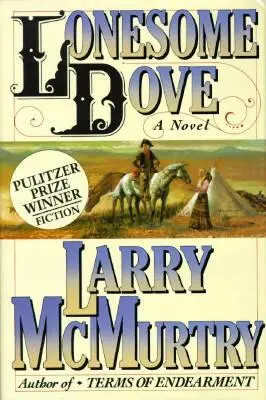
- Название:Lonesome Dove
- Автор:
- Жанр:
- Год:неизвестен
- ISBN:нет данных
- Рейтинг книги:5 / 5. Голосов: 1
-
Избранное:Добавить в избранное
- Отзывы:
-
Ваша оценка:
Lonesome Dove: краткое содержание, описание и аннотация
Предлагаем к чтению аннотацию, описание, краткое содержание или предисловие (зависит от того, что написал сам автор книги «Lonesome Dove»). Если вы не нашли необходимую информацию о книге — напишите в комментариях, мы постараемся отыскать её.
A love story, an adventure, an American epic, Lonesome Dove embraces all the West – legend and fact, heroes and outlaws, whoeres and ladies, Indians and settlers – in a novel that recreates the central American experience, the most enduring of our national myths.
Set in the late nineteenth century, Lonesome Dove is the story of a cattle drive from Texas to Montana – and much more. It is a drive that represents for everybody involved not only a daring, even a foolhardy, adventure, but a part of the American Dream – the attempt to carve out of the last remaining wilderness a new life.
Agustus McCrae and W.F. Call are former Texas Rangers, partners and friends who have shared hardship and danger together without ever quite understanding (or wanting to understand) each other's deepest emotions. Gus is the romantic, a reluctant rancher who has a way with women and the sense to leave well enough alone. Call is a driven, demanding man, a natural authority figure with no patience for weaknesses, and not many of his own. He is obsessed with the dream of creating his own empire, and with the need to conceal a secret sorrow of his own. The two men could hardly be more different, but both are tough, redoubtable fighters who have learned to count on each other, if nothing else.
Call's dream not only drags Gus along in its wake, but draws in a vast cast of characters:
– Lorena, the whore with the proverbial heart of gold, whom Gus (and almost everyone else) loves, and who survives one of the most terrifying experiences any woman could have…
– Elmira, the restless, reluctant wife of a small-time Arkansas sheriff, who runs away from the security of marriage to become part of the great Western adventure…
– Blue Duck, the sinister Indian renegade, one of the most frightening villains in American fiction, whose steely capacity for cruelty affects the lives of everyone in the book…
– Newt, the young cowboy for whom the long and dangerous journey from Texas to Montana is in fact a search for his own identity…
– Jake, the dashing, womanizing ex-Ranger, a comrade-in-arms of Gus and Call, whose weakness leads him to an unexpected fate…
– July Johnson, husband of Elmira, whose love for her draws him out of his secure life into the wilderness, and turns him into a kind of hero…
Lonesome Dove sweeps from the Rio Grande (where Gus and Call acquire the cattle for their long drive by raiding the Mexicans) to the Montana highlands (where they find themselves besieged by the last, defiant remnants of an older West).
It is an epic of love, heroism, loyalty, honor, and betrayal – faultlessly written, unfailingly dramatic. Lonesome Dove is the novel about the West that American literature – and the American reader – has long been waiting for.
Lonesome Dove — читать онлайн бесплатно полную книгу (весь текст) целиком
Ниже представлен текст книги, разбитый по страницам. Система сохранения места последней прочитанной страницы, позволяет с удобством читать онлайн бесплатно книгу «Lonesome Dove», без необходимости каждый раз заново искать на чём Вы остановились. Поставьте закладку, и сможете в любой момент перейти на страницу, на которой закончили чтение.
Интервал:
Закладка:
With no shooting to do for a little while, Augustus took stock of the situation and decided the worst part of it was that he had no one to talk to. He had been within a minute or two of death, which could not be said to be boring, exactly-but even desperate battle was lacking in something if there was no one to discuss it with. What had made battle interesting over the years was not his opponents but his colleagues. It was fascinating, at least to him, to see how the men he had fought with most often reacted to the stimulus of attack.
Pea Eye, for example, was mostly concerned with not running out of bullets. He was extremely conservative in his choice of targets, so conservative that he often spent a whole engagement sighting at people but never pulling the trigger.
"Could have wasted a shell," he said, if someone pointed this out to him. It was true that when he did shoot he rarely missed, but that was because he rarely shot at anything over thirty yards away.
Call was interesting to observe in a battle too. It took a fight to bring out the fighter in him, and a fighter was mostly what he was. Call was a great attacker. Once the enemy was sighted, he liked to go after them, and would often do so in defiance of the odds. He might plan elaborately before a battle, but once it was joined his one desire was to close with the enemy and destroy him. Call had destruction in him and would go on killing when there was no need. Once his blood heated, it was slow to cool. Call himself had never been beaten for good-only death could accomplish that-and he reasoned that if an enemy was alive he wasn't beaten either-not for good.
Augustus knew that reasoning wasn't accurate-men could get enough of fighting and turn from it. Some would do almost anything to avoid the fear it produced.
Deets understood that. He would never fire on a fleeing man, whereas Call would pursue a man fifty miles and kill him if the man had attacked him. Deets fought carefully and shrewdly-he would have known the trick about fresh blood. But Deets's great ability was in preventing ambushes. He would seem to feel them coming, often a day or two early, when he could have had no particular clues. "How'd you know?" they would ask him and Deets would have no answer. "Just knew," he said.
The six remaining Indians had retreated well beyond rifle range, but they weren't gone. He could see them holding council, but they were three hundred yards away and the heat waves created a wavery mirage between him and them.
Unless there were more Indians, Augustus didn't consider that he was in a particularly serious situation. It was hot and the blowflies were already buzzing over the horse blood, but those were trivial discomforts. He had filled his canteen that morning, and the Canadian was no more than ten miles to the north. More than likely the Indians would decide they had missed their big chance and go away. They might try to get him at night, but he didn't plan to be there. Come dark he would head for the river.
All afternoon the six Indians stayed where they were. Occasionally they would fire a shot his way, hoping to get lucky. Finally one rode off to the east, returning about an hour later with a white man who set up a tripod and began to shoot at him with a fifty-caliber buffalo gun.
That was an inconvenient development. Augustus had to hastily dig himself a shallow hole on the other side of the horse, where the blood and the blowflies were worse. They were not worse, though, than the impact of a fifty-caliber bullet, several of which hit the horse in the next hour. Augustus kept digging. Fortunately the man was not a par ticularly good shot-many of the bullets sang overhead, though one or two hit his saddle and ricocheted.
Once when the buffalo hunter was reloading, Gus took a quick shot at him, raising his barrel to compensate for the range. The shot missed the white man but wounded one of the Indian horses. The horse's scream unnerved the shooter, who moved his tripod back another fifty yards. Augustus kept low and waited for darkness, which was only another hour away.
The shooter kept him pinned until full dark-but as soon as it was too dark to shoot, Augustus yanked his saddle loose from the dead mount and walked west, stopping to take what bullets he could salvage from the men he had killed. None had many, but one had a fairly good rifle, and Augustus took it as insurance. He hated carrying the saddle, but it was a shield of sorts; if he got caught in open country it might be the only cover he would have.
While he was going from corpse to corpse collecting ammunition, he was startled to hear the sudden rattle of shots from the east. That was puzzling. Either the Indians had fallen to fighting among themselves or someone else had come on the scene. Then the shots ceased and he heard the sound of running horses-the Indians leaving, most probably.
This new development put him in a quandary. He was prepared for a good hard walk to the river, carrying a heavy saddle, but if there were strangers around they might be friendly, and he might not have to carry the saddle. Possibly the scout for a cattle herd had stumbled into the little group of hostiles, though the main trail routes lay to the east.
At any rate, he didn't feel he should ignore the possibility, so he turned back toward the shooting. There was still a little light in the sky, though it was dark on the ground. From time to time Augustus stopped to listen and at first heard nothing: the plains were still.
The third time he stopped, he thought he heard voices. They were faint, but they were white, an encouraging sign. He went cautiously toward them, trying to make as little noise as possible. It was hard to carry a saddle without it creaking some, but he was afraid to put it down for fear he could not find his way back to it in the dark. Then he heard a horse snort and another horse jingle his bit. He was getting close. He stopped to wait for the moon to rise. When it did, he moved a little closer, hoping to see something. Instead he heard what sounded like a subdued argument.
"We don't know how many there is," one voice said. "There could be five hundred Indians around here, for all we know."
"I can go find them," another voice said. It was a girlish voice, which surprised him.
"You hush," the first voice said. "Just because you can catch varmints don't mean you can sneak up on Indians."
"I could find 'em," the girlish voice insisted.
"They'll find you and make soup of you if you ain't lucky," was the reply.
"I don't think there's no five hundred," a third voice said. "I don't think there's five hundred Indians left in this part of the country."
"Well, if there was even a hundred, we'd have all we could do," the first voice pointed out.
"I'd like to know who they were shooting at when we rode up," the other man said. "I don't believe it was buffalo, though I know it was a buffalo gun."
Augustus decided he wouldn't get a better opportunity than that, so he cleared his throat and spoke in the loudest tones he could muster without actually shouting.
"They were shooting at me," he said. "I'm Captain McCrae, and I'm coming in."
He took a few steps to the side when he said it, for he had known men to shoot from reflex when they were frightened. Nothing was more dangerous than walking into the camp of a bunch of men who had their nerves on edge.
"Don't get nervous and shoot, I'm friendly," he said, just as he saw the outline of their horses against the sky.
"I hate this walking around in the dark," he added loudly-not that it was much of an observation. It was designed to keep the strangers from getting jumpy.
Then he saw four people standing by the horses. It was too dark to tell much about any of them, but he dumped the saddle on the ground and went over to shake hands.
Читать дальшеИнтервал:
Закладка:
Похожие книги на «Lonesome Dove»
Представляем Вашему вниманию похожие книги на «Lonesome Dove» списком для выбора. Мы отобрали схожую по названию и смыслу литературу в надежде предоставить читателям больше вариантов отыскать новые, интересные, ещё непрочитанные произведения.









Обсуждение, отзывы о книге «Lonesome Dove» и просто собственные мнения читателей. Оставьте ваши комментарии, напишите, что Вы думаете о произведении, его смысле или главных героях. Укажите что конкретно понравилось, а что нет, и почему Вы так считаете.