Larry McMurtry - Lonesome Dove
Здесь есть возможность читать онлайн «Larry McMurtry - Lonesome Dove» весь текст электронной книги совершенно бесплатно (целиком полную версию без сокращений). В некоторых случаях можно слушать аудио, скачать через торрент в формате fb2 и присутствует краткое содержание. Жанр: Современная проза, на английском языке. Описание произведения, (предисловие) а так же отзывы посетителей доступны на портале библиотеки ЛибКат.
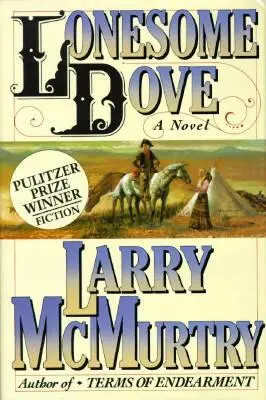
- Название:Lonesome Dove
- Автор:
- Жанр:
- Год:неизвестен
- ISBN:нет данных
- Рейтинг книги:5 / 5. Голосов: 1
-
Избранное:Добавить в избранное
- Отзывы:
-
Ваша оценка:
Lonesome Dove: краткое содержание, описание и аннотация
Предлагаем к чтению аннотацию, описание, краткое содержание или предисловие (зависит от того, что написал сам автор книги «Lonesome Dove»). Если вы не нашли необходимую информацию о книге — напишите в комментариях, мы постараемся отыскать её.
A love story, an adventure, an American epic, Lonesome Dove embraces all the West – legend and fact, heroes and outlaws, whoeres and ladies, Indians and settlers – in a novel that recreates the central American experience, the most enduring of our national myths.
Set in the late nineteenth century, Lonesome Dove is the story of a cattle drive from Texas to Montana – and much more. It is a drive that represents for everybody involved not only a daring, even a foolhardy, adventure, but a part of the American Dream – the attempt to carve out of the last remaining wilderness a new life.
Agustus McCrae and W.F. Call are former Texas Rangers, partners and friends who have shared hardship and danger together without ever quite understanding (or wanting to understand) each other's deepest emotions. Gus is the romantic, a reluctant rancher who has a way with women and the sense to leave well enough alone. Call is a driven, demanding man, a natural authority figure with no patience for weaknesses, and not many of his own. He is obsessed with the dream of creating his own empire, and with the need to conceal a secret sorrow of his own. The two men could hardly be more different, but both are tough, redoubtable fighters who have learned to count on each other, if nothing else.
Call's dream not only drags Gus along in its wake, but draws in a vast cast of characters:
– Lorena, the whore with the proverbial heart of gold, whom Gus (and almost everyone else) loves, and who survives one of the most terrifying experiences any woman could have…
– Elmira, the restless, reluctant wife of a small-time Arkansas sheriff, who runs away from the security of marriage to become part of the great Western adventure…
– Blue Duck, the sinister Indian renegade, one of the most frightening villains in American fiction, whose steely capacity for cruelty affects the lives of everyone in the book…
– Newt, the young cowboy for whom the long and dangerous journey from Texas to Montana is in fact a search for his own identity…
– Jake, the dashing, womanizing ex-Ranger, a comrade-in-arms of Gus and Call, whose weakness leads him to an unexpected fate…
– July Johnson, husband of Elmira, whose love for her draws him out of his secure life into the wilderness, and turns him into a kind of hero…
Lonesome Dove sweeps from the Rio Grande (where Gus and Call acquire the cattle for their long drive by raiding the Mexicans) to the Montana highlands (where they find themselves besieged by the last, defiant remnants of an older West).
It is an epic of love, heroism, loyalty, honor, and betrayal – faultlessly written, unfailingly dramatic. Lonesome Dove is the novel about the West that American literature – and the American reader – has long been waiting for.
Lonesome Dove — читать онлайн бесплатно полную книгу (весь текст) целиком
Ниже представлен текст книги, разбитый по страницам. Система сохранения места последней прочитанной страницы, позволяет с удобством читать онлайн бесплатно книгу «Lonesome Dove», без необходимости каждый раз заново искать на чём Вы остановились. Поставьте закладку, и сможете в любой момент перейти на страницу, на которой закончили чтение.
Интервал:
Закладка:
Back at the camp, Augustus rested in the shade of the little bluff. Aus Frank continued to haul in bones until sundown. After pitching his last load up on the pyramid, he wheeled the barrow to his camp, turned it over and sat on it. He looked at Augustus for two or three minutes without saying anything.
"Well, are you going to invite me for supper or not?" Augustus asked.
"Never should have arrested me," Aus Frank said. "I don't like that goddamn bank."
"You didn't stay in jail but four hours," Augustus reminded him. "Now that I've seen how hard you work, I'd say you probably needed the rest. You could have studied English or something. I see you've learned it finally."
"I don't like the goddamn bank," Aus repeated.
"Let's talk about something else," Augustus suggested. "You're just lucky you didn't get shot on account of that bank. Me and Call were both fine shots in those days. The thicket was the only thing that saved you."
"They cheated me because I couldn't talk good," Aus Frank said.
"You got a one-track mind, Aus," Augustus said. "You and half of mankind. How long you been up here on the Canadian river?"
"I come five years," Aus said. "I want a store."
"That's fine, but you've outrun the people," Augustus said. "They won't be along for another ten years or so. I guess by then you'll have a helluva stock of buffalo bones. I just hope there's a demand for them."
"Had a wagon," Aus Frank said. "Got stole. Apaches got it."
"That so?" Augustus said. "I didn't know the Apaches lived around here."
"Over by the Pecos," Aus said. "I quit the mountains. Don't like snow."
"I'll pass on snow myself, when I have the option," Augustus said. "This is a lonely place you've settled in, though. Don't the Indians bother you?"
"They leave me be," Aus said. "That one you're hunting, he's a mean one. He kilt Bob. Built a fire under him and let him sizzle.
"He don't bother me, though," he added. "Kilt Bob and let me be."
"Bob who?"
"Old Bob, that I was in the mountains with," Aus said.
"Well, his burning days are over, if I find him," Augustus said.
"He's quick, Blue Duck," Aus said. "Has some Kiowas with him. They ate my dog."
"How many Kiowas?" Augustus asked.
"It was a big dog," Aus said. "Killed two wolves. I had a few sheep once but the Mexicans run them off."
"It's a chancy life out here on the plains," Augustus said. "I bet you get a nice breeze in the winter, too."
"Them Kiowas ate that dog," Aus repeated. "Good dog."
"Why ain't Blue Duck killed you?" Augustus asked.
"Laughs at me," Aus said. "Laughs at my bones. He says he'll kill me when he gets ready."
"How many Kiowas does he run around with?" Augustus asked again. The old man was evidently not used to having anyone to talk to. His remarks came out a little jerky.
"Six," Aus Frank said.
"Who's over at the Walls?" Augustus asked.
The old man didn't answer. Darkness had fallen, and Augustus could barely see him sitting on his wheelbarrow.
"No beaver in this river," Aus Frank said after several minutes.
"No, a beaver would be foolish to be in this river," Augustus said. "There ain't a tree within twenty miles, and beavers like to gnaw trees. You should have stayed up north if you like beavers."
"I'd rather gather these bones," the old man said. "You don't have to get your feet wet."
"Did you get to Montana when you was a beaverman?"
Augustus waited several minutes for a reply, but the old man never answered. When the moon came up, Augustus saw that he had fallen asleep sitting on his wheelbarrow, his head fallen over in his arms.
Augustus was tired and hungry. He lay where he was, thinking about food, but making no effort to get up and fix any, if there was any to be fixed. While he was thinking he ought to get up and eat, he fell asleep.
Deep in the night a sound disturbed him, and he came awake and drew his pistol. It was well on toward morning-he could tell that by the moon-but the sound was new to him.
Cautiously he turned over, only to see at once that the source of the sound was Aus Frank. He had risen in the night and collected another load of buffalo bones. Now he was heaving them up on the pyramid. The sound that had awakened Augustus was the sound of bones, clicking and rattling as they slid down the sides of the pyramid.
Augustus holstered his pistol and walked over to watch the old man.
"You're an unusual fellow, Aus," he said. "I guess you just work night and day. You should have partnered up with Woodrow Call. He's as crazy about work as you are. The two of you might own the world by now if you'd hooked up."
Aus Frank didn't respond. He had emptied the wheelbarrow, and he pushed it up the slope, away from the river.
Augustus caught his horse and rode east. On his way he saw Aus Frank again, working under the moonlight. He had plenty to work with, for the plain around was littered with buffalo bones. It looked as if a whole herd had been wiped out, for a road of bones stretched far across the plain.
He remembered when he had first come to the high plains, years before. For two days he and Call and the Rangers had ridden parallel to the great southern buffalo herd-hundreds of thousands of animals, slowly grazing north. It had been difficult to sleep at night because the horses were nervous around so many animals, and the sounds of the herd were constant. They had ridden for nearly a hundred miles and seldom been out of sight of buffalo.
Of course they had heard that the buffalo were being wiped out, but with the memory of the southern herd so vivid, they had hardly credited the news. Discussing it in Lonesome Dove they had decided that the reports must be exaggerated-thinned out, maybe, but not wiped out. Thus the sight of the road of bones stretching over the prairie was a shock. Maybe roads of bones were all that was left. The thought gave the very emptiness of the plains a different feel. With those millions of animals gone, and the Indians mostly gone in their wake, the great plains were truly empty, unpeopled and ungrazed.
Soon the whites would come, of course, but what he was seeing was a moment between, not the plains as they had been, or as they would be, but a moment of true emptiness, with thousands of miles of grass resting unused, occupied only by remnants-of the buffalo, the Indians, the hunters. Augustus thought they were crazed remnants, mostly, like the old mountain man who worked night and day gathering bones to no purpose.
"No wonder you never worked out in Waco, Aus," he said, speaking as much to himself as to the old man. Aus Frank was not in a talkative mood, or a listening mood either. He had filled his wheelbarrow and was heading back to camp.
"I'm going to the Walls to kill that big renegade for you," Augustus said. "Need anything?"
Aus Frank stopped, as if thinking it over.
"I wisht they hadn't killed that dog," he said. "I liked that dog. It was them Kiowas that killed it, not the Mexicans. Six Kiowas."
"Well, I got six bullets," Augustus said. "Maybe I'll send the rascals where your dog went."
"Them Kiowas shot Bob's horse," Aus added. "That's how come they caught him. Built a fire under him and cooked him. That's their way."
Then he lifted his wheelbarrow full of bones and walked off toward the Canadian river.
The light was just coming, the plains black in the distance, the sky gray where it met the land. Though dawn was his favorite hour, it was also an hour at which Augustus most keenly felt himself to be a fool. What was it but folly to be riding along the Canadian River alone, easy pickings for an outlaw gang, and hungry to boot? A chain of follies had put him there: Call's abrupt decision to become a cattleman and his own decision, equally abrupt, to try and rescue a girl foolish enough to be taken in by Jake Spoon. None of it was sensible, yet he had to admit there was something about such follies that he liked. The sensible way, which he had pursued once or twice in his life, had always proved boring, usually within a few days. In his case it had led to nothing much, just excessive drunkenness and reckless card playing. There was more enterprise in certain follies, it seemed to him.
Читать дальшеИнтервал:
Закладка:
Похожие книги на «Lonesome Dove»
Представляем Вашему вниманию похожие книги на «Lonesome Dove» списком для выбора. Мы отобрали схожую по названию и смыслу литературу в надежде предоставить читателям больше вариантов отыскать новые, интересные, ещё непрочитанные произведения.









Обсуждение, отзывы о книге «Lonesome Dove» и просто собственные мнения читателей. Оставьте ваши комментарии, напишите, что Вы думаете о произведении, его смысле или главных героях. Укажите что конкретно понравилось, а что нет, и почему Вы так считаете.