Larry McMurtry - Lonesome Dove
Здесь есть возможность читать онлайн «Larry McMurtry - Lonesome Dove» весь текст электронной книги совершенно бесплатно (целиком полную версию без сокращений). В некоторых случаях можно слушать аудио, скачать через торрент в формате fb2 и присутствует краткое содержание. Жанр: Современная проза, на английском языке. Описание произведения, (предисловие) а так же отзывы посетителей доступны на портале библиотеки ЛибКат.
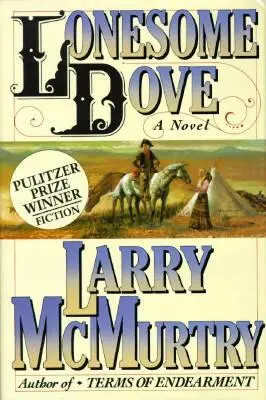
- Название:Lonesome Dove
- Автор:
- Жанр:
- Год:неизвестен
- ISBN:нет данных
- Рейтинг книги:5 / 5. Голосов: 1
-
Избранное:Добавить в избранное
- Отзывы:
-
Ваша оценка:
Lonesome Dove: краткое содержание, описание и аннотация
Предлагаем к чтению аннотацию, описание, краткое содержание или предисловие (зависит от того, что написал сам автор книги «Lonesome Dove»). Если вы не нашли необходимую информацию о книге — напишите в комментариях, мы постараемся отыскать её.
A love story, an adventure, an American epic, Lonesome Dove embraces all the West – legend and fact, heroes and outlaws, whoeres and ladies, Indians and settlers – in a novel that recreates the central American experience, the most enduring of our national myths.
Set in the late nineteenth century, Lonesome Dove is the story of a cattle drive from Texas to Montana – and much more. It is a drive that represents for everybody involved not only a daring, even a foolhardy, adventure, but a part of the American Dream – the attempt to carve out of the last remaining wilderness a new life.
Agustus McCrae and W.F. Call are former Texas Rangers, partners and friends who have shared hardship and danger together without ever quite understanding (or wanting to understand) each other's deepest emotions. Gus is the romantic, a reluctant rancher who has a way with women and the sense to leave well enough alone. Call is a driven, demanding man, a natural authority figure with no patience for weaknesses, and not many of his own. He is obsessed with the dream of creating his own empire, and with the need to conceal a secret sorrow of his own. The two men could hardly be more different, but both are tough, redoubtable fighters who have learned to count on each other, if nothing else.
Call's dream not only drags Gus along in its wake, but draws in a vast cast of characters:
– Lorena, the whore with the proverbial heart of gold, whom Gus (and almost everyone else) loves, and who survives one of the most terrifying experiences any woman could have…
– Elmira, the restless, reluctant wife of a small-time Arkansas sheriff, who runs away from the security of marriage to become part of the great Western adventure…
– Blue Duck, the sinister Indian renegade, one of the most frightening villains in American fiction, whose steely capacity for cruelty affects the lives of everyone in the book…
– Newt, the young cowboy for whom the long and dangerous journey from Texas to Montana is in fact a search for his own identity…
– Jake, the dashing, womanizing ex-Ranger, a comrade-in-arms of Gus and Call, whose weakness leads him to an unexpected fate…
– July Johnson, husband of Elmira, whose love for her draws him out of his secure life into the wilderness, and turns him into a kind of hero…
Lonesome Dove sweeps from the Rio Grande (where Gus and Call acquire the cattle for their long drive by raiding the Mexicans) to the Montana highlands (where they find themselves besieged by the last, defiant remnants of an older West).
It is an epic of love, heroism, loyalty, honor, and betrayal – faultlessly written, unfailingly dramatic. Lonesome Dove is the novel about the West that American literature – and the American reader – has long been waiting for.
Lonesome Dove — читать онлайн бесплатно полную книгу (весь текст) целиком
Ниже представлен текст книги, разбитый по страницам. Система сохранения места последней прочитанной страницы, позволяет с удобством читать онлайн бесплатно книгу «Lonesome Dove», без необходимости каждый раз заново искать на чём Вы остановились. Поставьте закладку, и сможете в любой момент перейти на страницу, на которой закончили чтение.
Интервал:
Закладка:
"Much obliged," he said. "I reckon I can't."
"Well, the job's open," Wilbarger said. "We may meet again. I've got to lope up to the Red River to see if I think the water's fresh enough for my stock."
"What'll you do if it ain't?" Joe asked. He had never known anyone who just said one unusual thing after another, as Wilbarger did. How could the water in a river not be fresh enough for cows?
"Well, I could piss in it to show it what I thought of it," Wilbarger said.
"Could you use any company?" July asked. "We're going up that way."
"Oh, I can always use good conversation, when I can get it," Wilbarger said. "I was brought up to expect good conversation, but then I run off to the wilderness and it's been spotty ever since. Why are you going north when the man you want is to the south?"
"I've got other business as well," July said. He didn't want to describe it though. He hadn't meant to ask Wilbarger if they could ride along. He wouldn't ordinarily have done it, but then his life was no longer ordinary. His wife was lost, and his deputy also. He felt more confused than he ever had in his life, whereas Wilbarger was a man who seemed far less confused than most. He seemed to know his mind immediately, whatever the question put to him.
Wilbarger started at once and loped several miles without speaking. Joe loped with him. The country was open, lightly spotted with elm and post oak. They came to a fair-sized stream and Wilbarger stopped to water his horse.
"Have you been to Colorado?" July asked.
"Yes, once," Wilbarger said. "Denver's no worse than most towns out here. I intend to avoid that country, though. The Indians in those parts ain't entirely reformed, and the outlaws are meaner than the Indians, with less excuse."
It was not comforting talk when one's wife was said to be on a whiskey boat going up the Arkansas.
"Planning a trip to Colorado?" Wilbarger asked.
"I don't know," July said. "Maybe."
"Well, if you go up on the plains and get scalped, there'll be that much less law in Arkansas," Wilbarger said. "But then there might not be that much crime in Arkansas now. I guess most of the crime's moved to Texas."
July wasn't listening. He was trying to convince himself that Peach was wrong-that Elmira had just gone wandering for a few days. When Wilbarger started to move on, July did not.
"Thanks for the company," he said. "I think we better go look for my deputy."
"There's a perfectly straight trail from Fort Smith into Texas," Wilbarger said. "Captain Marcy laid it out. If that deputy can't even stay in a road, I expect you ought to fire him."
Then he loped away without saying goodbye. Joe wished they were going with him. In only a few hours the man had paid him several compliments and had offered to hire him. He found himself feeling resentful both of July and Roscoe. July didn't seem to know what he wanted to do, and as for Roscoe, if he couldn't stay in a road, then he deserved to be lost. He wished he had spoken up and grabbed the job when Wilbarger offered it.
But the moment had been missed-Wilbarger was already out of sight, and they were still sitting there. July looked depressed, as he had ever since they had left Fort Smith. Finally, without a word, he turned east, back toward Arkansas. Joe wished he was old enough to point out to July that nothing he was doing made any sense. But he knew July probably wouldn't even hear him in the state he was in. Joe felt annoyed, but he kept quiet and followed along.
52.
THE AMAZING THING about Janey, in Roscoe's view, was that she knew her way. Almost as amazing was that she liked to walk. The first day or two it felt a little wrong that he was riding and she was walking, but she was just a slip of a girl, and he was a grown man and a deputy besides. He pointed out to her that she was welcome to ride-she weighed practically nothing, and anyway they weren't traveling fast enough to tire a horse.
But Janey didn't want to ride. "I'll walk and all you have to do is keep up," she said. Of course it was no trouble for a man on horseback to keep up with a girl on foot, and Roscoe began to relax and even to enjoy the trip a little. It was pretty weather. All he had to do was trot along and think. What he mostly thought about was how surprised July would be when they showed up and told him the news.
Not only could Janey keep them on the trail but she was also extremely useful when it came to rounding up grub. Once they got settled in a camp at night she would disappear and come back five minutes later with a rabbit or a possum or a couple of squirrels. She could even catch birds. Once she came back with a fat brownish bird of a sort Roscoe had never seen.
"Now what bird is that?" he asked.
"Prairie chicken," Janey said. "There was two but one got away."
They ate the prairie chicken and it was as good as any regular chicken Roscoe had ever had. Janey cracked open the bones with her teeth and sucked out the marrow.
The only problem with her at all, from Roscoe's point of view, was that she was tormented by bad dreams and whimpered at night. Roscoe loaned her a blanket, thinking she might be cold, but that wasn't it. Even wrapped in a blanket she still whimpered, and because of that didn't sleep much. He would awake in the grayness just before dawn and see Janey sitting up, stirring the little campfire and scratching her ankles. She was barefoot, of course, and her ankles and shins were scratched by the rough grass she went through each day.
"Did you never have any shoes?" he asked once.
"Never did," Janey said, as if it didn't matter.
The only times she would consent to crawl up on the horse was when they had a sizable creek to cross. She didn't like wading in deep water.
"'Fraid of them snappers," she said. "If one of them was to bite me I'd die."
"They're mighty slow," Roscoe said. "It's easy to outrun 'em."
"I dream about them," Janey said, not reassured. "They just keep coming, and I can't run."
Except for snapping turtles and sleep, she seemed to fear nothing. Many times coiled rattlers would sing at them as they traveled, and Janey would never give the snakes a glance. Old Memphis was more nervous about snakes than she was, and Roscoe more nervous than either one of them. He had once heard of a man being bitten by a rattlesnake that had gotten up in a tree. According to the story, the snake had dropped right off a limb and onto the man and had bitten him in the neck. Roscoe imagined how unpleasant it could be to have a snake drop on one's neck-he took care to ride under as few limbs as possible and was glad to see the trees thinning out as they rode west.
It seemed they were on a fairly good trail, for every day they encountered three or four travelers, sometimes more. Once they caught up with a family plodding along in a wagon. It was such a large family that it looked like a small town on the move, particularly if you wanted to count the livestock. The old man of the family, who was driving the team, didn't seem talkative, but his wife was.
"We're from Missouri," she said. "We're going west and I guess we'll stop when we feel like it. We've got fourteen young 'uns and are hoping to establish a farm."
Eight or nine of the young ones were riding in the wagon. They stared at Roscoe and Janey, as silent as owls.
Several times they met soldiers going east toward Fort Smith. The soldiers were a taciturn lot and passed without much talk. Roscoe attempted to inquire about July, but the soldiers made it clear that they had better things to do than keep a lookout for Arkansas sheriffs.
Janey was shy of people. She had keen eyesight and would usually see other travelers before Roscoe did. Often when she saw one she disappeared, darting off the trail and hiding in weeds and tall grass until the stranger passed.
Читать дальшеИнтервал:
Закладка:
Похожие книги на «Lonesome Dove»
Представляем Вашему вниманию похожие книги на «Lonesome Dove» списком для выбора. Мы отобрали схожую по названию и смыслу литературу в надежде предоставить читателям больше вариантов отыскать новые, интересные, ещё непрочитанные произведения.








Обсуждение, отзывы о книге «Lonesome Dove» и просто собственные мнения читателей. Оставьте ваши комментарии, напишите, что Вы думаете о произведении, его смысле или главных героях. Укажите что конкретно понравилось, а что нет, и почему Вы так считаете.