Tracy Chevalier - Remarkable Creatures
Здесь есть возможность читать онлайн «Tracy Chevalier - Remarkable Creatures» — ознакомительный отрывок электронной книги совершенно бесплатно, а после прочтения отрывка купить полную версию. В некоторых случаях можно слушать аудио, скачать через торрент в формате fb2 и присутствует краткое содержание. Жанр: Современная проза, на английском языке. Описание произведения, (предисловие) а так же отзывы посетителей доступны на портале библиотеки ЛибКат.
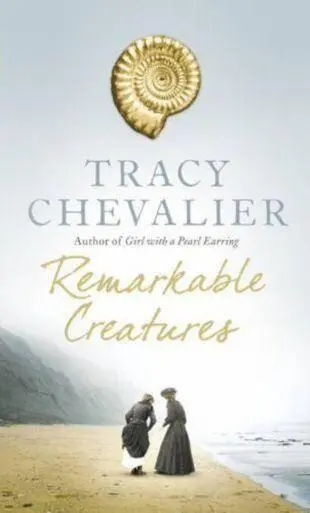
- Название:Remarkable Creatures
- Автор:
- Жанр:
- Год:неизвестен
- ISBN:нет данных
- Рейтинг книги:4 / 5. Голосов: 1
-
Избранное:Добавить в избранное
- Отзывы:
-
Ваша оценка:
Remarkable Creatures: краткое содержание, описание и аннотация
Предлагаем к чтению аннотацию, описание, краткое содержание или предисловие (зависит от того, что написал сам автор книги «Remarkable Creatures»). Если вы не нашли необходимую информацию о книге — напишите в комментариях, мы постараемся отыскать её.
Remarkable Creatures — читать онлайн ознакомительный отрывок
Ниже представлен текст книги, разбитый по страницам. Система сохранения места последней прочитанной страницы, позволяет с удобством читать онлайн бесплатно книгу «Remarkable Creatures», без необходимости каждый раз заново искать на чём Вы остановились. Поставьте закладку, и сможете в любой момент перейти на страницу, на которой закончили чтение.
Интервал:
Закладка:
Bessy brought me the paper as I rested by the fire one mid-December afternoon. I did not often fall ill, and my weakness irritated me so that I had become as grumpy as Bessy normally was. I sighed as she set it on a small table next to me along with a cup of tea. Still, it was some diversion, for my sisters were busy in the kitchen, making up a batch of Margaret’s salve to go in Christmas baskets, along with jars of rosehip jelly. I had wanted to include an ammonite in each basket, but Margaret felt they did not invoke a festive spirit and insisted on pretty shells instead. I forget sometimes that people see fossils as the bones of the dead. Indeed, they are, though I tend to view them more as works of art reminding us of what the world was once like.
I paid little attention to what I read until I came across a short notice, wedged between news of two fires, one burning down a barn, the other the premises of a pastry cook. It read:
On Wednesday evening Mary Anning, the well-known fossilist, whose labours have enriched the British and Bristol Museums, as well as the private collections of many geologists, found, east of town, and immediately under the celebrated Black Ven Cliff, some remains, which were removed on that night and the succeeding morning, to undergo an examination, the result of which is, that this specimen appears to differ widely from any which have before been discovered at Lyme, either of the Ichthyosaurus or Plesiosaurus, while it approaches nearly to the structure of the Turtle. The whole osteology has not yet been satisfactorily disclosed, owing to its very recent removal.
It will be for the great geologists to determine by what term this creature is to be known. The great Cuvier will be informed when the bones are completely disclosed, but probably it will be christened at Oxford or London, after an account has been accurately furnished. No doubt the Directors of the British or Bristol Museums will be anxious to possess this relic of the “great Herculaneum ”.
Mary had found it at last. She had found the new monster that she and William Buckland had speculated must exist, and I had to find out about her discovery in the newspaper, as if I were just anyone and had no claim on her. Even the men producing the Western Flying Post knew about it before me.
It is difficult to have a falling-out in a town the size of Lyme Regis. I had first learned that when we Philpots stopped seeing Lord Henley: we then managed to run into him everywhere, so that it became almost a game dodging him on Broad Street, along the path by the river, at St Michael’s. We provided the town with years of gossip and amusement, for which we ought to have been thanked.
With Mary the severing was far more painful, because she was so close to my heart. After our fight in the churchyard, I regretted what I’d said to her almost immediately, wishing I had let her find out from Colonel Birch himself about the widow he might marry. I shall never forget the look of betrayal and despair on her face. On the other hand, I felt the sting of her comments about my jealousy and my sisters and my fish like a whipping that lingered.
I was too proud to go and apologise, though, and I expect she was too. I longed to have Bessy come into the parlour with a telltale grimace and announce that I had a visitor. But it didn’t happen, and once the time for such a rapprochement had passed, it became impossible to regain our old standing.
It is not easy to let someone go, even when they have said unforgivable things to you. For at least a year it cut me deeply to see her, out on the beach, or on Broad Street, or by the Cobb. I began to avoid Cockmoile Square, taking back-lanes to St Michael’s, and the path by the church to the beach. I no longer went to Black Ven, where Mary usually hunted, instead heading in the opposite direction, past the Cobb and onto Monmouth Beach. There were not so many fossil fish there, and so I collected less, but at least I was not so likely to run into her.
It was lonely, though. Over the years Mary and I had spent a great deal of time together out hunting. Some days we wouldn’t speak for hours, but her presence near by, bent over the ground, scrabbling in the mud or splitting open rocks, was a familiar comfort. Now I would glance around and still be surprised to find there was only me on the deserted beach. Such solitude brought on a self-indulgent melancholy that I detested, and I would make cutting remarks to jolt myself out of it. Margaret began to complain that I had grown more prickly, and Bessy threatened to give notice when I was sharp with her.
It wasn’t only on the beach that I missed Mary. I also longed for the company of her sitting at my dining table while I unpacked my basket and showed off what I had found. I could only do so the rare times when Henry De La Beche or William Buckland or Doctor Carpenter was about, or when someone occasionally came to see my collection and showed more than simply a fashionable interest in fossils. Without Mary’s knowledge and encouragement, I felt my own studies slacken.
At the same time I had to watch her become more popular with outsiders. They actively sought her out, and she began taking visitors on fossil walks to Black Ven. With Colonel Birch’s auction money and Mary’s growing fame, the Annings were at last freeing themselves from the debt Richard Anning had put them into many years before. Mary and Molly Anning had new dresses, and they bought proper furniture again, and coal to warm themselves. Molly Anning stopped taking in laundry and began running the fossil shop properly, and it became a busy place. I should have been glad for them. Instead I was envious.
For a short time I even considered leaving Lyme and going to live with my sister Frances and her family, who had recently moved to Brighton. When I casually mentioned the possibility to Louise and Margaret, they both reacted with horror. “How can you think of leaving us?” Margaret cried, and Louise was pale and silent. I even found Bessy sniffling into her pastry dough, and had to reassure them all that Morley Cottage would always remain my home.
It took a long time, but eventually I did grow used to not having Mary’s company or her friendship. It became as if she lived in Charmouth or Seatown or Eype. It was surprising that in such a small town she and I were able to avoid each other so well. But then, she was so busy with new collectors that I would have seen less of her even if I hadn’t been trying to. While I accommodated her absence, a dull ache in my heart remained, like a fracture that, though healed, ever after flares up during damp weather.
I did run into her once where I couldn’t get away. I was with my sisters, heading along the Walk, when Mary came from the opposite direction, a small black and white dog at her heels. It happened too quickly for me to duck aside. Mary started when she saw us, but continued towards us, as if determined not to be deterred. Margaret and Louise said hello to her, and she to them. She and I carefully avoided meeting each other’s eyes.
“What a lovely little dog!” Margaret cried, kneeling to pet it. “What is his name?”
“Tray.”
“Where did you get him?”
“A friend give him to me, to keep me company upon beach.” Mary turned red, which told us who the friend was. “If he likes you, he lets you pet him. If he don’t, he growls.”
Tray sniffed at Louise’s dress, then mine. I stiffened, expecting him to growl, but he looked up at me and panted. I had always assumed pets did not like those their owners did not like.
Other than that meeting, I was able to avoid her, though I sometimes saw her in the distance, Tray following, on the beach or in town.
There was one moment when I was briefly tempted to try to restore our friendship. A few months after our fight, I heard that Mary had discovered a loose jumble of bones, which she pieced together in a speculative fashion, though the specimen was without a skull. I wanted to see it, but the Annings sold it to Colonel Birch and shipped it to him before I got up the courage to visit Cockmoile Square. I was only able to read about it in papers Henry De La Beche and Reverend Conybeare published, in which they named this notional creature a plesiosaurus, a “near lizard”. It had a very long neck and huge paddles, and William Buckland likened it to a serpent threaded through the shell of a turtle.
Читать дальшеИнтервал:
Закладка:
Похожие книги на «Remarkable Creatures»
Представляем Вашему вниманию похожие книги на «Remarkable Creatures» списком для выбора. Мы отобрали схожую по названию и смыслу литературу в надежде предоставить читателям больше вариантов отыскать новые, интересные, ещё непрочитанные произведения.
Обсуждение, отзывы о книге «Remarkable Creatures» и просто собственные мнения читателей. Оставьте ваши комментарии, напишите, что Вы думаете о произведении, его смысле или главных героях. Укажите что конкретно понравилось, а что нет, и почему Вы так считаете.