Tracy Chevalier - Remarkable Creatures
Здесь есть возможность читать онлайн «Tracy Chevalier - Remarkable Creatures» — ознакомительный отрывок электронной книги совершенно бесплатно, а после прочтения отрывка купить полную версию. В некоторых случаях можно слушать аудио, скачать через торрент в формате fb2 и присутствует краткое содержание. Жанр: Современная проза, на английском языке. Описание произведения, (предисловие) а так же отзывы посетителей доступны на портале библиотеки ЛибКат.
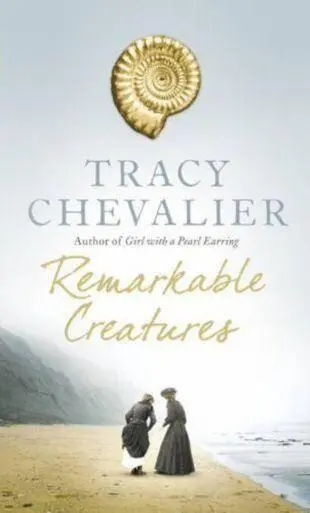
- Название:Remarkable Creatures
- Автор:
- Жанр:
- Год:неизвестен
- ISBN:нет данных
- Рейтинг книги:4 / 5. Голосов: 1
-
Избранное:Добавить в избранное
- Отзывы:
-
Ваша оценка:
Remarkable Creatures: краткое содержание, описание и аннотация
Предлагаем к чтению аннотацию, описание, краткое содержание или предисловие (зависит от того, что написал сам автор книги «Remarkable Creatures»). Если вы не нашли необходимую информацию о книге — напишите в комментариях, мы постараемся отыскать её.
Remarkable Creatures — читать онлайн ознакомительный отрывок
Ниже представлен текст книги, разбитый по страницам. Система сохранения места последней прочитанной страницы, позволяет с удобством читать онлайн бесплатно книгу «Remarkable Creatures», без необходимости каждый раз заново искать на чём Вы остановились. Поставьте закладку, и сможете в любой момент перейти на страницу, на которой закончили чтение.
Интервал:
Закладка:
I didn’t go upon beach either. Something had happened to me. I couldn’t find curies. I went out and it was like I was blind. Nothing glittered; there were no tiny jolts of lightning, no pattern popping out from the random shapes.
They tried to help-Mam, Miss Philpot. Even Joe left his upholstering to come out hunting with me when I knew he’d rather be inside covering chairs. And when he come to Lyme, Mr Buckland, who never noticed anything about other people, was gentle with me, guiding me to specimens he found, showing me where he thought we should look, staying at my side more than usual-in fact, doing all the things I normally done for him upon beach. He also entertained me with stories of his travels to the Continent with Reverend Conybeare, and with his antics at Oxford, how he kept a tame bear as a pet, and dressed it up and introduced it to the other Oxford dons. And how a friend brought back a crocodile in brine from a voyage, and Mr Buckland got to add a new member of the animal kingdom to his tasting list. I couldn’t help smiling at his stories.
He was the only one who got through the fog even briefly. He begun talking to me about things we’d found over the years that didn’t seem to belong to the ichie: verteberries wider and chunkier, paddle bones flatter than they should be. One day he showed me a verteberry with a piece of rib that was attached lower than on an ichie’s verteberry. “Do you know, Mary, I think there may be another creature out there,” he said. “Something with a spine and ribs and paddles like the ichthyosaurus, but with anatomy rather more like a crocodile’s. Wouldn’t that be something, to find another of God’s creatures?”
For a moment my mind went clear. I studied Mr Buckland’s kindly face, even rounder and pudgier than when I first knew him, his eyes bright and his brow bulging with ideas, and I almost said, “Yes, I think so too. I been wondering about a new monster for years.” I didn’t say it. Before I could, my mind sank down again like a leaf settling to the bottom of a pond.
Mam and Joe went hunting while I stayed back and minded the shop. It was a surprise the first time Mam went out with Joe to Black Ven. She give me a funny look as they left, but she said nothing. She had been out with me now and then, but always as company, not to hunt herself. She was good at the business side-writing letters to collectors, chasing up what we was owed and describing specimens for sale, convincing visitors to buy more than they’d meant to at the shop. She never went looking for curies. She didn’t have the eye, or the patience. Or so I’d thought. I was amazed when they come back hours later and Mam, all smug, handed me a basket heavy with finds. It was mostly ammos and bellies-the easiest curies for a beginner to see since their even lines stand out from the rocks. But she’d also managed to find some pentacrinites, a damaged sea urchin, and, most surprising of all, part of the shoulder bone of an ichie. We could get three shillings for that bone alone, and eat for a week.
When she was in the privy I accused Joe of putting what he found in her basket and saying it were hers. He shook his head. “She did it herself. I don’t know how she manages it, she’s so haphazard in her hunting. But she finds things.”
Mam later told me she’d made a bargain with God: if He showed her where the curies were, she would never again question His judgment, which she had done many times over the years with all the death and debt she had to suffer. “He must have listened,” Mam said, “for I didn’t have to look hard to find ’em. They were just there upon beach, waiting for me to pick up. I don’t know why you fussed so much when you went out looking, needing all that time day after day. It ain’t so hard to find curies.”
I wanted to argue with her but was in no position to since I weren’t going hunting any more. And it was true that when Mam went out she always filled her basket. She had the eye all right, she just didn’t want to admit it.
All of that changed on the 12th of May, 1820. I was behind our table in Cockmoile Square, showing sea lilies to a Bristol couple, when a boy come by with a packet for Joe. He wanted a shilling to pay for it, as it was bigger than your average letter. I didn’t have a shilling, and was about to send the boy away again when I saw the handwriting I had been waiting for these months. I knew his hand because, just as Miss Elizabeth had taught me, I’d shown him how to write labels of each specimen he found-a description of it, the Linnaean name if known, where and when found, in which layer of rock, and any other information that might be useful.
I snatched the packet from the boy and stared at it. Why were it addressed to Joe? They weren’t ever over friendly together. Why wouldn’t he write to me?
“You can’t have that unless you pay, Mary.” The boy pulled at the packet.
“I haven’t the shilling yet, but I’ll get it somehow. Can’t you let me have it and I’ll owe you?”
In answer he pulled at the packet again. I hugged it to my chest. “I’m not giving it up. I been waiting for this letter for months.”
The boy sneered. “That be from your sweetheart, eh? The old man you went round with who left you, didn’t he?”
“You shut your gob, boy!” I turned to the gentleman, knowing such a fuss in front of customers would sell no curies. “Sorry, sir. Have you decided what you want?”
“Indeed,” the lady answered for her husband. “We shall take a shilling’s worth of crinoids.” She smiled as she held out a coin.
“Oh, thank you, ma’am, thank you!” I handed the shilling to the boy. “You get out now, you!”
He made a rude gesture as he left, and I apologised again to the couple. Though the lady had been so understanding about the letter, she took her time about choosing her crinoids, and I had to swallow my impatience. Then I had to wrap them up in paper, and the man wanted extra string, and I got it all in knots, and thought I would go mad with fixing it. At last it was done and they left, the lady whispering, “I hope there is good news in your letter.”
I went inside then and sat in the dusty workshop, the packet in my lap. I read the address again: “Joseph Anning, Esq., The Fossil Shop, Cockmoile Square, Lyme Regis, Dorsetshire.” Why had he written to my brother? And why was it a packet wrapped in brown paper rather than a letter? What could Colonel Birch want to send to my brother?
Why hadn’t he sent it to me?
I knew from the incoming tide that Joe and Mam would be back in half an hour. I didn’t know how I could sit there with the letter and wait even that little while for them to return. I couldn’t bear it.
I looked at the packet. Then I turned it over, counted to three, and broke the seal. Joe would be angry, but I could-n’t help it. I was sure it was really meant for me.
Along with a folded letter there was a pamphlet the size of the exercise books I used to practise my letters in at Sunday school. On the front page it read:
A Catalogue of
a small but very fine Collection of
Organised Fossils,
from the Blue Lias Formation
at Lyme and Charmouth, in Dorsetshire
consisting principally of Bones,
illustrating the
Osteology of the Ichthio-Saurus, or Proteo-Saurus,
and of Specimens of
the Zoophyte, called Pentacrinite,
the Genuine Property of Colonel Birch,
collected at a considerable Expense,
which will be sold at Auction,
by Mr Bullock,
at his Egyptian Hall in Piccadilly
on Monday, the 15th Day of May, 1820
Punctually at one o’clock
I studied this page without really taking it in. Only when I turned the pages of the catalogue and read the list of specimens, each of which I could picture and name where it had been found, did I begin to understand. He was selling it, every last cury I had worked so hard to add to his collection just for the satisfaction of knowing he would be handling it. All the pentacrinites he loved so, the ammos and parts of lobsters, the fish I should really have given to Elizabeth Philpot, the strange crustaceous insect I had never seen before and would have studied more carefully with the Philpots’ magnifying glass, but that he wanted it. All the fragments of ichies, jaws and teeth and eye sockets and verteberries, all about to be scattered.
Читать дальшеИнтервал:
Закладка:
Похожие книги на «Remarkable Creatures»
Представляем Вашему вниманию похожие книги на «Remarkable Creatures» списком для выбора. Мы отобрали схожую по названию и смыслу литературу в надежде предоставить читателям больше вариантов отыскать новые, интересные, ещё непрочитанные произведения.

Обсуждение, отзывы о книге «Remarkable Creatures» и просто собственные мнения читателей. Оставьте ваши комментарии, напишите, что Вы думаете о произведении, его смысле или главных героях. Укажите что конкретно понравилось, а что нет, и почему Вы так считаете.