Tracy Chevalier - Remarkable Creatures
Здесь есть возможность читать онлайн «Tracy Chevalier - Remarkable Creatures» — ознакомительный отрывок электронной книги совершенно бесплатно, а после прочтения отрывка купить полную версию. В некоторых случаях можно слушать аудио, скачать через торрент в формате fb2 и присутствует краткое содержание. Жанр: Современная проза, на английском языке. Описание произведения, (предисловие) а так же отзывы посетителей доступны на портале библиотеки ЛибКат.
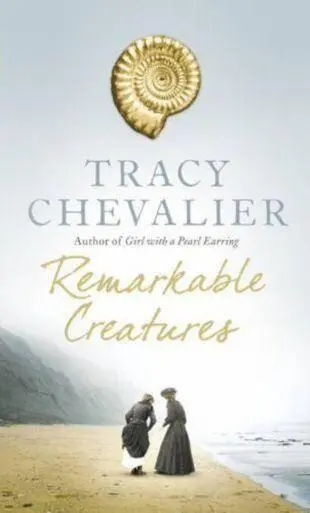
- Название:Remarkable Creatures
- Автор:
- Жанр:
- Год:неизвестен
- ISBN:нет данных
- Рейтинг книги:4 / 5. Голосов: 1
-
Избранное:Добавить в избранное
- Отзывы:
-
Ваша оценка:
Remarkable Creatures: краткое содержание, описание и аннотация
Предлагаем к чтению аннотацию, описание, краткое содержание или предисловие (зависит от того, что написал сам автор книги «Remarkable Creatures»). Если вы не нашли необходимую информацию о книге — напишите в комментариях, мы постараемся отыскать её.
Remarkable Creatures — читать онлайн ознакомительный отрывок
Ниже представлен текст книги, разбитый по страницам. Система сохранения места последней прочитанной страницы, позволяет с удобством читать онлайн бесплатно книгу «Remarkable Creatures», без необходимости каждый раз заново искать на чём Вы остановились. Поставьте закладку, и сможете в любой момент перейти на страницу, на которой закончили чтение.
Интервал:
Закладка:
Mary’s hair was always going to be a dull brown, and scrubby from the wind rather than the curled ringlets that were the fashion. But she did at least comb her fringe daily, and pull the rest into a bun which she covered with a cap and bonnet. I am not sure how much good making an effort with her looks did, for her reputation was already much compromised by her time with Mr Buckland, even with the ill-fated Fanny as companion. The landslip accident might normally have brought Mary some sympathy, but Fanny’s injuries caused much indignation amongst working people, creating sides that cast Mary as the villain. If she was trying to soften her elbows and tame her hair, it could not be for any Lyme man she fancied she could snare. She had too openly flouted the rules of what was expected from a girl in her position. Now that it had tangible consequences in the form of Fanny’s broken gait, vague impressions hardened into harsh opinions.
Mary paid little attention to what others said about her, a trait in her I both admired and despaired of. Perhaps I was a little jealous that she could be so free with her contempt for society’s workings in a way that a woman of my class could not. Even in a place as independent-minded as Lyme, I was all too aware of the judgements made if one stepped too far out of place.
Perhaps Mary did not care for the sort of life Lyme had decided for her. She had spent a great deal of time with people above her station-me most of all, but also William Buckland, and various gentlemen who made their way to Lyme, having heard of or seen the creatures Mary had found. It rather turned her head, and raised her hopes that she might be able to move up in the world. I do not think she ever seriously considered any of the men as potential suitors: most gentlemen viewed her as little more than a knowledgeable servant. William Buckland was more appreciative of her talent, but was too caught up in his own head to notice her as a woman. Such a man would be deeply frustrating, as I briefly allowed myself to discover.
For Mary’s interest in men piqued my own, which I had thought dead but discovered was merely dormant, a rosebush that needed but a little attention to attempt to flower. Once I invited William Buckland to dine with us at Morley Cottage so that he might look at my specimen collection. He accepted with an enthusiasm I suspected was for my fossils, yet I allowed myself to think might be directed towards me as well. For a match between him and me was not such a mad idea. Granted I was several years older than him, and too old to have many children. But it was not impossible. Molly Anning had borne her last child at the age of forty-six. William Buckland and I were of similar social standing, and intellectually suited. Of course I was not educated to his degree, but I read widely. I knew enough about geology and fossils to be a supportive wife to him in his profession.
Margaret, always quick to spot romantic potential even for an aging spinster, encouraged these thoughts by going on about Mr Buckland’s vivid eyes, and nagging me about what I would wear to dinner. What began as genial interest grew to such a pitch of quiet excitement that by the appointed day my stomach was fizzing with nerves.
We waited for him for two hours, Bessy harrumphing and tossing pots about in the kitchen, before we gave in and sat down to a ruined meal that I forced myself to eat. If nothing else, I was obliged to Bessy for making the special effort. She was already on the verge of giving notice once more, and certainly would if I refused to eat. I would also not display disappointment to my sisters, though every bite was lead in my mouth.
The next day I did not seek him out, but nonetheless came upon William Buckland on the beach, for once without Mary. He greeted me heartily, but when I mentioned being disappointed that we had not seen him the day before, he looked surprised. “Was I meant to dine with you, Miss Philpot? Are you sure? Because, you see, yesterday I heard a man had found part of a long sequence of vertebrae down at Seatown, and I had to go and see for myself. And do you know, I’m glad I did, for they are well preserved and yet quite different from Mary’s creature’s vertebrae. I am wondering if they might be from a different animal altogether.”
Unrepentant at his social error, he also did not sense that I was upset. To him it was perfectly normal that going to see a set of unusual vertebrae would take precedence over dining with ladies.
I said nothing but “Good day, sir,” and turned away. It was then I understood that only a woman beautiful enough to distract him or patient enough to put up with him would manage to marry William Buckland.
I thought that was the end of my new regard for men. I had never imagined there would be a Colonel Birch.
The summer Colonel Birch arrived in Lyme, Mary was in a peculiar state, pulled this way and that. On the one hand, the creature she and Joseph had discovered had become quite famous. Charles Konig bought the original specimen from Bullock’s and put it on display at the British Museum. He named it an ichthyosaurus, which means “fish lizard”, for its anatomy falls somewhere between the two. He and others studied it and published articles in which they speculated that the ichthyosaurus was a marine reptile, for it breathed in air like a mammal but swam like a fish. I read these papers, lent to me by William Buckland, with great curiosity, noting that none of them discussed the thorny questions of extinction or God’s hand in the creature’s disappearance. Indeed, they did not bring up religious issues at all. Perhaps they were copying Cuvier, who never mentioned God’s intentions in his writings. It was a relief to me to accept the ichthyosaurus as what it was-an ancient marine reptile with its own name.
Mary found it harder, and often still called it a crocodile, as did most of the local residents, though eventually she settled on ichie. To her the new scientific name took her creature away from her even more effectively than its physical removal. Learned men were discussing it at meetings and writing about it, and Mary was excluded from their activity. She was relied upon to find the specimens, but not to take part in studying them. And even that hunting was proving difficult-she had not found a complete ichthyosaurus in over a year, though she combed Church Cliffs and Black Ven every day.
One day I suggested we look for brittle stars and crinoids on the beach towards Seatown, several miles east of Charmouth. We did not usually go so far afield, but I thought a change of scene would do Mary good, and suggested Seatown to get her away from her endless tramping up and down the same beach in search of an elusive monster. We chose a sunny day when the tides favoured an early start. She left behind Church Cliffs and Black Ven willingly enough, but at Gabriel’s Ledge, just beyond Charmouth, she kept turning and looking behind us, as if the cliffs were calling her back. “There was a flash back there,” she insisted. “Didn’t you see it?”
I shook my head and continued along the beach, hoping she would follow.
“There it is again,” Mary said. “Oh, look, Miss Philpot, do you think he’s coming for us?”
A man was striding up the beach. Although there were other people out, taking advantage of the mild weather and the glorious morning light, he cut through them as if he knew exactly what his goal was, and it was us. He was tall and erect, and wore the high boots and long red coat of a soldier. The uniform’s brass buttons winked in the sun. I am not often moved by the sight of a man, but having this one make it his clear purpose to reach us was a thrill I will long remember.
He smiled as he approached. He was a striking figure of fifty or so, with the straight military bearing so pleasing in a man, trim and upright and confident. His face was weathered, his eyes slits against the sun and wind, but he was handsome with it. When he removed his cocked hat and bowed, I could see the parting in his bushy black hair, which was threaded with grey.
Читать дальшеИнтервал:
Закладка:
Похожие книги на «Remarkable Creatures»
Представляем Вашему вниманию похожие книги на «Remarkable Creatures» списком для выбора. Мы отобрали схожую по названию и смыслу литературу в надежде предоставить читателям больше вариантов отыскать новые, интересные, ещё непрочитанные произведения.

Обсуждение, отзывы о книге «Remarkable Creatures» и просто собственные мнения читателей. Оставьте ваши комментарии, напишите, что Вы думаете о произведении, его смысле или главных героях. Укажите что конкретно понравилось, а что нет, и почему Вы так считаете.