Tracy Chevalier - Remarkable Creatures
Здесь есть возможность читать онлайн «Tracy Chevalier - Remarkable Creatures» — ознакомительный отрывок электронной книги совершенно бесплатно, а после прочтения отрывка купить полную версию. В некоторых случаях можно слушать аудио, скачать через торрент в формате fb2 и присутствует краткое содержание. Жанр: Современная проза, на английском языке. Описание произведения, (предисловие) а так же отзывы посетителей доступны на портале библиотеки ЛибКат.
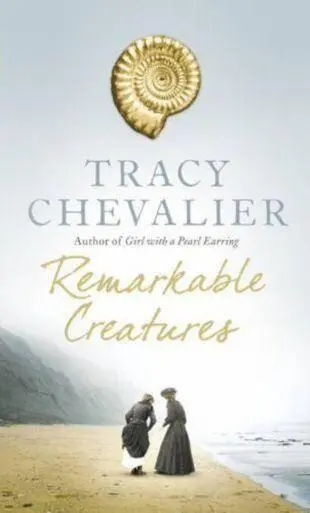
- Название:Remarkable Creatures
- Автор:
- Жанр:
- Год:неизвестен
- ISBN:нет данных
- Рейтинг книги:4 / 5. Голосов: 1
-
Избранное:Добавить в избранное
- Отзывы:
-
Ваша оценка:
Remarkable Creatures: краткое содержание, описание и аннотация
Предлагаем к чтению аннотацию, описание, краткое содержание или предисловие (зависит от того, что написал сам автор книги «Remarkable Creatures»). Если вы не нашли необходимую информацию о книге — напишите в комментариях, мы постараемся отыскать её.
Remarkable Creatures — читать онлайн ознакомительный отрывок
Ниже представлен текст книги, разбитый по страницам. Система сохранения места последней прочитанной страницы, позволяет с удобством читать онлайн бесплатно книгу «Remarkable Creatures», без необходимости каждый раз заново искать на чём Вы остановились. Поставьте закладку, и сможете в любой момент перейти на страницу, на которой закончили чтение.
Интервал:
Закладка:
It was thinking of the cliff and landslips that made me realise who it must be. “Captain Cury?” I remembered now that I had seen him earlier.
Even as the finger wriggled, I saw the handle of his spade, poking out of the clay that had buried him. I was so glad he was there that any spite I felt towards him vanished. “Captain Cury! Mr Buckland’s gone to get help. They’ll be back to dig us out.”
The finger moved, but less than before.
“Was you up on the cliff and come down with the slip?”
The finger didn’t move.
“Captain Cury, can you hear me? Are your bones broke? Fanny’s leg is broke, I think. Mr Buckland’s taken her with him. He’ll come back soon.” I was chattering on to mask my terror.
The finger stayed stiff, pointing up at the sky. I knew what that meant, and begun to cry. “Don’t go! Stay with me! Please stay, Captain Cury!”
Between me and Captain Cury the croc eye watched us both. Captain Cury and I are going to be like the croc, I thought. We will become fossils, trapped upon beach forever.
After a while I stopped looking at Captain Cury’s finger, now as still as any rock caught in the clay. I couldn’t bear to watch the tide steadily rising. Instead I gazed up into the flat white sky, a few pewter clouds swimming about in it. After spending so much of my life looking down at stones, it was strange to look up into emptiness. I spotted a gull circling high above. It seemed it would never get closer, but would always be a dot hovering far away. I kept my eyes fixed on it, and did not look at the finger or the croc again.
It was so quiet I wanted to make a noise to break the spell. I wanted the lightning to pass through me and jolt me into life, for I was feeling the opposite of that sensation-a slow darkness was creeping through my body.
There had been plenty of deaths in our family-Pa and all the children. I spent most of my time collecting what were dead bodies of animals. But I had not thought much of my own death before. Even when I had been visiting Lady Jackson I’d really thought more of her passing than mine, and treating death as a drama to revel in. But dying was no drama. Dying was cold and hard and painful, and dull. It went on too long. I was exhausted and growing bored with it. Now I had too much time to think about whether I was going to die from the tide coming in and drowning me like Lady Jackson, or the mud pressing the air out of me as it had Captain Cury, or a falling rock striking me. I couldn’t think for long or it hurt too much, like touching a piece of ice. I tried to think of God instead, and how He would help me through it.
I never told anyone this, but thinking of Him then didn’t make me less scared.
It was hard to breathe now with the mud so heavy. My breathing got slower, and so did the beat of my heart, and I closed my eyes.
When I come to, someone was digging at the clay round me. I opened my eyes and smiled. “Thank you. I knew you would come. Oh, thank you for coming to me.”
6. A little in love with him myself
You might think saving someone’s life would bind you ever after. That is not what happened with Mary and me. I am not blaming her, but digging her out of the landslip that day, using Captain Cury’s spade and racing against the tide and the rocks that rained down on either side of us, seemed to drive us apart rather than bring us closer.
It was a miracle Mary survived, and intact as well, especially given Captain Cury’s terrible suffocating death just a few feet from her. She had bad bruising up and down her body, but only a few broken bones-some ribs and her collarbone. This kept her in bed a few weeks-not long enough to satisfy Doctor Carpenter, but she refused to convalesce any longer, and soon reappeared on the beach, bound up tightly to keep the bones in place.
I was amazed she was willing to go out hunting again after what she’d been through. Not only that-she did not change her habits, but went back to pacing along the base of the cliffs, where landslips could come down. When I suggested that Molly and Joseph Anning would understand if she did not want to go back to hunting, Mary declared, “I been struck by lightning and buried in a landslip and survived both. God must have other plans for me. Besides,” she added, “I can’t afford to stop.”
On top of her father’s debts, which years later the family was still struggling to clear, they now owed Doctor Carpenter. He was fond of Mary because of their shared interest in fossils, as well as for the pleasure he took from knowing his advice had saved her from the lightning strike. However, he still had to be paid for his care of Mary, and of Fanny Miller as well, as insisted on by her family. The Annings did not challenge this demand. More surprising, they did not expect William Buckland to pay for Fanny’s care; nor would Molly Anning let me write to him about it on their behalf. “He can afford it more than you,” I reasoned when I was visiting Mary to lend her a Bible she wanted to read while she was still in bed. “And it is because of him that Fanny was out on the beach at all.”
Molly Anning did not pause while she counted a pile of pennies from the fossil table sales. “If Mr Buckland felt he ought to pay, he would have offered to before he went back to Oxford. I ain’t going to chase after him for his money.”
“I don’t think he has thought about it one way or the other,” I said. “He is a scholar, not a practical man. If put to him, though, I am sure he would honour the debt and pay Doctor Carpenter-for Mary’s treatment as well as Fanny’s.”
“No.” Molly Anning’s stubbornness revealed a certain pride I had not realised she possessed. She measured most things by the coins they represented and the distance they put between the Annings and the workhouse, but in this instance I believe she understood that money was not the issue. Whether or not William Buckland was involved, the Annings had placed an innocent girl in danger, and effectively crippled her. Fanny could not now expect to marry well, or at all. Her fair looks might make up for a great deal, but most husbands at that working level of society would need a wife who was able to walk a mile. No amount of money could make up for what Fanny had lost. Molly Anning took on the debt as a sort of punishment.
Mary never talked about the half hour she was buried before I found her. But the experience changed her. I often caught in her eyes a faraway expression, as if she were listening to someone calling from the top of Black Ven, or a gull crying out at sea. Death had come and camped next to her on the beach, taking Captain Cury while sparing her, and reminding her of its presence and of her own limits. All of us begin to feel deeply our mortality at some time in our lives, but it is usually when we are older than Mary was then.
Mary’s contact with death also came at a time when she was maturing. One day I helped Molly Anning remove the bandages that had bound Mary’s broken bones, and discovered that under her ill-?tting dress she had a womanly figure, with her waist and breasts and hips all in good proportion. Her shoulders were perhaps a little hunched from her fascination with the ground, and her knuckles were raw, her fingers rough and cracked from use. She was not graceful, as Margaret had been at that age. But she had a fresh, bold presence that could attract men.
She had begun to sense it as well. She took more care to wash her face and hands, and asked Margaret for some of the salve she had concocted to try to save my own hands from the drying force of Blue Lias clay. Made of beeswax, turpentine, lavender and yarrow, it was useful for dressing wounds as well as chapped skin, but Mary wore it on her hands, elbows and cheeks, and I began to associate her with that scent, a curious mixture of the medicinal and the floral.
Читать дальшеИнтервал:
Закладка:
Похожие книги на «Remarkable Creatures»
Представляем Вашему вниманию похожие книги на «Remarkable Creatures» списком для выбора. Мы отобрали схожую по названию и смыслу литературу в надежде предоставить читателям больше вариантов отыскать новые, интересные, ещё непрочитанные произведения.


Обсуждение, отзывы о книге «Remarkable Creatures» и просто собственные мнения читателей. Оставьте ваши комментарии, напишите, что Вы думаете о произведении, его смысле или главных героях. Укажите что конкретно понравилось, а что нет, и почему Вы так считаете.