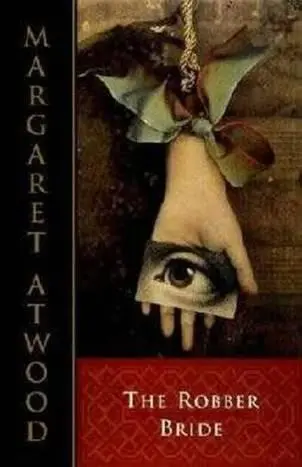
Margaret Atwood - The Robber Bride
Здесь есть возможность читать онлайн «Margaret Atwood - The Robber Bride» весь текст электронной книги совершенно бесплатно (целиком полную версию без сокращений). В некоторых случаях можно слушать аудио, скачать через торрент в формате fb2 и присутствует краткое содержание. Год выпуска: 1993, Жанр: Современная проза, на английском языке. Описание произведения, (предисловие) а так же отзывы посетителей доступны на портале библиотеки ЛибКат.
- Название:The Robber Bride
- Автор:
- Жанр:
- Год:1993
- ISBN:нет данных
- Рейтинг книги:5 / 5. Голосов: 1
-
Избранное:Добавить в избранное
- Отзывы:
-
Ваша оценка:
The Robber Bride: краткое содержание, описание и аннотация
Предлагаем к чтению аннотацию, описание, краткое содержание или предисловие (зависит от того, что написал сам автор книги «The Robber Bride»). Если вы не нашли необходимую информацию о книге — напишите в комментариях, мы постараемся отыскать её.
Even Zenia’s name is enough to provoke the old sense of outrage, of humiliation and confused pain. The truth is that at certain times—early mornings, the middle of the night—she finds it hard to believe that Zenia is really dead.’ Zenia is beautiful, smart and greedy; by turns manipulative and vulnerable, needy and ruthless; a man’s dream and a woman’s nightmare. She is also dead. Just to make absolutely sure Tony, Roz and Charis are there for the funeral. But five years on, as the three women share a sisterly lunch, the impossible happens: ‘with waves of ill will flowing out of her like cosmic radiation’, Zenia is back ...
This is the wise, unsettling, drastic story of three women whose lives share a common wound: Zenia, a woman they first met as university students in the sixties. Zenia is smart and beautiful, by turns manipulative, vulnerable—and irresistible. She has entered into their separate lives to ensnare their sympathy, betray their trust, and exploit their weaknesses. Now Zenia, thought dead, has suddenly reappeared. In this richly layered narrative, Atwood skilfully evokes the decades of the past as she retraces three women’s lives, until we are back in the present—where it’s yet to be discovered whether Zenia’s ‘pure, free-wheeling malevolence’ can still wreak havoc.
reports from the farthest reaches of the sex wars and is one of Margaret Atwood’s most intricate and subversive novels yet.
Exploring the paradox of female villainy, this tale of three fascinating women is another peerless display of literary virtuosity by the supremely gifted author of
and
. Roz, Charis and Tony all share a wound, and her name is Zenia. Beautiful, smart and hungry, by turns manipulative and vulnerable, needy and ruthless, Zenia is the turbulent center of her own neverending saga. She entered their lives in the sixties, when they were in college. Over the three decades since, she has damaged each of them badly, ensnaring their sympathy, betraying their trust, and treating their men as loot. Then Zenia dies, or at any rate the three women—with much relief -- attend her funeral. But as
begins, Roz, Charis and Tony have come together at a trendy restaraunt for their monthly lunch when in walks the seemingly resurrected Zenia...
In this consistently entertaining and profound new novel, Margaret Atwood reports from the farthest reaches of the war between the sexes with her characteristic well-crafted prose, rich and devious humor, and compassion.
The Robber Bride — читать онлайн бесплатно полную книгу (весь текст) целиком
Ниже представлен текст книги, разбитый по страницам. Система сохранения места последней прочитанной страницы, позволяет с удобством читать онлайн бесплатно книгу «The Robber Bride», без необходимости каждый раз заново искать на чём Вы остановились. Поставьте закладку, и сможете в любой момент перейти на страницу, на которой закончили чтение.
Интервал:
Закладка:
DPs meant Displaced Persons. They came from the east, across the ocean; what had displaced them was the war. Roz’s mother said they should consider themselves lucky to be here. The grown-up DPs had odd clothes, dismal and shabby clothes, and strange accents, and a shuffling, defeated look to them. A confused look, as if they didn’t know where they were or what was going on. The children would shout after them on the street: “DP! DP! Go back where you come from!” Some of the older boys would shout “Dog Poop!”
The DPs didn’t understand, but they knew they were being shouted at. They would hurry faster, their heads hunched down into their coat collars; or they would turn around and glare. Roz would join the shouting packs, if she wasn’t near her house. Her mother didn’t like her running around on the street like a ragamuffin, screeching like a pack of hooligans. Afterwards, Roz was ashamed of herself for yelling at the DPs like that; but it was hard to resist when everyone else was doing it.
Sometimes Roz got called a DP herself, because of her dark skin. But it was just a bad name, like “moron,” or—much worse—“bugger.” It didn’t mean you were one. If Roz could get those kids cornered, and if they weren’t too much bigger than she was, she would give them a Chinese burn. That was two hands on the arm and then a twist, like wringing out the wash. It did burn, and it left a red mark. Or else she would kick them, or else she would yell back. She had a temper, said the nuns.
Still, even if Roz wasn’t a DP, there was something: There was something about her that set her apart, an invisible barrier, faint and hardly there, like the surface of water, but strong nevertheless. Roz didn’t know what it was but she could feel it. She wasn’t like the others, she was among them but she wasn’t part of them. So she would push and shove, trying to break her way in.
To school Roz wore a navy tunic and a white blouse, and on the front of the tunic there was a crest with a dove on it. The dove was the Holy Spirit. There was a picture of it in the chapel, coming down from Heaven with its wings outspread, on top of the Virgin Mary’s head, while the Virgin Mary rolled her eyes upwards in a way that Roz’s mother had told her never to do or they might get stuck that way; likewise crossing them. There was a second picture too, the Disciples and Apostles receiving the Holy Spirit at the Feast of Pentecost; this time the dove had red fire around it.
The dove made the Virgin Mary pregnant, but everyone knew that men couldn’t have babies, so the Disciples and Apostles didn’t get pregnant, they only talked in tongues and prophesied. Roz didn’t know what talking in tongues meant, and neither did Sister Conception, because when Roz asked about it Sister Conception told her not to be impertinent.
The Pentecost picture was in the long main corridor of the school, with its creaky wooden floors and smell of goodness, a smell composed of slippery floor wax and plaster dust and incense from the chapel that made a small cool pool of guilty fear collect in Roz’s stomach every time she smelled it, because God could see everything you did and also thought and most of these things annoyed him. He seemed to be angry much of the time, like Sister Conception.
But God was also Jesus, who got nailed to the cross. Who nailed him? Roman soldiers, who wore armour. There they were, three of them, looking brutal and making jokes, while Mary in blue and Mary Magdalene in red wept in the background.
It wasn’t really the Roman soldiers’ fault because they were just doing their job. Really it was the fault of the Jews. One of the prayers in chapel was a prayer for the conversion of the Jews, which meant they would switch over to being Catholic and then get forgiven. In the meantime God was still mad at them and they would have to keep on being punished. That’s what Sister Conception said.
Things were more complicated than that, thought Roz, because Jesus had arranged for himself to be crucified on purpose: It was a sacrifice, and a sacrifice was when you gave your life to save other people. Roz wasn’t sure why getting yourself crucified was such a favour to everyone but apparently it was. So if Jesus did it on purpose, why was it the fault of the Jews? Weren’t they helping him out? A question of Roz’s that went unanswered by Sister Conception, though Sister Cecilia, who was prettier and on the whole nicer to Roz, took a crack at it: a bad deed remained bad, she said, even if the result was good. There were lots of bad deeds that turned out to have good results, because God was a mystery, which meant he switched things around, but humans weren’t in control of that, they were only in control of their own hearts. It was what was in your heart that counted.
Roz knew what a heart looked like. She’d seen lots of pictures of hearts, mostly the heart of Jesus, inside his opened-up chest. They were nothing like Valentines; they were more like the cows’ hearts in the butcher store, brownish red and dotted and rubbery-looking. The heart of Jesus glowed, because it was holy. Holy things glowed in general.
Every sin people did was like another nail pounded into the cross. That was what the nuns said, especially at Easter. Roz was less concerned about Jesus, because she knew it would come out all right for him, than she was about the two thieves. One of them believed right away that Jesus was God, so that one would sit on Jesus’s right hand in Heaven. But what about the other one? Roz had a sneaking sympathy for the other thief. He must have been in just as much pain as Jesus and the first thief, but it wasn’t a sacrifice because he didn’t do it on purpose. It was worse to be crucified when you didn’t want to be. And anyway, what had he stolen? Maybe something small. It never said.
Roz felt that he deserved a place in Heaven, too. She knew something about the seating plan: God in the middle, Jesus to the right of him, the good thief to the right of Jesus. The right hand was the right hand, and you always had to use it to make the sign of the cross, even if you were left-handed. But who sat on the left hand of God? There must have been someone, because God had a left hand as well as a right hand, and nothing about God could possibly be bad because God was perfect, and Roz couldn’t see that side just being left empty. So the bad thief could sit there; he could feast along with the rest. (And where was the Virgin Mary in all of this? Was it a long dinner table, with maybe God at one end and the Virgin Mary at the other? Roz knew enough not to ask. She knew she would be called wicked and impious. But it was something she would have liked to know.)
Sometimes when Roz asked questions the nuns gave her funny looks. Or they gave each other funny looks, pursing their mouths, shaking their heads. Sister Conception said, “What can you expect?” Sister Cecilia took extra time to pray with Roz, when Roz had been bad and needed to do penance after school. “There is more joy in Heaven over the one lost lamb,” she said to Sister Conception.
Roz added sheep to Heaven. They would be outside the window, naturally. But she was glad to know about them. That meant dogs and cats stood a chance, too. Not that she was allowed to have either; they would have made too much trouble for her mother, who had enough things to do as it was.
XLIII
Roz is late coming home from school. She walks by herself, through the failing light, in the snow that is falling, not very much of it, down through the air like tiny white flakes of soap. She hopes the snow will stay around until Christmas.
She’s late because she’s been rehearsing for the Nativity play, in which she is the chief angel. She wanted to be the Virgin Mary, but she’s the chief angel instead because she’s so tall, and besides that she can remember all the lines. She has a white costume with a sparkly gold halo made out of a coat-hanger, and wings of stiff white cardboard with painted gold feather-tips, held on by straps.
Читать дальшеИнтервал:
Закладка:
Похожие книги на «The Robber Bride»
Представляем Вашему вниманию похожие книги на «The Robber Bride» списком для выбора. Мы отобрали схожую по названию и смыслу литературу в надежде предоставить читателям больше вариантов отыскать новые, интересные, ещё непрочитанные произведения.







Обсуждение, отзывы о книге «The Robber Bride» и просто собственные мнения читателей. Оставьте ваши комментарии, напишите, что Вы думаете о произведении, его смысле или главных героях. Укажите что конкретно понравилось, а что нет, и почему Вы так считаете.