Peter Carey - Theft - A Love Story
Здесь есть возможность читать онлайн «Peter Carey - Theft - A Love Story» весь текст электронной книги совершенно бесплатно (целиком полную версию без сокращений). В некоторых случаях можно слушать аудио, скачать через торрент в формате fb2 и присутствует краткое содержание. Год выпуска: 2006, Жанр: Современная проза, на английском языке. Описание произведения, (предисловие) а так же отзывы посетителей доступны на портале библиотеки ЛибКат.
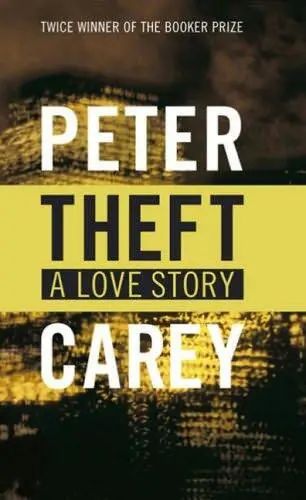
- Название:Theft: A Love Story
- Автор:
- Жанр:
- Год:2006
- ISBN:нет данных
- Рейтинг книги:4 / 5. Голосов: 1
-
Избранное:Добавить в избранное
- Отзывы:
-
Ваша оценка:
Theft: A Love Story: краткое содержание, описание и аннотация
Предлагаем к чтению аннотацию, описание, краткое содержание или предисловие (зависит от того, что написал сам автор книги «Theft: A Love Story»). Если вы не нашли необходимую информацию о книге — напишите в комментариях, мы постараемся отыскать её.
“I don't know if my story is grand enough to be a tragedy, although a lot of shitty stuff did happen. It is certainly a love story but that did not begin until midway through the shitty stuff, by which time I had not only lost my eight-year-old son, but also my house and studio in Sydney where I had once been famous as a painter could expect in his own backyard. . .”
So begins Peter Carey's highly charged and lewdly funny new novel. Told by the twin voices of the artist, Butcher Bones, and his “damaged two-hundred-and-twenty-pound brother” Hugh, it recounts their adventures and troubles after Butcher's plummeting prices and spiralling drink problem force them to retreat to New South Wales. Here the formerly famous artist is reduced to being a caretaker for his biggest collector, as well as nurse to his erratic brother.
Then the mysterious Marlene turns up in Manolo Blahniks one stormy night. Claiming that the brothers' friend and neighbour owns an original Jacques Liebovitz, she soon sets in motion a chain of events that could be the making or ruin of them all.
Displaying Carey's extraordinary flare for language, Theft is a love poem of a very different kind. Ranging from the rural wilds of Australia to Manhattan via Tokyo - and exploring themes of art, fraud, responsibility and redemption - this great novel will make you laugh out loud.
Theft: A Love Story — читать онлайн бесплатно полную книгу (весь текст) целиком
Ниже представлен текст книги, разбитый по страницам. Система сохранения места последней прочитанной страницы, позволяет с удобством читать онлайн бесплатно книгу «Theft: A Love Story», без необходимости каждый раз заново искать на чём Вы остановились. Поставьте закладку, и сможете в любой момент перейти на страницу, на которой закончили чтение.
Интервал:
Закладка:
Having had my own painting ripped apart by morons because a piece of collage was allegedly thirty by twenty-one and a half inches, I was not likely to forget the number.
"See," she said, "the title of this one is Tour en bois, quatre (Woodlathe, number four)."
If I was somehow irritated by this coincidence, I had no good reason to be—artists can do twenty studies for a major work. In fact it was not even a coincidence, but somehow this thing pissed me off.
'Tour en bois," I said. "I know what it means."
"Shoosh, baby. I know you know. But look anyway." Watching her slip on a pair of white cotton gloves you would swear she had spent twenty years working at the Tate. She held the old catalogue in her open palms and sniffed it like a rose. Then, softly, deftly, she brought it back to the grey cloth and Mr.
Utamaro, having gravely bowed, returned this ridiculously ordinary item to its glassine bag.
By now dark had fallen and the cars ran past the window in such a way that the whole wall became like a canvas by the great Jim Doolin who had been driven out of Melbourne in 1966. Now, surely, we could go, but no, we moved to a small alcove where Mr. Utamaro formally refilled my glass and I learned the story of Tour en bois, quatre which had come to Japan as part of an exhibition of works by Dumont, Leger, Leibovitz, Metzinger and Duchamp organised by Mitsukoshi to introduce the Japanese public to cubism. This was in 1913. Mr. Utamaro's father had photographed the paintings and met with M.
Leibovitz himself. And bless me, if there was not one more exhibit—a very solid-looking Japanese gentleman side by side with the old goat in a fancy restaurant with heavy black Empire chairs.
"Do you know who this is, Michael?"
"Of course l don't."
"This is Mr. Utamaro's friend, Mr. Mauri, who bought Tour en bois, quatre in 1913."
I nodded.
"Michael, you know his son."
I don't think so.
"Michael! His son is the gentleman who bought your entire show. I told you," she said, colouring intensely enough for me to realise she was not excited but upset.
"I'm sure you didn't say the name."
"Oh, never mind," she said, and was suddenly fond, stretching out her hand across the table to hold my arm. "So when we do meet him, baby, perhaps he will show us Tour en bois, quatre.'
I looked to Mr. Utamaro and bowed from my chair. I hoped that would be polite enough for a hairy barbarian.
Marlene stood. Mr. Utamaro stood.
Thank Christ, I thought, that's over.
I was, as they say, mistaken.
32
Marlene said, You must be over the moon with your success.
I said it was a damn good feeling. It was a dirty lie, but it is completely unacceptable to tell the truth—that it is very bloody unpleasant to have all your paintings hoovered out of you by strangers. If it had been a museum, OK, that's completely different. But the punter was someone I understood to be a corporate Japanese. Buy the Empire State Building, you're welcome. Take every Van Gogh you want. Have a Leibovitz, why would I care? But what the fuck was this Mr. Mauri going to do with J, the Speaker? The so-called Plaintiff had all the "precommencement" paintings and now this bugger had the rest. Was there a faster way to be erased from history?
All of these nasty ungrateful thoughts I kept buttoned up for at least twelve hours, until, that is, we were sitting on tatami beside forty Japanese men drinking beer and eating raw fish for their breakfast.
When I said the unsayable, Marlene leaned across to touch my butcher hands, and held each ugly sausage finger as if it had been, individually, miraculously, responsible for The Last Supper.
And then, without for a second interrupting this particular series of caresses, she very quietly drew my attention to the benefits of my situation. For instance, she revealed that she had authenticated a Leibovitz for Henry Beigel, a South African millionaire and had learned, in the process, that the fucker had squirrelled away a hundred and twenty-six works by the American painter Jules Olitski. Beigel was a total bastard, she said, but he had an eye, she said, a real eye, and he was slowly driving up Olitski's prices and he, like Mr. Mauri, had been known to buy a damn show.
So, she told me, her very long eyelashes delineated like pen strokes in the ever-present neon light, if you were Jules Olitski you would know your prices were protected and that your best work would end up in a good museum. You would have your future underwritten, not by some flake like Jean-Paul but by an educated, greedy art collector, no-one better.
Fine, yes, Henry Beigel, but Mr. Mauri, who the fuck was he? I did not mean to be abrasive. I was happy, of course I was bloody happy. I was grateful. I loved her, more than the eyelashes and cheeks, her tenderness, her generosity, and—even if this sounds weird—her guile. I was at home with her, with her light, slight body, her bottomless eyes.
That morning, after breakfast, we both returned to the scene of the crime at Mitsukoshi. I expected I would feel better when we entered. We both expected it, I think. But instead my work seemed lost and alien, almost meaningless, like wretched polar bears in a northern Queensland zoo. What did these punters think? I asked a fellow with a blond streak on his head, but that was later, after lunch. I had been drinking, and Marlene shooshed me and we went out in the streets and walked a little, not stopping at the bars.
The faxed invitation from Mr. Mauri was waiting at the so-called Ryokan. It consisted of two pages, the first a delicately drawn map, the second a very formal letter that read like a comic translation from The Government Inspector.
I decided that I would be a gentleman and stay away from Mr.
Mauri.
To this very generous offer, Marlene made no response, not until we were inside our tiny room. Even there she took her time, removed her sandals, and squatted, quietly before the little table.
"All right, Butcher," she said, "time to cut the crap."
She fixed me with her snake eyes.
"First," she said, "this man is a very important collector. Second, I do a lot of business with him. Third, you are not going to disgrace me now."
In my ugly early life this would have been the starting point for a fearsome row which might have run into the early hours of the following day and ended with me alone in some Ukrainian bar at dawn. To Marlene Leibovitz I said, "OK".
"OK what?"
"OK, I won't disgrace you."
I was embarrassed, I suppose, to give in without a fight. I could easily have worked myself into a fury, but when I slipped into my Armani jacket she reached up to tie my tie.
"Oh," she said, "I do love you."
With Marlene I was always in a foreign country.
Of course everyone but me knows about Roppongi. It was here apparently, in High Touch Town, that Mr. Mauri's father had the famous bar where American spies and gangsters and visiting movie stars would hang out all night long. It was Mr. Mauri's father who claimed to have turned the pinball machine Japanese, by setting it on end and—having made sure a lot could fit into a small space—devised a sly system, involving soft stuffed toys and very nicking narrow alleyways, where it became pachinko, a gambling machine. Some dispute this, but no-one argues that Mauri San was both a thug and a very serious art collector, well before the war. The son was filial to a fault. So to enter Mauri's office you had to walk through the ancestral shrine, the bar, the chalkboard menu featuring shitty pizza and Italian meatballs, leftovers from the cowboy years of occupation.
At that hour, before the famous lighting did its trick, Mauri's Blue Bar had all the fusty dullness of a theatre with the house lights on, and it really took a lot of imagination to understand how anyone would pay twenty dollars for a martini in this joint.
Читать дальшеИнтервал:
Закладка:
Похожие книги на «Theft: A Love Story»
Представляем Вашему вниманию похожие книги на «Theft: A Love Story» списком для выбора. Мы отобрали схожую по названию и смыслу литературу в надежде предоставить читателям больше вариантов отыскать новые, интересные, ещё непрочитанные произведения.







Обсуждение, отзывы о книге «Theft: A Love Story» и просто собственные мнения читателей. Оставьте ваши комментарии, напишите, что Вы думаете о произведении, его смысле или главных героях. Укажите что конкретно понравилось, а что нет, и почему Вы так считаете.