Peter Carey - Theft - A Love Story
Здесь есть возможность читать онлайн «Peter Carey - Theft - A Love Story» весь текст электронной книги совершенно бесплатно (целиком полную версию без сокращений). В некоторых случаях можно слушать аудио, скачать через торрент в формате fb2 и присутствует краткое содержание. Год выпуска: 2006, Жанр: Современная проза, на английском языке. Описание произведения, (предисловие) а так же отзывы посетителей доступны на портале библиотеки ЛибКат.
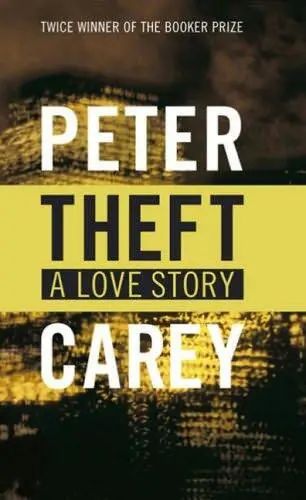
- Название:Theft: A Love Story
- Автор:
- Жанр:
- Год:2006
- ISBN:нет данных
- Рейтинг книги:4 / 5. Голосов: 1
-
Избранное:Добавить в избранное
- Отзывы:
-
Ваша оценка:
Theft: A Love Story: краткое содержание, описание и аннотация
Предлагаем к чтению аннотацию, описание, краткое содержание или предисловие (зависит от того, что написал сам автор книги «Theft: A Love Story»). Если вы не нашли необходимую информацию о книге — напишите в комментариях, мы постараемся отыскать её.
“I don't know if my story is grand enough to be a tragedy, although a lot of shitty stuff did happen. It is certainly a love story but that did not begin until midway through the shitty stuff, by which time I had not only lost my eight-year-old son, but also my house and studio in Sydney where I had once been famous as a painter could expect in his own backyard. . .”
So begins Peter Carey's highly charged and lewdly funny new novel. Told by the twin voices of the artist, Butcher Bones, and his “damaged two-hundred-and-twenty-pound brother” Hugh, it recounts their adventures and troubles after Butcher's plummeting prices and spiralling drink problem force them to retreat to New South Wales. Here the formerly famous artist is reduced to being a caretaker for his biggest collector, as well as nurse to his erratic brother.
Then the mysterious Marlene turns up in Manolo Blahniks one stormy night. Claiming that the brothers' friend and neighbour owns an original Jacques Liebovitz, she soon sets in motion a chain of events that could be the making or ruin of them all.
Displaying Carey's extraordinary flare for language, Theft is a love poem of a very different kind. Ranging from the rural wilds of Australia to Manhattan via Tokyo - and exploring themes of art, fraud, responsibility and redemption - this great novel will make you laugh out loud.
Theft: A Love Story — читать онлайн бесплатно полную книгу (весь текст) целиком
Ниже представлен текст книги, разбитый по страницам. Система сохранения места последней прочитанной страницы, позволяет с удобством читать онлайн бесплатно книгу «Theft: A Love Story», без необходимости каждый раз заново искать на чём Вы остановились. Поставьте закладку, и сможете в любой момент перейти на страницу, на которой закончили чтение.
Интервал:
Закладка:
What a BLESSED RELIEF it turned out to be so far away from the constant raging about art, and all the world trying to prevent my brother having the publicity to which he was entitled. Strange to say, I never knew such peace as camping on the shore of Edgecliff Road, a river in flood, roaring with rubber tyres and bricks and blasphemies.
I truly hoped my brother was happy eating raw fish and fucking himself stupid. His broken promise was his own to suffer beebop, shee-bop, it hurt me not at all.
31
I have said some dreadful things about Business Class, some in print, but I am an artist and I had often need to make myself at home amongst the purchasing class. I let the lackey fill my glass with, as it happened, Tasmanian bloody pinot noir and after the last chocolate and second armagnac Marlene lay her head upon my chest and we slept damn near all the way to Narita. Even with a bursting bladder, I was as weightless as an astronaut.
Of course I would be punished for this trip, but that would be later and this was now and not since the bawling screaming murderous year I ran away to study life drawing at Footscray Tech had it ever once occurred to me that it might be possible to ever be free of my brother's bony elbow, his stinky breath, his sweaty sudden arrivals in the middle of my sleep. During the Boeing's descent, and then through all the wait at Immigration, on the train, through the following days, I continued to feel so high and happy. Forgive me, I did not worry about Hugh. Not for a second did I try to imagine how he felt.
In Tokyo they are intent on concreting themselves to death, but I found the city beautiful, a three-dimensional representation of my neon leaping heart.
As Marlene had predicted, my paintings had been delayed in Sydney while Amberstreet and his fellow geniuses ripped the crates apart. Why else send my paintings to Japan if not to hide a stolen Leibovitz? Go suck my dick!
Of course they failed to find the Tourenbois so they spent a few hundred taxpayers' dollars to crate them up again. By some miracle they didn't hurt my canvases, which I saw unpacked at Mitsukoshi only two days late.
I would normally have driven the gallery nuts with hanging and rehanging, but I found myself agreeing to leave matters in their hands, and for the next three days we did the honeymooner special, and I will spare you the cute postcards of Asakusa, and the cries of the caged birds who staffed the front desk at our hotel. I was happy in Japan, happy with Marlene, happy to wake and look at those clear bright inquisitive, mischievous eyes. lb do the simplest thing with her was a pleasure, to look at anything, to drift, light as gossamer down a lane, to be confused by the labyrinth of Lego-coloured subway symbols, to discuss the gauze of August light falling across the billowing curtains of construction sites. We finally arrived at Mitsukoshi just as the white-gloved greeters began their morning work, and on the thirteenth floor we found my paintings and even if my name was spelled BONE I did not care, even if they had lit each canvas so fastidiously there was no spill of light onto the wall and there was, let us say, a slightly precious decorated element which was a very fucking long way from Bellingen, I did not care. The work could still bite your leg off and spit the crunchy pieces on the floor.
Marlene was so close, a shadow, a touch of sleeve, a whisper of hand, a living breath of kindness on my cheek.
"Do you see that?" she asked me.
"See what?"
"That."
She indicated, I thought, the general way the gallery was arranged—five rooms, nine big canvases, impossible to see more than one work at any time. The numbers and titles were placed away from the work, on the adjoining wall where it was both clearly attached but also separate.
"The titles?"
"You moron, Butcher. Look." Beside each of the titles was a small Japanese character, black on white. "Here," she whispered.
"This is the Japanese version of a red sticker. It means no longer available. Sold, yes. You've sold out, my love."
And there, in the middle of the empty gallery she leaped on me, pinned her legs around my waist.
"Shit."
"Yes, shit. Congratulations."
This was what Amberstreet could not get his provincial little head around. The show was not even open, and I had sold it without a suck-up dinner or dangerous conversation with a critic. This was so much better than Australia. Even in my good years I had never had a sell-out before the drinks were poured and while I kissed her soft, wide mouth, I was—forgive me— doing calculations, multiplying, subtracting. I had two hundred bloody thousand dollars after commission and freight. Just like that.
Later there would be the opening celebration about which there is nothing much to say. Certainly, in the country of Hokusai and Hiroshige I did not expect an introduction by lesbian trick riders, but by then much stranger things had happened.
It was to a printer's shop we went a few days later, carrying a professionally wrapped bottle of Lagavulin. We were to pay our respects to Mr. Utamaro who had printed the catalogue for my show. That was all I knew about him, and that he had his offices at the end of a blank-faced lane in Ikekuburo. God knows what the other buildings were, warehouses or something else—-I have no idea. Mr. Utamaro met us at the lift in a canvas printer's apron and led us into one of those very simple rooms you might normally expect to find at a framer's. His steel windows were so close to the expressway you could see no more than five speeding Hondas at any time.
Below the windows and around the room were deep wooden studio drawers, each one neatly labelled, not in English naturally With infinite courtesy, he removed a poster for Pollock, a catalogue for Matisse, and with the freeway rumbling in our ears, set them carefully upon the pale scrubbed table which occupied the centre of the room.
The old codger was handsome, strangely freckled, with a high forehead from which he swept his mane of silver hair. There was a delicacy in his mouth and a softness to his hands that soon made it clear that he was a great deal more than a common printer. I never, for a second, underestimated him, but he was very hard to understand and—also, by the way—I had not expected an extended visit. It was not until my face was aching from politeness that I helped myself to the second glass of scotch. Well, fuck it, I was Australian. What else was I meant to do?
When the cars on the expressway turned on their lights, we were still stuck with Mr. Utamaro and then the glow of the passing faces, all separated in their own cocoons of life, reminded me of the melancholy parade that cut the Marsh in half on Sunday nights. I topped up my glass again, why not?
Mr. Utamaro rolled down a soft grey cloth on the wooden table and on top of this he placed a glassine bag. Then, having looked up expectantly at Marlene, he slid out a very ordinary brochure, maybe eight inches by six inches, black-and-white, glossy but discoloured with age.
"Michael!" she cried, but although she reached for my hand, what she was looking at was the brochure, on the cover of which was, so I thought, the painting Dozy Boylan had bought years later.
Marlene made a dove noise. "Oh."
Mr. Utamaro bowed.
"Christ," I said. "It's Monsieur et Madame Tourenbois"
Mr. Utamaro smiled.
"No, no, shoosh." Marlene's colour was very high, a sort of aspen pink. She pointed at the title and dimensions which were, in the midst of all the Japanese, in English. "It's a different work," she said.
Well I already knew she had an eye but I have one as well, and I had grown up with a black-and-white reproduction of Monsieur et Madame Tourenbois.
"No, it's the same."
"Yes, darling," and she stroked my hand as if to soften the contradiction. "Except it's smaller. It's twenty-eight by eighteen inches. A study."
Читать дальшеИнтервал:
Закладка:
Похожие книги на «Theft: A Love Story»
Представляем Вашему вниманию похожие книги на «Theft: A Love Story» списком для выбора. Мы отобрали схожую по названию и смыслу литературу в надежде предоставить читателям больше вариантов отыскать новые, интересные, ещё непрочитанные произведения.







Обсуждение, отзывы о книге «Theft: A Love Story» и просто собственные мнения читателей. Оставьте ваши комментарии, напишите, что Вы думаете о произведении, его смысле или главных героях. Укажите что конкретно понравилось, а что нет, и почему Вы так считаете.