Adriana Trigiani - Very Valentine
Здесь есть возможность читать онлайн «Adriana Trigiani - Very Valentine» весь текст электронной книги совершенно бесплатно (целиком полную версию без сокращений). В некоторых случаях можно слушать аудио, скачать через торрент в формате fb2 и присутствует краткое содержание. Жанр: Современная проза, на английском языке. Описание произведения, (предисловие) а так же отзывы посетителей доступны на портале библиотеки ЛибКат.
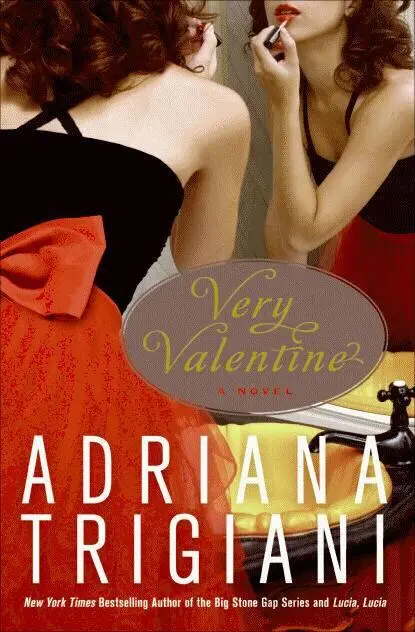
- Название:Very Valentine
- Автор:
- Жанр:
- Год:неизвестен
- ISBN:нет данных
- Рейтинг книги:3 / 5. Голосов: 1
-
Избранное:Добавить в избранное
- Отзывы:
-
Ваша оценка:
Very Valentine: краткое содержание, описание и аннотация
Предлагаем к чтению аннотацию, описание, краткое содержание или предисловие (зависит от того, что написал сам автор книги «Very Valentine»). Если вы не нашли необходимую информацию о книге — напишите в комментариях, мы постараемся отыскать её.
In this luscious, contemporary family saga, the Angelini Shoe Company, makers of exquisite wedding shoes since 1903, is one of the last family-owned businesses in Greenwich Village. The company is on the verge of financial collapse. It falls to thirty-three-year-old Valentine Roncalli, the talented and determined apprentice to her grandmother, the master artisan Teodora Angelini, to bring the family's old-world craftsmanship into the twenty-first century and save the company from ruin.
While juggling a budding romance with dashing chef Roman Falconi, her duty to her family, and a design challenge presented by a prestigious department store, Valentine returns to Italy with her grandmother to learn new techniques and seek one-of-a-kind materials for building a pair of glorious shoes to beat their rivals. There, in Tuscany, Naples, and on the Isle of Capri, a family secret is revealed as Valentine discovers her artistic voice and much more, turning her life and the family business upside down in ways she never expected. Very Valentine is a sumptuous treat, a journey of dreams fulfilled, a celebration of love and loss filled with Trigiani's trademark heart and humor.
Very Valentine — читать онлайн бесплатно полную книгу (весь текст) целиком
Ниже представлен текст книги, разбитый по страницам. Система сохранения места последней прочитанной страницы, позволяет с удобством читать онлайн бесплатно книгу «Very Valentine», без необходимости каждый раз заново искать на чём Вы остановились. Поставьте закладку, и сможете в любой момент перейти на страницу, на которой закончили чтение.
Интервал:
Закладка:
“He had a question about quarterly taxes. That’s all.”
“I figured he already sold the building and the Moishe brothers were on their way to pack us up.”
She sets the paper down on her lap. “You know, Valentine, I’m just trying to do the right thing for my family.”
I’d like to tell Gram that this time the right thing for her family is the wrong thing for the two of us. I’ve met with a real estate agent in the village, and there’s simply no place to move the Angelini Shoe Company that we can possibly afford in the vicinity of Perry Street. The real estate agent found an empty loft space way out in Brooklyn, in an industrial area surrounded by auto-repair shops, a steel factory, and a lumberyard. The thought of moving our shop away from the Hudson River and the energy of Greenwich Village made me so sad, I never even went to look at the space.
“You understand why I’m on edge.” I look out the window.
“Nothing has happened yet.”
I nod. This is vintage Gram, and the very attitude that got us into trouble in the first place. And, I’m afraid I’m just like her. Denial provides temporary comfort, cushioned with hope and bound by luck, it’s a neutral, an emotional state that goes with everything. Years may pass as we wait for the other shoe to drop, and in the meantime? Well, we’re fine . We wait in hope. Denial does no damage until the last minute, when it’s too late to salvage a situation. “I’m sorry. I’m just nervous, that’s all,” I tell her.
As the train pulls into the Forest Hills station, I help Gram stand. Her grip is strong, but her knees are unreliable, and lately, they’re getting worse. It takes her longer to climb the stairs at night, and she’s all but stopped her walks in the Village. I cut an article out of the New York Times about knee replacement and left it by her morning coffee, but when Gram read that there’s a six-week recuperation period, it killed any possibility that she’d actually go in for the surgery. “My knees are good enough,” she insisted. “They got me this far, they can get me to the finish line.” Then she dropped the article into the recycling bin.
We take the escalator up to the street. I don’t know what we would have done if she had to climb the stairs. I might’ve had to throw her on my back like the shepherd carrying the sheep in our Christmas crèche.
We emerge on the sidewalk facing Our Lady Queen of Martyrs Church where I attended mass every Sunday until I went to college. Gram takes my arm as we walk the two blocks to my family homestead.
“You know, sometimes I can’t believe I grew up here,” I say as I take in the old neighborhood.
“When your mother told me that she was moving to Forest Hills after she got married, I almost died. She said, ‘Ma, the fresh air.’ Now, I’m asking you-is this air any better than our air in Manhattan?”
“Don’t forget her pride and joy-her garden and her very own attached garage.”
“That was your mother’s highest aspiration. To park her car where she lived.” Gram shakes her head sadly. “Where did I go wrong?”
“She’s a good mother, Gram, and a fine member of the Forest Hills bourgeoisie.” I take Gram’s arm as we cross the street. “Did she ever rebel?”
“I wish!” barks Gram. “I hoped she’d become a hippie like all the other kids her age. At least that showed some moxie. I told your mother that every generation should take their culture by the collar and shake it. But the only thing your mother wanted to shake were martinis. To tell you the truth, I don’t know where she came from.”
I know what Gram means. I used to pray for a feminist mother. My friend Cami O’Casey’s mother, Beth, was a lean broomstick of a woman, with gray hair at thirty-six, who wore Jesus sandals and pounded her own oatmeal. She worked in a government agency in Harlem and wore cool buttons that said things like KILL YOUR TV SET and I LOVE YOU WITH ALL MY KIDNEY. Instead, I got Hollywood “Mike,” with her wiglets and her tackle box full of makeup and that damned dressing room mirror surrounded by Greta Garbo lightbulbs. Cami’s mother marched for peace while my mom sat around and waited for fishnet hose to come back in style.
To this day, my mother holds up current fashion trends like barbells. She knows when to shelve lime green because purple is the color of the moment. When big hair was huge in the eighties, Mom went for perms. She’d come home kinked, frizzed, and puffy, and when the curls weren’t big enough, she’d throw her head upside down and spray her hair from the roots out until it stood away from her scalp like the rays over the head of Jesus on the Holy Sacrament tabernacle. Sometimes her hair was so big we worried that she might not fit into the car.
I prayed a novena in 1984 so my mother wouldn’t get emphysema from all the hairspray she used. I did a science project on the devastation caused by aluminum chlorofluorocarbons, the powdery stuff in aerosol cans, especially Aqua Net. I showed my mother scientific proof that her beauty regimen could actually kill her. She just patted me on the head and called me “My little Ralph Nader.”
When I wasn’t praying to God to spare her life, I prayed my father wouldn’t get asthma or worse from the secondhand hairspray inhalation. I imagined the entire family dead from the fumes and the police finding us on the floor like a clump of Lincoln logs. When I told my mother my deepest fear, she said, “But when the authorities find us, I bet my hair looks good.”
“Your mother’s been landscaping again,” Gram says as we stand at the foot of the front walk of 162 Austin Street. “It looks like Babylon came to Queens.”
The Roncalli Tudor is freshly painted and shellacked with chocolate brown and off-white trim over the entry porch. There are three brand-new, glossy holly bushes on either side of the entrance. There are two small English-style flower beds where plain grass would ordinarily grow. The plots are crammed with decorative pumpkins, squat autumn cabbages, and the last of the purple impatiens, hemmed in by a slanting brick border on either side of the walk. Three hanging baskets spilling with shiny green leaves are suspended from the portico like the chickens in Chinatown. Over the front windows there’s a United States flag unfurled next to the flag of Italy. The window boxes beneath them are stuffed with red, white, and green foil pinwheels that spin in the breeze. Cars are to Queens Boulevard what flora, fauna, and foil are to my mother’s front yard. Everywhere you look, something is growing or spinning or swaying. My father may be a retired urban park ranger, but my mother has yet to allow him to put down his trowel.
“She doesn’t know when to stop.” Gram takes a step onto the walkway. “I wonder what she spends a year on Miracle-Gro.”
“A lot. The Burpee seed catalog is my mother’s porn.”
“Hi, kids!” Mom pushes the front door open and runs down the sidewalk to greet us. “Ma, you look like a jillion.”
“Thanks, Mike.” Gram gives Mom a kiss on the cheek. “Your garden looks-”
“You know I hate grass. It’s too country.”
Mom wears a long, white, raw-silk tunic with matching white slacks. The deep V neckline of the tunic is studded with flat turquoise beads. Her brown hair is blown straight to her shoulders, revealing extra large, silver hoop earrings. Her shoes, winter white suede mules with four-inch chunky heels, show off her slim ankles. Her left arm, from wrist to elbow, is covered in silver bangle bracelets. She jingles them. “Very Jennifer Lopez, don’t you think?”
“Very,” I tell her.
“I’m making custom omelets. Daddy is doing the French toast thing,” Mom tells us as we climb the stairs. “Everybody is here.”
Читать дальшеИнтервал:
Закладка:
Похожие книги на «Very Valentine»
Представляем Вашему вниманию похожие книги на «Very Valentine» списком для выбора. Мы отобрали схожую по названию и смыслу литературу в надежде предоставить читателям больше вариантов отыскать новые, интересные, ещё непрочитанные произведения.







Обсуждение, отзывы о книге «Very Valentine» и просто собственные мнения читателей. Оставьте ваши комментарии, напишите, что Вы думаете о произведении, его смысле или главных героях. Укажите что конкретно понравилось, а что нет, и почему Вы так считаете.