Malcolm Bradbury - Doctor Criminale
Здесь есть возможность читать онлайн «Malcolm Bradbury - Doctor Criminale» весь текст электронной книги совершенно бесплатно (целиком полную версию без сокращений). В некоторых случаях можно слушать аудио, скачать через торрент в формате fb2 и присутствует краткое содержание. Город: London, Год выпуска: 2000, ISBN: 2000, Издательство: Picador, Жанр: Современная проза, на английском языке. Описание произведения, (предисловие) а так же отзывы посетителей доступны на портале библиотеки ЛибКат.
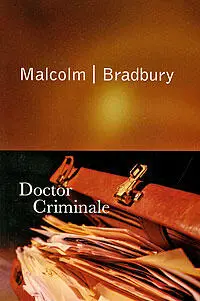
- Название:Doctor Criminale
- Автор:
- Издательство:Picador
- Жанр:
- Год:2000
- Город:London
- ISBN:978-0330390347
- Рейтинг книги:5 / 5. Голосов: 1
-
Избранное:Добавить в избранное
- Отзывы:
-
Ваша оценка:
Doctor Criminale: краткое содержание, описание и аннотация
Предлагаем к чтению аннотацию, описание, краткое содержание или предисловие (зависит от того, что написал сам автор книги «Doctor Criminale»). Если вы не нашли необходимую информацию о книге — напишите в комментариях, мы постараемся отыскать её.
Doctor Criminale — читать онлайн бесплатно полную книгу (весь текст) целиком
Ниже представлен текст книги, разбитый по страницам. Система сохранения места последней прочитанной страницы, позволяет с удобством читать онлайн бесплатно книгу «Doctor Criminale», без необходимости каждый раз заново искать на чём Вы остановились. Поставьте закладку, и сможете в любой момент перейти на страницу, на которой закончили чтение.
Интервал:
Закладка:
For, if I seemed gloomy, Ildiko, sitting across from me, seemed excited. ‘You don’t look happy!’ she said, leaning forward. ‘Of course not,’ I said, ‘I just feel this whole quest is going wrong.’ ‘Because of Codicil and little Miss Black Trousers?’ she asked, ‘You don’t really believe that Criminale Bazlo smuggles cows in his suitcases?’ ‘Of course not,’ I said. ‘Really you should not listen to this lady,’ said Ildiko, ‘She is not a good friend for you.’ ‘She’s not my friend,’ I said. ‘She knows nothing,’ she said,. ‘These people in the European Community like to interfere in everything? Criminale never even thinks about money.’ ‘That’s my impression too,’ I said. ‘Bazlo does nothing wrong,’ said Ildiko, ‘Well, except of course those things you have to do wrong to survive in a Marxist country.’ I looked at her. ‘What do you mean?’ I asked, ‘What things?’ ‘You know, you are so ignorant,’ she said, ‘Those usual things.’ ‘Ildiko, what usual things?’ Ildiko was just about to speak when I put my finger to my lips. The train had stopped at Domodossola near the Swiss border, and I realized that immigration men and probably the finance police as well were coming down the coach. A moment later the door slid open and two men entered, checking our papers with what seemed peculiar care. Then they looked at each other and went. I had a feeling that, no doubt courtesy of Cosima Bruckner, our time of crossing the border was being logged precisely.
Then a very serious-looking Swiss, wearing glasses and a small beard, and carrying a heavy briefcase, got into the compartment. The train moved on; as paradise slipped ever further behind, the Swiss Alpine wonderland began to rise up ahead. High mountains replaced the Lombardy plain, Italian chaos began giving way to Swiss neatness, Italian noise to Swiss silence. Indeed the Swiss in our compartment twice made Ildiko dust down her seat, after he had caught her furtively eating a chocolate bar purchased at Milano Central. We wanted to talk, but the Swiss, who was reading a Geneva newspaper, cast such firm and forbidding glances at us that even conversation came to seem an offence against decency, probably subject to citizens’ arrest. At last Ildiko, ever Ildiko, grew impatient and suggested that we go along to the restaurant car. Leaving the compartment to the Swiss, we set off down the long line of corridors.
Immediately the train plunged into a great gloomy tunnel (I suppose, when I think of it, it must have been the Simplon) and we seemed to be cutting through the chilly core and fundament of the world. Through semi-darkness we groped our way down the coaches to the dining-car. Here all was comfort; white-coated waiters bearing damask napkins flitted, the brass table-lamps gleamed, the white cloths were reflected in the heavy blackness outside, bottles of good wine rattled against the window glass. ‘Steak, please,’ said Ildiko to the waiter, ‘And I think we have the best red wine.’ ‘All right,’ I said, ‘What do you mean, the things you have to do wrong to survive in a Marxist country?’ ‘You really are so ignorant,’ said Ildiko, ‘That is because you live in a country where everything is what it seems.’ ‘Britain?’ I asked, ‘I hadn’t noticed.’ ‘Oh, you British are complaining all the time, you do not like this or that, how you suffer,’ said Ildiko, ‘But at least you can live openly. You can be yourself, have your nice little private life. Nobody spies with you, nobody denounces, you do not have to treat with the regime. And of course you can shop.’
‘Please don’t mention shops,’ I said. ‘Shall I explain you Marxism?’ Ildiko asked, ‘Or did you study it at school? I know you think it is clever and complicate, but really it is very simple. Karl Marx wrote a book called Das Kapital and after that we never had any. And that is a pity because, do you know, money is freedom, Francis.’ ‘Not for everyone,’ I said. ‘Listen, do you know what is the currency in Hungary?’ ‘Yes, the forint,’ I said. ‘No, that is scrap paper, fit only to wipe yourself with in a certain place, if you don’t mind I say so,’ said Ildiko, ‘The same with the zloty, the crown, the lev, the rouble. The currency of Marxism is the American dollar. That was not explained in Marx. But that is what the Party officials at their dachas had, that is why they had their own private food and medicine, why they shopped in the dollar shop, if you don’t mind I mention just one shop. That is why when Western visitors came we stopped them on the street and said, “Change money, change money.” We had to have them, the only way to live was the dollar.’
‘You mean to travel?’ I asked. ‘Please, most of the time you could not travel,’ said Ildiko, ‘Unless you made sports, or belonged to the Party, or liked to keep a little record on your friends. No, with dollar you could live under the table where everything lived. Do you understand?’ ‘Not quite,’ I said. ‘Oh, yes, in Marxism there are always two systems, official, and unofficial,’ said Ildiko, ‘In the official world you are a Party member, or a dissident, you believe in the victory of the proletariat, what a victory, and the heroism of the state. In the unofficial world,, everyone, even the officials, they were someone else. Party members were not Party members, enemies were friends and friends were enemies. You trusted no one but you could trade with everyone. And with dollar you could buy anything: influence, dacha, a job, sex, black-market petrol, travel permit, what you liked. Nothing was what it seemed, nothing was what was said. So every story had two meanings, everyone had two faces.’ ‘Including Criminale?’ I asked.
‘I said everyone,’ said Ildiko, ‘Criminale is an honest man, but he also had to live in such a world. You saw his apartment, you know how he travelled. You read his books, how they go a bit this way, then that.’ ‘I thought so,’ I said, ‘But what did he do?’ ‘Remember, Criminale had one clever thing, the book,’ said Ildiko, ‘And the book, you know, is wonderful. A person always must stay in one place, you can even hold him there. A book can go in the pocket, be on tape, now go down a fax machine. It can change, one language to another, one meaning to another.’ ‘It’s what Roland Barthes said, the reader creates the writer.’ ‘Did Roland also say that it is always the writer who sells and the reader who buys?’ asked Ildiko, ‘You are not paid to read. Unless you are great professor, or maybe a poor publisher like me. But you are paid to write, and if you are famous, all round the world, then you make much money.’ ‘And Criminale made a lot of money?’ ‘Well, why not?’ asked Ildiko, ‘This is how the writer becomes free. Otherwise you are a state writer, that is a hack. If the state doesn’t like you, you sweep the street. You never saw Criminale sweep the street.’
There was suddenly a great burst of light, as we came out of the tunnel and into the Swiss Alpine world. Now we passed by places with names like Plug and Chug, past deep blue lakes and sharp-pointed Alps that shone with snow and ice, beside rivers that roared and plunged with winter rain, through forests that stirred with animals and grim hunting birds, through pine-covered slopes and across deep ravines, through damp clouds of mist and showers of pelting rain. We passed green pastures where the chalet chimneys steamed, dark slopes down which the gravel and boulders slid. ‘You mean Criminale made serious money?’ I asked. ‘Well, he is one of the world’s bestselling intellectual writers,’ said Ildiko, ‘What do you think?’ ‘And the state didn’t mind?’ I asked. ‘Of course, yes,’ said Ildiko, ‘But also it needed Criminale. So it was always necessary to make certain arrangements. His books had to go to the West, some money had to come from the West. There were other things. And always someone had to help him.’
Читать дальшеИнтервал:
Закладка:
Похожие книги на «Doctor Criminale»
Представляем Вашему вниманию похожие книги на «Doctor Criminale» списком для выбора. Мы отобрали схожую по названию и смыслу литературу в надежде предоставить читателям больше вариантов отыскать новые, интересные, ещё непрочитанные произведения.






Обсуждение, отзывы о книге «Doctor Criminale» и просто собственные мнения читателей. Оставьте ваши комментарии, напишите, что Вы думаете о произведении, его смысле или главных героях. Укажите что конкретно понравилось, а что нет, и почему Вы так считаете.