Nick Hornby - Fever Pitch
Здесь есть возможность читать онлайн «Nick Hornby - Fever Pitch» весь текст электронной книги совершенно бесплатно (целиком полную версию без сокращений). В некоторых случаях можно слушать аудио, скачать через торрент в формате fb2 и присутствует краткое содержание. Год выпуска: 1992, ISBN: 1992, Издательство: Victor Gollancz, Жанр: Современная проза, на английском языке. Описание произведения, (предисловие) а так же отзывы посетителей доступны на портале библиотеки ЛибКат.
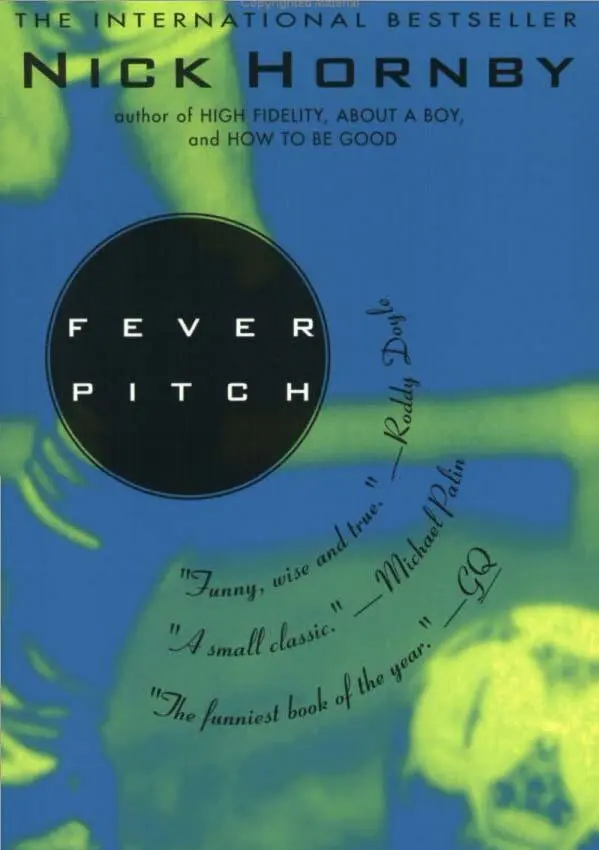
- Название:Fever Pitch
- Автор:
- Издательство:Victor Gollancz
- Жанр:
- Год:1992
- ISBN:0 575 40015 3
- Рейтинг книги:3 / 5. Голосов: 1
-
Избранное:Добавить в избранное
- Отзывы:
-
Ваша оценка:
Fever Pitch: краткое содержание, описание и аннотация
Предлагаем к чтению аннотацию, описание, краткое содержание или предисловие (зависит от того, что написал сам автор книги «Fever Pitch»). Если вы не нашли необходимую информацию о книге — напишите в комментариях, мы постараемся отыскать её.
Nick Hornby has been a football fan since the moment he was conceived. Call it predestiny. Or call it preschool. Fever Pitch is his tribute to a lifelong obsession. Part autobiography, part comedy, part incisive analysis of insanity, Hornby’s award-winning memoir captures the fever pitch of fandom—its agony and ecstasy, its community, its defining role in thousands of young mens’ coming-of-age stories. Fever Pitch is one for the home team. But above all, it is one for everyone who knows what it really means to have a losing season.
Fever Pitch — читать онлайн бесплатно полную книгу (весь текст) целиком
Ниже представлен текст книги, разбитый по страницам. Система сохранения места последней прочитанной страницы, позволяет с удобством читать онлайн бесплатно книгу «Fever Pitch», без необходимости каждый раз заново искать на чём Вы остановились. Поставьте закладку, и сможете в любой момент перейти на страницу, на которой закончили чтение.
Интервал:
Закладка:
I floated through my finals as if I had been anaesthetised with a benign, idiocy-inducing drug. Some of my fellow-students, grey with sleeplessness and concern, were perplexed by my mood; others, the football fans, understood and were envious. (At college, just as at school, there were no other Arsenal fans.) I got my mediocre degree without any undue alarm; and some two months later, when I had come down from the Cup Final win and the end-of-year celebrations, I began to face up to the fact that on the afternoon of 12th May I had achieved most of what I had ever wanted to achieve in my life, and that I had no idea what to do with the rest of it. I was twenty-two, and the future suddenly looked blank and scary.
Filling a Hole
ARSENAL v LIVERPOOL
1.5.80
It is hard for me, and for many of us, to think of years as being self-contained, with a beginning on 1st January and an ending 365 days later. I was going to say that 1980 was a torpid, blank, directionless year for me but that would be wrong; it was 79/80that was these things. Football fans talk like that: our years, our units of time, run from August to May (June and July don’t really happen, especially in years which end with an odd number and which therefore contain no World Cup or European Championship). Ask us for the best or the worst period in our lives and we will often answer with four figures—66/67 for Manchester United fans, 67/68 for Manchester City fans, 69/70 for Everton fans, and so on—a silent slash in the middle of them the only concession to the calendar used elsewhere in the western world. We get drunk on New Year’s Eve, just as everyone else does, but really it is after the Cup Final in May that our mental clock is wound back, and we indulge in all the vows and regrets and renewals that ordinary people allow themselves at the end of the conventional year.
Perhaps we should be given a day off work on Cup Final Eve, so that we can gather together and celebrate. We are, after all, a community within a community; and just as the Chinese have their New Year, when in London the streets around Leicester Square are closed off and the London Chinese have a procession and eat traditional food, and the tourists come to watch them, maybe there is a way in which we can mark the passing of another season of dismal failure, dodgy refereeing decisions, bad back-passes and terrible transfer dealing. We could dress up in our horrible new away shirts, and chant and sing; we could eat Wagon Wheels—the marshmallow biscuit that only football fans eat, because it is only sold at football grounds—and gangrenous hamburgers, and drink warm and luridly orange fizz from a plastic bottle, a refreshment manufactured especially for the occasion by a company called something like Stavros of Edmonton. And we could get the police to keep us standing in … oh, forget it. This terrible litany has made me realise just how awful our lives are for these nine months, and that when they are over I want to live every day of the twelve short weeks available to me as if I were a human being.
For me, 79/80 was a season when football—always hitherto the backbone of life—provided the entire skeleton. For the whole season I did nothing else apart from go to the pub, work (in a garage outside Cambridge, because I could think of nothing better to do), hang out with my girlfriend, whose course lasted a year longer than mine, and wait for Saturdays and Wednesdays. The extraordinary thing was that Arsenal in particular seemed to respond to my need for as much football as possible: they played seventy games that season, twenty-eight of them cup-ties of one kind or another. Every time I gave any indication of becoming more listless than was good for me, Arsenal obliged by providing another match.
By April 1980 I was sick to death of my job, and my indecision, and myself. But just when it began to seem as though the holes in my life were too big to be plugged, even by football, Arsenal’s anxiety to distract me became frenzied: between 9th April and 1st May they played six semi-final games, four against Liverpool in the FA Cup and two against Juventus in the Cup-Winners Cup. Only one of these—the first leg of the Juventus tie—was in London, and so everything revolved around the radio. All I can recall about that entire month is that I worked, and slept, and listened to Peter Jones and Bryon Butler live from Villa Park or Hillsborough or Highfield Road.
I’m not a good radio listener, but then very few fans are. The crowd are much quicker than the commentators—the roars and groans precede the descriptions of the action by several seconds—and my inability to see the pitch makes me much more nervous than I would be if I were at the game, or watching on TV. On the radio, every shot at your goal is heading for the top corner, every cross creates panic, every opposition free kick is right on the edge of the area; in those days before televised live games, when Radio 2 was my only link with Arsenal’s distant cup exploits, I used to sit playing with the dial, switching between one station and another, desperate to know what was going on, but equally desperate not to have to hear. Radio football is football reduced to its lowest common denominator. Shorn of the game’s aesthetic pleasures, or the comfort of a crowd that feels the same way as you, or the sense of security that you get when you see that your defenders and goalkeeper are more or less where they should be, all that is left is naked fear. The bleak, ghostly howl that used to afflict Radio 2 in the evenings was entirely apposite.
The last two of those four semi-finals against Liverpool nearly killed me. In the third match, Arsenal took the lead in the first minute and hung on to it for the next eighty-nine; I sat and stood and smoked and wandered around for the entirety of the second half, unable to read or talk or think, until Liverpool equalised in injury time. The equaliser was like the shot from a gun that had been aimed at my head for an hour, the sickening difference being that it didn’t put an end to it all like a bullet would have done—on the contrary, it forced me to go through the whole thing again. In the fourth game, three days later, Arsenal took the lead once more, which was when I became so fearful that I had to turn the radio off and discovered the talismanic properties of the Buzzcocks. This time, Liverpool didn’t come back, and Arsenal reached their third FA Cup Final in three years; the trouble was that I was almost too wrung-out and jumpy and nicotine-poisoned to care.
Liam Brady
ARSENAL v NOTTINGHAM FOREST
5.5.80
For a year I had lived with the possibility of Liam Brady’s transfer to another club in the same way that, in the late fifties and early sixties, American teenagers had lived with the possibility of the impending Apocalypse. I knew it would happen, yet, even so, I allowed myself to hope; I fretted about it daily, read all the papers scrupulously for hints that he might sign a new contract, studied his onfield relationship with the other players at the club carefully in case it revealed signs of bonds too strong to be broken. I had never felt so intensely about an Arsenal player: for five years he was the focus of the team, and therefore the centre of a very important part of myself, and the consciousness of his rumoured desire to leave Arsenal was always with me, a small shadow on any X-ray of my well-being.
Most of this fixation was easy to explain. Brady was a midfield player, a passer, and Arsenal haven’t really had one since he left. It might surprise those who have a rudimentary grasp of the rules of the game to learn that a First Division football team can try to play football without a player who can pass the ball, but it no longer surprises the rest of us: passing went out of fashion just after silk scarves and just before inflatable bananas. Managers, coaches and therefore players now favour alternative methods of moving the ball from one part of the field to another, the chief of which is a sort of wall of muscle strung across the half-way line in order to deflect the ball in the general direction of the forwards. Most, indeed all, football fans regret this. I think I can speak for all of us when I say that we used to like passing, that we felt that on the whole it was a good thing. It was nice to watch, football’s prettiest accessory (a good player could pass to a team-mate we hadn’t seen, or find an angle we wouldn’t have thought of, so there was a pleasing geometry to it), but managers seemed to feel that it was a lot of trouble, and therefore stopped bothering to produce any players who could do it. There are still a couple of passers in England, but then, there are still a number of blacksmiths.
Читать дальшеИнтервал:
Закладка:
Похожие книги на «Fever Pitch»
Представляем Вашему вниманию похожие книги на «Fever Pitch» списком для выбора. Мы отобрали схожую по названию и смыслу литературу в надежде предоставить читателям больше вариантов отыскать новые, интересные, ещё непрочитанные произведения.







Обсуждение, отзывы о книге «Fever Pitch» и просто собственные мнения читателей. Оставьте ваши комментарии, напишите, что Вы думаете о произведении, его смысле или главных героях. Укажите что конкретно понравилось, а что нет, и почему Вы так считаете.