Janet Fitch - White Oleander
Здесь есть возможность читать онлайн «Janet Fitch - White Oleander» весь текст электронной книги совершенно бесплатно (целиком полную версию без сокращений). В некоторых случаях можно слушать аудио, скачать через торрент в формате fb2 и присутствует краткое содержание. Жанр: Современная проза, на английском языке. Описание произведения, (предисловие) а так же отзывы посетителей доступны на портале библиотеки ЛибКат.
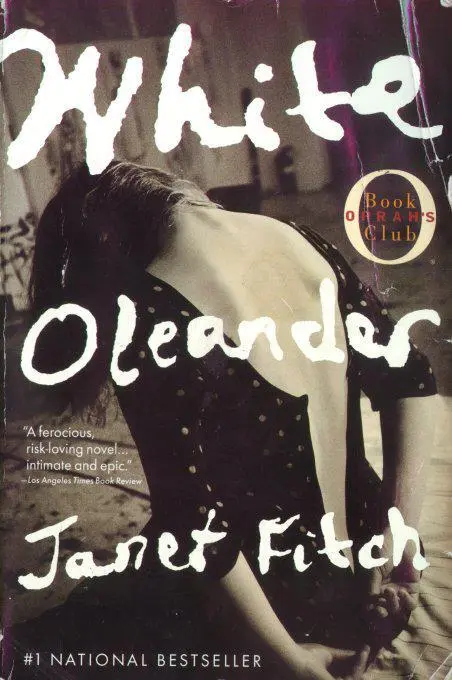
- Название:White Oleander
- Автор:
- Жанр:
- Год:неизвестен
- ISBN:нет данных
- Рейтинг книги:3 / 5. Голосов: 1
-
Избранное:Добавить в избранное
- Отзывы:
-
Ваша оценка:
White Oleander: краткое содержание, описание и аннотация
Предлагаем к чтению аннотацию, описание, краткое содержание или предисловие (зависит от того, что написал сам автор книги «White Oleander»). Если вы не нашли необходимую информацию о книге — напишите в комментариях, мы постараемся отыскать её.
White Oleander — читать онлайн бесплатно полную книгу (весь текст) целиком
Ниже представлен текст книги, разбитый по страницам. Система сохранения места последней прочитанной страницы, позволяет с удобством читать онлайн бесплатно книгу «White Oleander», без необходимости каждый раз заново искать на чём Вы остановились. Поставьте закладку, и сможете в любой момент перейти на страницу, на которой закончили чтение.
Интервал:
Закладка:
“Breathe,” I said in her ear. “Please, Yvonne, try.”
She tried to breathe, a couple of shallow inhalations, but it hurt too much. She flopped back down on the narrow bed, too tired to go on. All she could do was grip my hand and cry. And I thought of the way the baby was linked to her, as she was linked to her mother, and her mother, all the way back, inside and inside, knit into a chain of disaster that brought her to this bed, this day. And not only her. I wondered what my own inheritance was going to be.
“I wish I was dead,” Yvonne said into the pillowcase with the flowers I’d brought from home.
THE BABY CAME four hours later. A girl, born 5:32 P.M. A Gemini. We went home the next day. Rena picked us up at the hospital’s front loop. She refused to come in. We stopped at the observation window in Neonatal, but the baby was already gone. Rena wouldn’t let Yvonne take the baby home even for a few weeks.
“Better just walk away,” Rena had said. “You get attach, a loser game.”
She was right, I thought, as I pushed Yvonne’s wheelchair to the exit, though her motives cared nothing for Yvonne, she just didn’t want to become a foster grandma. She never had any kids, never wanted any. What’s in it for me? “Babies make me sick,” she was always telling Yvonne. “Eat, shit, cry. You think you keep, think again.”
In the hospital driveway, Niki got out of the van, gave Yvonne a bunch of balloons, hugged her. We helped her into the back. She was still tired, she could barely walk. There was a pinched nerve in her left leg, and stitches where the doctor cut her. She smelled sour, like old blood. She looked like she just got hit by a car. Rena didn’t even look at her.
I sat with her in the back on the ripped-out carseat. Yvonne leaned against me, her head on my shoulder. “Sing ‘Michelle,’ ” she whispered.
I held her hand, pressed my other hand against her forehead the way she liked, and sang softly in my tuneless voice as we bounced and clattered along, heading for home. “Michelle, ma belle.” The song seemed to soothe her. She rested her head against my shoulder and quietly sucked her thumb.
WEEKS WENT BY, and there was no call from Susan to let me know when I would see my mother. Now that she’d won my complicity, I heard no more about it. Not in May, not in June. I sat by the river’s edge, watching the white egrets and brown wading birds fish in the current. It was my graduation day over at Marshall High School, but I saw no reason to attend. Even if she were out, my mother would never have come. Ceremonies not of her own invention didn’t interest her. I would rather just let it pass quietly, like a middle-aged woman’s birthday.
The truth was, I was scared, so scared I was afraid to even mention it, like the morning I did the acid. It was a fear that could open its mouth and swallow me whole, like a hammerhead shark in five feet of water. I didn’t know what happened now. I wasn’t headed to Yale or art school, I was going nowhere. I was painting license plate frames, I was sleeping with a thief, he said I could move in with him anytime. Maybe I’d learn to pick locks, hijack a truck. Why should my mother have a monopoly on crime?
I sat by the water, watching it flow, and the egrets preen, their button eyes, thinking about what Mr. Delgado had said in our last class. He said the reason we studied history was to find out why things were the way they were, how we got here. He said you could do anything you wanted to people who didn’t know their history. That was the way a totalitarian system worked.
Who was I, really? I was the sole occupant of my mother’s totalitarian state, my own personal history rewritten to fit the story she was telling that day. There were so many missing pieces. I was starting to find some of them, working my way up-river, collecting a secret cache of broken memories in a shoebox. There was a swan in it, a white wooden swan with long black nares, like the swan on Claire’s frosted shower doors. I sat on the swan and made tinkle for Annie. There were white tile squares on the floor, that I played making shapes out of as I sat there, flowers and houses. They were perfect six-sided hexagonals and they all fit together. Also a yellow kitchen linoleum with a paint-spatter design, red and black, and laundry baskets. That laundry feeling, the smell of dryer. Yellow sunlight through a roll-down blind. My finger through the round pull.
But who was Annie? A friend? A babysitter? And why had she potty-trained me instead of my mother? I wanted to know what was behind the swan and the yellow linoleum. There were other children there, I remembered that, watching them going to school. And a box full of crayons. Did we live with her, or had she left me there?
And Klaus, the silhouette that was my father. We are larger than biography. Where did that leave me? I wanted to know how they met, fell in love, why they split up. Their time together was a battleground full of white stones, grass grown over the trenches, a war I lost everything in and had no way to know what happened. I wanted to know about our traveling years, why we could never go home.
I lay back on the sloped embankment and looked up. It was the best place to look at the sky. The concrete banks blocked out its fuzzy flat edges, where you saw the smog and the haze, and you just got the good part, the center, a perfect bowl of infinite blue. I let myself fall upward into that ultramarine. Not a pale, arctic morning like my mother’s eyes, this blue was tender, warm, merciful, without white, pure chroma, a Raphael sky. When you didn’t see the horizon, you could almost believe it was a bowl. The roundness of it hypnotized me.
I heard someone’s steps coming toward me. It was Yvonne. Her heavy tread, long hair like a sheet of water. I lay back down. She sat next to me.
“Lie down, look at this great sky.”
She lay down next to me, her hands folded across her stomach the way she did when she was pregnant, though the baby was gone. She was quiet, smaller than usual, like a leaf shrinking. A flight of pigeons raced across the rich curved surface of the sky, their wings beating white and gray in unison, like a semaphore. I wondered if they knew where they were going when they flew like that.
I squeezed her hand. It was like holding my own hand. Her lips were pouty, chapped. It was like we were floating here in the sky, cut off from future and past. Why couldn’t that be enough.
A flight of pigeons should be enough. Something without a story. Maybe I should set aside my broken string of beads, my shoeboxes of memories. No matter how much I dug, it was only a story, and not enough. Why couldn’t it just be a heron. No story, just a bird with long thin legs.
If I could just stop time. The river and the sky.
“You ever think of killing yourself?” Yvonne said.
“Some people say that when you come back, you pick up just where you left off.” I took Yvonne’s arm in mine. Her skin was so soft. Her T-shirt smelled of despair, like metal and rain.
“I thought it was your graduation today, ese” she said.
“What’s the point,” I said. “Marching across the stage like ducks in a shooting gallery.”
Yvonne sighed. “If I was you, I’d be proud.”
I smiled. “If you were me, you’d be me. Whoever the hell that is.”
Mrs. Luanne Davis suggested applying to City College, I could transfer anytime, but I’d already lost faith. A future wasn’t something I could forge by myself out of all these broken pieces I had, like Siegfried’s sword in the old story. The future was a white fog into which I would vanish, unmarked by the flourish of rustling taffeta blue and gold. No mother to guide me.
I imagined the lies the valedictorian was telling them right now. About the exciting future that lies ahead. I wish she’d tell them the truth: Half of you have gone as far in life as you’re ever going to. Look around. It’s all downhill from here. The rest of us will go a bit further, a steady job, a trip to Hawaii, or a move to Phoenix, Arizona, but out of fifteen hundred how many will do anything truly worthwhile, write a play, paint a painting that will hang in a gallery, find a cure for herpes? Two of us, maybe three? And how many will find true love? About the same. And enlightenment?Maybe one. The rest of us will make compromises, find excuses, someone or something to blame, and hold that over our hearts like a pendant on a chain.
Читать дальшеИнтервал:
Закладка:
Похожие книги на «White Oleander»
Представляем Вашему вниманию похожие книги на «White Oleander» списком для выбора. Мы отобрали схожую по названию и смыслу литературу в надежде предоставить читателям больше вариантов отыскать новые, интересные, ещё непрочитанные произведения.





Обсуждение, отзывы о книге «White Oleander» и просто собственные мнения читателей. Оставьте ваши комментарии, напишите, что Вы думаете о произведении, его смысле или главных героях. Укажите что конкретно понравилось, а что нет, и почему Вы так считаете.