Peter Matthiessen - Shadow Country
Здесь есть возможность читать онлайн «Peter Matthiessen - Shadow Country» весь текст электронной книги совершенно бесплатно (целиком полную версию без сокращений). В некоторых случаях можно слушать аудио, скачать через торрент в формате fb2 и присутствует краткое содержание. Жанр: Современная проза, на английском языке. Описание произведения, (предисловие) а так же отзывы посетителей доступны на портале библиотеки ЛибКат.
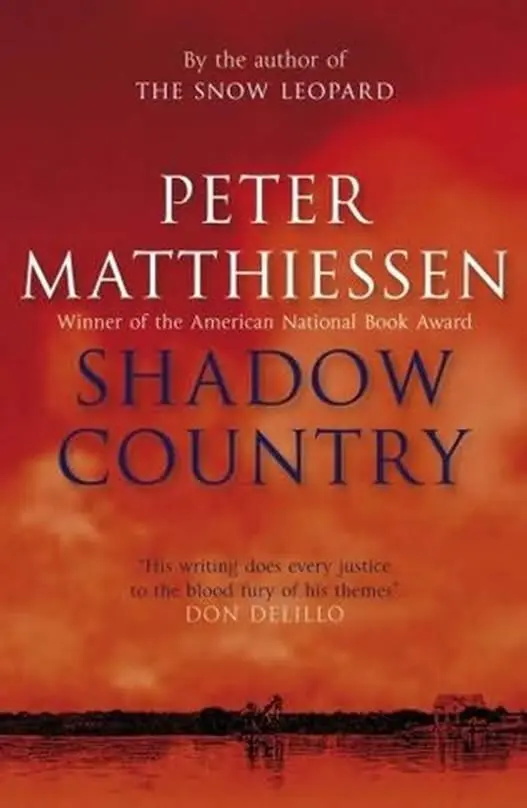
- Название:Shadow Country
- Автор:
- Жанр:
- Год:неизвестен
- ISBN:нет данных
- Рейтинг книги:3 / 5. Голосов: 1
-
Избранное:Добавить в избранное
- Отзывы:
-
Ваша оценка:
Shadow Country: краткое содержание, описание и аннотация
Предлагаем к чтению аннотацию, описание, краткое содержание или предисловие (зависит от того, что написал сам автор книги «Shadow Country»). Если вы не нашли необходимую информацию о книге — напишите в комментариях, мы постараемся отыскать её.
Peter Matthiessen's great American epic-Killing Mister Watson, Lost Man's River, and Bone by Bone-was conceived as one vast mysterious novel, but because of its length it was originally broken up into three books. In this bold new rendering, Matthiessen has cut nearly a third of the overall text and collapsed the time frame while deepening the insights and motivations of his characters with brilliant rewriting throughout. In Shadow Country, he has marvelously distilled a monumental work, realizing his original vision.
Inspired by a near-mythic event of the wild Florida frontier at the turn of the twentieth century, Shadow Country reimagines the legend of the inspired Everglades sugar planter and notorious outlaw E. J. Watson, who drives himself relentlessly toward his own violent end at the hands of neighbors who mostly admired him, in a killing that obsessed his favorite son.
Shadow Country traverses strange landscapes and frontier hinterlands inhabited by Americans of every provenance and color, including the black and Indian inheritors of the archaic racism that, as Watson's wife observed, "still casts its shadow over the nation."
Peter Matthiessen's lyrical and illuminating work in the Watson narrative has been praised highly by such contemporaries as Saul Bellow, William Styron, and W. S. Merwin. Joseph Heller said "I read it in great gulps, up each night later than I wanted to be, in my hungry impatience to find out more and more."
Shadow Country — читать онлайн бесплатно полную книгу (весь текст) целиком
Ниже представлен текст книги, разбитый по страницам. Система сохранения места последней прочитанной страницы, позволяет с удобством читать онлайн бесплатно книгу «Shadow Country», без необходимости каждый раз заново искать на чём Вы остановились. Поставьте закладку, и сможете в любой момент перейти на страницу, на которой закончили чтение.
Интервал:
Закладка:
“Oh heck, let me think back.” She’d been shown the gravestone as a child. As a second cousin, Rob Watson’s mother had been buried in New Bethel churchyard, south of Lake City, not in the family cemetery at Tustenuggee near Fort White. “There’s still a few of us back in those woods,” she sighed, “on our old land grant or what’s left of it. Uncle Edgar lived there, too.” Then she snapped, “I’ve talked too much already,” and hung up. Shortly she rang back: if he was really a history professor, she had decided, he should know the truth. If he promised that Julian Collins in Lake City and Cousin Ed Watson in Fort Myers would never hear about it-and on the condition that he made no mention of “that Tolen business”-the family in Fort White would meet with him the following day. “I’ll be there, too,” she warned.
At the billiards emporium and pool hall, Lucius found Arbie showing off for a lacquered female of uncertain age who sat with one hip cocked on the corner of the table, her cerise bootie dangling and twitching like a fish lure-the only whore in town, Lucius suspected. The archivist turned pool shark, giving Lucius a cool nod, racked his balls and broke the rack with a ferocious shot that left him square behind the eight ball. “Damn fool shot his own dog,” he muttered, walking around the table to inspect the catastrophe from another angle. “Story of my life.”
WATSON DYER
Watson Dyer, seated squarely in the hotel lobby, was a heavyset man but not a fat one, clad in the big suit and damp white shirt favored by politicians. Lucius had only a dim memory of the sullen dark-haired boy at Chatham Bend, yet the adult manifestation was unmistakable. His well-greased hair was slicked back from the high forehead of a moonish face, and white crescents beneath the pupils made his pale blue eyes seem to protrude, though they did not: lacking depth, they appeared to be inset into the skin like stones in hide. Strong brows were hooked down at the corners, hooding those eyes, and the left eyebrow but not the right was lifted quizzically as if in expectation that whoever stood in his way must now get out of it.
“Mr. Dyer? Lucius Watson. And Mr. Arbie Collins.”
Creasing his newspaper, Dyer considered this information, as if how such people were to be addressed was for W. Dyer to decide. His eyes seemed to be closing slowly, as in turtles, and when they opened once again, Lucius noticed a rim of darker blue on the pale pupils, and also a delicate shiver on the skin surface around the mouth, as if this man were fairly trembling with inner rage. When Dyer grinned, which he did rarely and as if by accident, those delicate shivers played like mad under his nose.
“So you’re still calling yourself Watson.” Mustering the meaty good-guy grin of the corporate executive, Watt Dyer pushed himself onto his feet in a waft of shaving lotion, extending a well-manicured hard hand.
“That’s his name,” Arbie said sharply. Though Arbie had more or less shaved for the occasion, Dyer’s hairline was so crisp that the other, by contrast, appeared disheveled; his red neckerchief, lacking its usual flair, made him look raffish, even seedy.
Dyer appraised him. “R. B. Collins, you say?” He took Lucius’s elbow and guided him toward the dining room, letting the disgruntled Arbie fall in behind. “Let’s get things straight,” said Dyer. “The noted historian I’m sponsoring at Naples-the objective authority my sugar folks wish to sponsor-is Professor L. Watson Collins, author of A History of Southwest Florida. ” He strode a ways while that sank in, then summoned Arbie alongside. “Now, boys, I ask you,” he complained, “if a lecture on a controversial figure by a published Florida historian wouldn’t be more… credible ? Than a lecture by his own son? Avoid any suspicion that our author might be… prejudiced ?”
“Our author?” Arbie sneered. “You don’t even know him.”
“I know all about him,” Dyer said in a soft voice, leaning in close for a long moment to peer through Arbie’s eyes into his brain, “and all about you, too, sir. Routine background check,” he added, raising both palms to quell Arbie’s protest. “Standard business practice. Before underwriting a project, you first investigate the background of all participating individuals.”
As for the land claim, Dyer explained that what he required were affidavits from “the Watson boys,” endorsing their father’s title claim to the Chatham property. Meanwhile, the newspaper would cover the Naples meeting where Professor Collins would point out the complete absence of hard evidence that E. J. Watson had ever committed murder. “Next, we encourage petitions to save the historic frontier home of the man who brought the sugarcane industry to Florida-”
“Oh, Lord.” Lucius shook his head. “I never claimed that.”
“He won’t be a party to some con game!” Arbie spat this impudence into Dyer’s face. Those eyes that considered Arbie reminded Lucius of a bear hunt with his father as a boy-the morose animal biding its time until the sudden swipe of long curved claws gutted the dog and left it whimpering, confused by the waning of its life.
Dyer said in an intense cold voice, “Tell me, sir, what is it that you call yourself? R. B.? ”
“None of your damned business.”
“Incorrect, sir. It is very much my business.” Controlling his anger, Dyer frowned at his watch and whacked his leg hard with his newspaper, startling the hostess; she beckoned them inside. Tossing the paper onto the spittoon for someone else to deal with, Dyer strode ahead.
At the table, Lucius produced his synopsis of Arbie’s notes on the Belle Starr case. Dyer skimmed the entire document while the waitress stood there awaiting their order with poised pencil; he sat hunched forward over the table, mantling the papers like a raptor. “A hearing in Arkansas federal court. No indictment. Won’t hurt us a bit.” He slipped the document into his briefcase. “All the same, we have to scrutinize any material in our book that might cast a bad light on our subject.”
Arbie sat arms folded on his chest as if trying to clamp down on chronic twitches. In a silence, he demanded, “What’s in this thing for you?”
“I mean, it must be a lot of work,” Lucius added tactfully. Though annoyed again by that “our book,” he was more annoyed that Arbie was asking questions he should have asked himself.
“Not a blessed thing.” Dyer sat back in his chair to beckon the waitress. “Call it nostalgia for the old family place, call it my sense of fair play.” He spiked the next question before Arbie could ask it. “No fee, no commission. The family won’t owe me one red cent.”
“Well, thank you! That calls for a drink.” Lucius waved the waitress to the table.
“No liquor served here,” Dyer said with satisfaction. “Fine old-fashioned fundamentalist family. ‘God is our Senior Partner’ -got that right there on the menu.” He smiled at the bill of fare. “The cheapest dinners are the best. Deep-fried chicken, deep-fried catfish, crispy and golden-they do it up real nice.”
“Crispy and golden it is,” Lucius muttered, cross about his drink. But just as the waitress fluttered in, Arbie stood up. When Dyer said equably, “Might’s well get your order in,” he stopped short, cocking his head. “You talking to me?” The attorney nodded. That Watt Dyer was so calm in the teeth of the other’s unreasonable hostility was impressive, Lucius thought, and a little scary. “Make mine the Cheap Golden Dinner,” Arbie told the waitress. He moved away among the diners, shoulders strangely high and stiff as if set to ward off a blow.
Lighting a cigar, Dyer shuffled through more pages. “You establish here that Cox was responsible for those last murders. Unlike Cox, E. J. Watson was a solid citizen…”
Читать дальшеИнтервал:
Закладка:
Похожие книги на «Shadow Country»
Представляем Вашему вниманию похожие книги на «Shadow Country» списком для выбора. Мы отобрали схожую по названию и смыслу литературу в надежде предоставить читателям больше вариантов отыскать новые, интересные, ещё непрочитанные произведения.








Обсуждение, отзывы о книге «Shadow Country» и просто собственные мнения читателей. Оставьте ваши комментарии, напишите, что Вы думаете о произведении, его смысле или главных героях. Укажите что конкретно понравилось, а что нет, и почему Вы так считаете.