Peter Matthiessen - Shadow Country
Здесь есть возможность читать онлайн «Peter Matthiessen - Shadow Country» весь текст электронной книги совершенно бесплатно (целиком полную версию без сокращений). В некоторых случаях можно слушать аудио, скачать через торрент в формате fb2 и присутствует краткое содержание. Жанр: Современная проза, на английском языке. Описание произведения, (предисловие) а так же отзывы посетителей доступны на портале библиотеки ЛибКат.
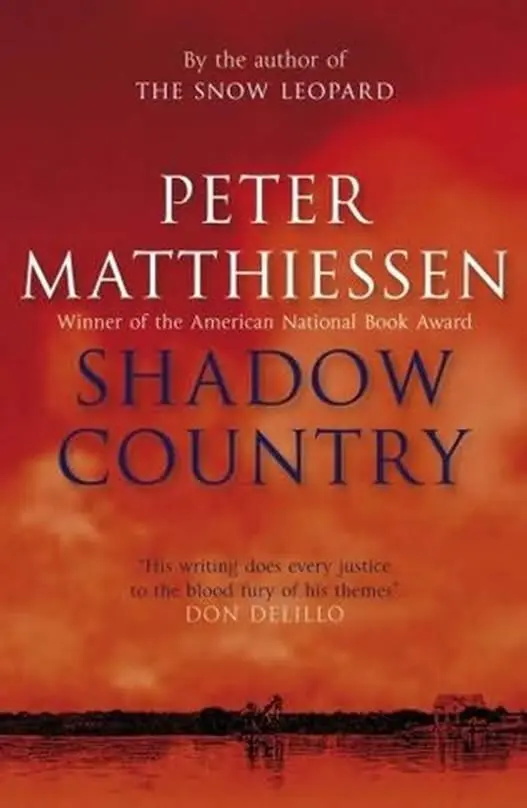
- Название:Shadow Country
- Автор:
- Жанр:
- Год:неизвестен
- ISBN:нет данных
- Рейтинг книги:3 / 5. Голосов: 1
-
Избранное:Добавить в избранное
- Отзывы:
-
Ваша оценка:
Shadow Country: краткое содержание, описание и аннотация
Предлагаем к чтению аннотацию, описание, краткое содержание или предисловие (зависит от того, что написал сам автор книги «Shadow Country»). Если вы не нашли необходимую информацию о книге — напишите в комментариях, мы постараемся отыскать её.
Peter Matthiessen's great American epic-Killing Mister Watson, Lost Man's River, and Bone by Bone-was conceived as one vast mysterious novel, but because of its length it was originally broken up into three books. In this bold new rendering, Matthiessen has cut nearly a third of the overall text and collapsed the time frame while deepening the insights and motivations of his characters with brilliant rewriting throughout. In Shadow Country, he has marvelously distilled a monumental work, realizing his original vision.
Inspired by a near-mythic event of the wild Florida frontier at the turn of the twentieth century, Shadow Country reimagines the legend of the inspired Everglades sugar planter and notorious outlaw E. J. Watson, who drives himself relentlessly toward his own violent end at the hands of neighbors who mostly admired him, in a killing that obsessed his favorite son.
Shadow Country traverses strange landscapes and frontier hinterlands inhabited by Americans of every provenance and color, including the black and Indian inheritors of the archaic racism that, as Watson's wife observed, "still casts its shadow over the nation."
Peter Matthiessen's lyrical and illuminating work in the Watson narrative has been praised highly by such contemporaries as Saul Bellow, William Styron, and W. S. Merwin. Joseph Heller said "I read it in great gulps, up each night later than I wanted to be, in my hungry impatience to find out more and more."
Shadow Country — читать онлайн бесплатно полную книгу (весь текст) целиком
Ниже представлен текст книги, разбитый по страницам. Система сохранения места последней прочитанной страницы, позволяет с удобством читать онлайн бесплатно книгу «Shadow Country», без необходимости каждый раз заново искать на чём Вы остановились. Поставьте закладку, и сможете в любой момент перейти на страницу, на которой закончили чтение.
Интервал:
Закладка:
I shudder like a horse each time I recall it. It’s true. I shudder. The crown of the skull, which I’d always thought was hard, seems to squash under a hammer blow instead of cracking cleanly like an egg. Seeing him fall, the boy cried, “Lo’d God, Zach!” and wet his pants utterly as he sank onto his knees, staring at Zachariah’s kicking feet. Asked if he’d like to pray, he nodded, just to live those extra seconds, and when he bent his head, I felled him. If I’d waited for his prayer, I could not have done it.
Both were still yanking and kicking. Dropping the pistol, leaning forward, hands on knees, I gulped deep breaths. When at last they lay still, I crossed their arms and covered them with marl, then returned in a halftrot to the boat, already fearful that those graves might not be deep enough to hide what I had done and yet too horrified and too exhausted to go back.
I scrubbed myself with rough mud at the river edge, lay stunned on the hard deck. When I sat up, I saw the same brown current ever descending between forest walls. I thought, You have just deprived two human beings of their lives. How can this river and this forest look the same?
At the Bend, I claimed I’d put those cutters on a fishing boat on her way north to Tampa. Unpaid? That’s right. No pay. Any more questions?
Back in the cane field by late afternoon, I worked as a cutter until dusk. That evening, wishing above all not to think, I resorted to the jug, hit myself hard. There is a difference between right and wrong, always was and always will be, but each man’s wrong and each man’s right are different. Just depends, as the old fellers say. Everything depends. What I’d done must have been wrong by my own lights because I’d hated the doing of it and still felt sick to death, no matter how often I insisted to myself that my business and my family’s future and my great plan for developing this southwest coast were simply more important than the loss of two anonymous brown lives, which were, by comparison, inconsequential. Sad but true, as even Mandy would agree. Well? Would she agree? You’re not sure, Mister Watson?
THE TUCKERS
Toward the century’s end, I was drinking much too much and knew it but I did not stop. To make things worse, my Island neighbors (Richard Harden warned me) had grown leery of Ed Watson, which was mostly my own fault. Having understood right from the start that a man who controlled the few pieces of high ground would control the development of this whole island coast, I had not discouraged the bad rumors about Watson, thinking they might scare settlers away. But now those tales were coming back to haunt me, and everything that happened seemed to make them worse.
First there were those accidents. Second, there was low morale due to my drinking. Next, there was trouble with my foreman. Wally Tucker was an inexperienced young man on the run from angry creditors in Key West; he had brought along a young woman of good family, having gone and gotten the girl pregnant. This damned fool waited until harvest to let me know that the field labor was too heavy for his Bet (the same nitwit who’d brought that dying man into my house to stain my floor). Because I would not excuse her from the field-we were already short-handed-he grew sullen, then quit, demanding their back pay. As foreman, he knew that the crew was never paid until after harvest, to make sure no one quit at this crucial time, and anyway, I had no money in the bank until a consignment of our syrup could be sold.
I must have been uneasy about shallow graves, for one night I dreamed I was walking barefoot over squishy whitish marl. Sure enough, within the fortnight, with our dispute still unsettled, young Bet Tucker, slopping hogs at evening, left the gate latch open. All night my animals went rooting through the cane fields and beyond. By the time the Tuckers ran them down next day, they had snuffled out those shallow graves in the woods west of the fields. The corpse whose blue shirt and tin belt buckle the Tuckers recognized was the fired crew boss Zachariah and the second man was his work partner Ted.
Badly frightened, those Tuckers soon convinced themselves that coming on those bodies after threatening to quit had made life very dangerous for them, too. Telling Sonborn they feared for their lives, they had fled in their sloop, after Tucker came in and demanded their money, then backed down.
Sonborn was still trying to defend them. “They were out calling the hogs-”
“Out screwing in the woods!” I roared, jumping up and kicking the chair against the wall. “Whose damn fault was it those hogs got loose in the first place?” Scared and unhappy, Sonborn agreed to forget the whole damn business, never mention it.
Needing food and water, those people got no farther than Richard Harden’s place near Lost Man’s River. The Hardens felt sorry for ’em, helped ’em build a shack on the island in the river mouth, as I discovered a month later when I made an offer for the quit-claim to that key to the Atwells up in Rodgers River. I told Winky Atwell to run those damn conchs off my property but Tucker refused to go without their salaries. I suspected that Tucker was already spreading tales about Ed Watson, since he muttered to Winky that he had a good mind to report me to Key West, so his response enraged me.
Whenever someone threatens to tell tales on me, get me in trouble, a taste of iron comes into my mouth and my hand hardens in a rage that spins up from the oldest corner of my brain. “Go away,” I told Josie Jenkins, spying through the door. “Just stay away from me.”
Through the window-he did not venture inside-that son of mine was pestering me. He would not let it go: Atwells sold that key right out from under ’em, he protested, with Bet having her baby any day now. “Settle with him, Papa! Maybe he’ll keep quiet!”
“What? Keep quiet about what ?”
Sonborn never did know when to stop for his own good. “Why do you act like it’s all Wally’s fault? You think he killed Ted and Zachariah?” He was half outraged and half scared to death, but in the end, he needed my approval. And for some damned reason I believe that he also wanted to protect me, when the one he should have protected, as I was still too blind to see, was not his maddened father but himself.
Too much had gone wrong and too much was at stake but instead of acting I kept drinking. Sometime after that, I must have fallen.
Who was speaking? Who was I and where? I could not rise, could not even roll over, being bound up in hard pain by molten chains.
A late afternoon sun shaft scorching my temple. A silhouette in the river window. Sonborn watching. Sonborn waiting. Sonborn plaguing me with his life loss. Son Born, go fuck yourself, I lost her, too, I told the silhouette. You are my nemesis, you know what that is, Sonborn? And the silhouette screeched, Papa, don’t call me that again or I will kill you!
Threatening his father upset him worse than it did me. He said, “Forgive me,” said he loved me- used that word ! A man twenty years old! “Get out of my sight,” I said. Get out of my damned life is what I meant.
He must have hated me for hating him. Was that why he took the Tuckers’ side? For all I knew, he had put them up to leaving and never awakened me in time to stop them.
Josie’s baby girl-mine, she insists-was yawling in the kitchen. Josie whispered at the door, “It’s New Year’s Eve.” I drank. “Stay away,” I said.
Most times when I drink, like any man, I flirt with trouble. Might pick a fight, shoot out the lights, smash something up out of the energy of life, just for the hell of it-just for the fun of breaking! The fucking glee of it! Or not so much glee as some queer ecstasy that releases itself in senselessness, ever feel that? Some union with this life through destruction that whirls a man free of his doomed puny self like the force that drove those mullet upward through the river surface on that evening at the Bend, and Mandy so moved by those silver shapes skipping aloft for that one hopeless instant, only to fall back with that tiny slap into the cold jaws of that dark water.
Читать дальшеИнтервал:
Закладка:
Похожие книги на «Shadow Country»
Представляем Вашему вниманию похожие книги на «Shadow Country» списком для выбора. Мы отобрали схожую по названию и смыслу литературу в надежде предоставить читателям больше вариантов отыскать новые, интересные, ещё непрочитанные произведения.









Обсуждение, отзывы о книге «Shadow Country» и просто собственные мнения читателей. Оставьте ваши комментарии, напишите, что Вы думаете о произведении, его смысле или главных героях. Укажите что конкретно понравилось, а что нет, и почему Вы так считаете.