Peter Matthiessen - Shadow Country
Здесь есть возможность читать онлайн «Peter Matthiessen - Shadow Country» весь текст электронной книги совершенно бесплатно (целиком полную версию без сокращений). В некоторых случаях можно слушать аудио, скачать через торрент в формате fb2 и присутствует краткое содержание. Жанр: Современная проза, на английском языке. Описание произведения, (предисловие) а так же отзывы посетителей доступны на портале библиотеки ЛибКат.
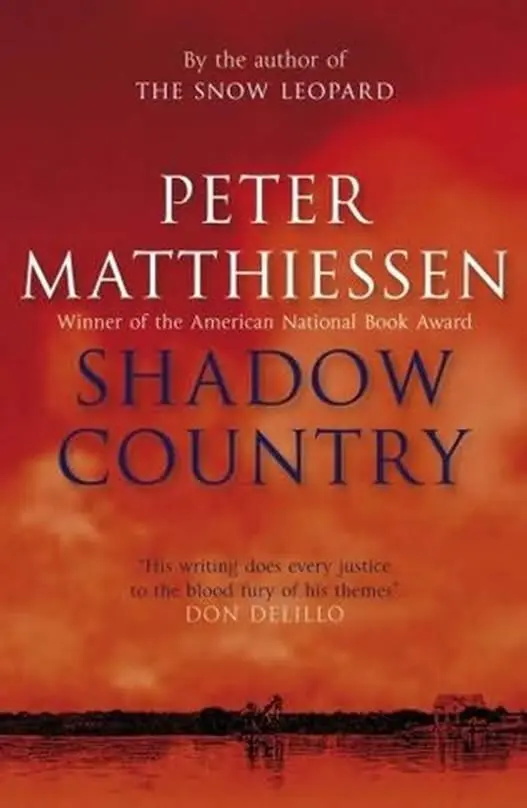
- Название:Shadow Country
- Автор:
- Жанр:
- Год:неизвестен
- ISBN:нет данных
- Рейтинг книги:3 / 5. Голосов: 1
-
Избранное:Добавить в избранное
- Отзывы:
-
Ваша оценка:
Shadow Country: краткое содержание, описание и аннотация
Предлагаем к чтению аннотацию, описание, краткое содержание или предисловие (зависит от того, что написал сам автор книги «Shadow Country»). Если вы не нашли необходимую информацию о книге — напишите в комментариях, мы постараемся отыскать её.
Peter Matthiessen's great American epic-Killing Mister Watson, Lost Man's River, and Bone by Bone-was conceived as one vast mysterious novel, but because of its length it was originally broken up into three books. In this bold new rendering, Matthiessen has cut nearly a third of the overall text and collapsed the time frame while deepening the insights and motivations of his characters with brilliant rewriting throughout. In Shadow Country, he has marvelously distilled a monumental work, realizing his original vision.
Inspired by a near-mythic event of the wild Florida frontier at the turn of the twentieth century, Shadow Country reimagines the legend of the inspired Everglades sugar planter and notorious outlaw E. J. Watson, who drives himself relentlessly toward his own violent end at the hands of neighbors who mostly admired him, in a killing that obsessed his favorite son.
Shadow Country traverses strange landscapes and frontier hinterlands inhabited by Americans of every provenance and color, including the black and Indian inheritors of the archaic racism that, as Watson's wife observed, "still casts its shadow over the nation."
Peter Matthiessen's lyrical and illuminating work in the Watson narrative has been praised highly by such contemporaries as Saul Bellow, William Styron, and W. S. Merwin. Joseph Heller said "I read it in great gulps, up each night later than I wanted to be, in my hungry impatience to find out more and more."
Shadow Country — читать онлайн бесплатно полную книгу (весь текст) целиком
Ниже представлен текст книги, разбитый по страницам. Система сохранения места последней прочитанной страницы, позволяет с удобством читать онлайн бесплатно книгу «Shadow Country», без необходимости каждый раз заново искать на чём Вы остановились. Поставьте закладку, и сможете в любой момент перейти на страницу, на которой закончили чтение.
Интервал:
Закладка:
Mostly Black Frank was silent as a knothole. When I asked him finally why he talked so much, he grinned, a little sheepish, saying he was grieving in advance for the faithless woman whom he meant to murder. He had tracked her “sweet man” to Arkansas-that was how he ended up in federal prison-and now he was headed home to Memphis to finish up the job. “Man got his honor to think about, Mist’ Jack,” he said. (For a fugitive, a new identity made sense. I had already changed my name to E. Jack Watson.)
“To err is human, to forgive divine,” I preached, thinking not to confuse this teaching with the news that I was on my way to South Carolina to kill my father.
“Well, maybe I might forgive that nigguh bitch after I got her good and dead but I ain’t promisin.” We chuckled a good while over that one.
Scavenging, traveling at night, we rode toward Memphis. But we were fugitives and one of us was white; in Memphis, we would draw too much attention. A nigra in a white man’s company was one thing but a white drifter in niggertown was quite another. Not that I didn’t trust this man. I did. All the same, my destination and my plans were my own business. If Frank got captured knowing where Watson might be headed, the law was duty bound to whip it out of him.
Frank and I had talked a lot about white men and blacks. If a black man sasses me-well, I won’t tolerate it, I told him. But as far as joking, passing the time of day, making sure he gets his feed and some fair treatment, I believe I can say I have done better by the nigras-or coloreds or darkies, or whatever Mandy calls ’em-than most of those damn-Yankee hypocrites who agitated so hard for emancipation, then abandoned ’em after ’76 and got so many killed when they turned their backs on their own Reconstruction.
That detachment of Union soldiers quartered at Edgefield in my boyhood-hell, those bluecoats had no feel for nigras, besides being so scared of the hating faces of our home people. They wanted so bad to get along that they cat-called louder than the townfolks at those gussied-up blacks in yeller boots who had the vote and called themselves Americans. The bluecoats never raised a hand to stop the Regulators, not even after a sniper shot a bluecoat, left him kicking in the dust on Court House Square. Their officer never stepped into the square, much less organized his men to hunt the killer, although he probably knew as well as everybody else that it was Will Coulter.
We parted company at the Black River. “Well, Frank, good luck,” I said abruptly at the fork, turning my horse off toward the north. I always thought Frank Reese was pretty hard and I still do, but plainly I took him by surprise and hurt his feelings if he had any. He didn’t answer and he didn’t wave, just sat his horse in the deep shadow of the river woods and watched me go. He wasn’t sulking, either. He expected no better out of life. As he once told me, matter-of-fact, “I ain’t nothin but a damn ol’ nigger. I got nothin comin.”
But this man and I had escaped together, we had swum the river. He wasn’t just any old nigger, he was my partner. I rode back, stuck my hand out, wished him all the best. First time in my whole damned life I ever offered my hand to a black man. And he didn’t take it, not till he looked me over and even then there was an awkward pause. When he finally produced a limp cool hand, he let me do the shaking and that riled me.
I rode away but in a while I turned to see if Reese was still there under the trees. He hadn’t moved. His face looked like a block of hard dark wood. I waved but he never twitched, not even to touch his hat brim. I rode back. I warned him how that kind of insolence might draw attention in Memphis, where the law would be on the lookout for a fugitive. If he wanted a fresh start in life, he could ride southeast to Columbia County, Florida, where my friend Will Cox might find him work. I was careful not to say that I might turn up there myself before the year was out.
He nodded but he didn’t thank me, didn’t even answer. I had nothing more to say, yet I didn’t go. We sat our horses by the river in the cool spring wind, watching long strings of brown cranes coming up across the country from the south. I reckon we were awaiting something that might mend our mood. Finally, I said, “Well, so long, Frank,” and turned my horse away. I never looked back. Maybe that man lifted his hat, maybe he didn’t.
THE SHADOW COUSIN
I rode across the backlands of America, south of the south border of Tennessee. The mountain folk were suspicious of lone riders, and I had to shoot more than one mean hound along the way. Hunting my supper from the saddle, I could not afford to waste my loads, and by the end, I rarely missed with that revolver. I took squirrel, turkey, and one fawn, a red grouse, here and there a rabbit.
Crossing the hinterlands, I took shelter in many a dirt-floor hut on nights of rain, but even where the people weren’t half-starved, I gagged down grub that would tumble the guts of an old turkey buzzard, sowbelly and grits slimy with lard, old corn bread dead as seed-bin dust, half-rotten potatoes boiled down to a reeking gruel. And even where these frontier folk weren’t too shiftless to step outside and trap or shoot, that wild meat was gulped down shiny purple raw or fried to a hard chip. Few troubled to catch the bream and trout that gleamed in every branch and pond throughout the backcountry.
One day, after twenty years of exile, I rode over the Great Smokies into Carolina. I was torn and filthy and outlandish, I was restless and excited, also unclear and uneasy about what I had come so far to do. However, as a Clouds Creek Watson, I still thought of myself as an honorable man who kept his word, and having promised my father I would take his life, I aimed to do it.
Years ago, arriving in Fort White, Florida, the Herlongs had brought word that Elijah D. Watson was still kicking up trouble around Edgefield Court House. Before tracking him down-probably I was stalling-I was curious to learn what that trouble might have been. Dismounting at the horse trough near the hotel, I crossed the courthouse square to the Archives Library, which kept records of our prominent county families. In these close quarters, in the stuffy air, I was offended by my own badgerish stink and beggar’s rags, but the elderly librarian, Miss Mims, quiet and courteous, pretended to take no notice of my condition as she came and went, fetching me documents.
From estate transactions in the county records and miscellaneous information in the Watson family file, I discovered that my father had pissed away far more inheritance than I ever knew. I had scarcely digested this when a very large lady came barging through the door, waving her cane at me even as she entered. From the librarian’s resigned expression, it was plain to see that this personage accosted every visitor she chanced to spot as they entered the library.
My great-aunt Sophia Boatright-for it was she-was elderly now, the last holdout of Grandfather Artemas’s generation. In pink bonnet and raspberry gown, she looked like a giant peony, and her perfume was no doubt powerful enough to block my scent. “It’s always gratifying to see manners, my good man,” Aunt Sophia snapped, as I hunched over my documents, “but you needn’t stand up on my account.” Laying her hand upon my shoulder, she pressed me down like a jack-in-the-box, the better to scan my reading matter. “Aha!” she said. “Since you, sir, no doubt”-she leaned to inspect me closer-“are a stranger in these parts, you might not know all that you should about some of our great Edgefield heroes, the earliest of whom was my forebear.” She tapped the page and there he was, the deathless Captain Michael. “Do you know who else was born in Edgefield? William Travis, hero of the Alamo, and Lewis Wigfall, who led South Carolina’s secession as ‘the flagship of the Confederacy,’ and almost every governor this state has had!” She drew from her large reticule a worn copy of an editorial from the Charleston News and Courier, which she spread on top of my reading matter on the table.
Читать дальшеИнтервал:
Закладка:
Похожие книги на «Shadow Country»
Представляем Вашему вниманию похожие книги на «Shadow Country» списком для выбора. Мы отобрали схожую по названию и смыслу литературу в надежде предоставить читателям больше вариантов отыскать новые, интересные, ещё непрочитанные произведения.









Обсуждение, отзывы о книге «Shadow Country» и просто собственные мнения читателей. Оставьте ваши комментарии, напишите, что Вы думаете о произведении, его смысле или главных героях. Укажите что конкретно понравилось, а что нет, и почему Вы так считаете.