Peter Matthiessen - Shadow Country
Здесь есть возможность читать онлайн «Peter Matthiessen - Shadow Country» весь текст электронной книги совершенно бесплатно (целиком полную версию без сокращений). В некоторых случаях можно слушать аудио, скачать через торрент в формате fb2 и присутствует краткое содержание. Жанр: Современная проза, на английском языке. Описание произведения, (предисловие) а так же отзывы посетителей доступны на портале библиотеки ЛибКат.
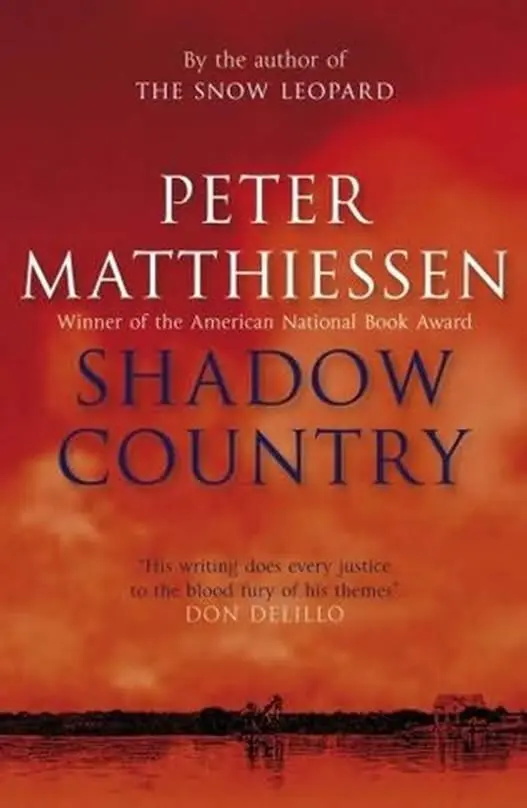
- Название:Shadow Country
- Автор:
- Жанр:
- Год:неизвестен
- ISBN:нет данных
- Рейтинг книги:3 / 5. Голосов: 1
-
Избранное:Добавить в избранное
- Отзывы:
-
Ваша оценка:
Shadow Country: краткое содержание, описание и аннотация
Предлагаем к чтению аннотацию, описание, краткое содержание или предисловие (зависит от того, что написал сам автор книги «Shadow Country»). Если вы не нашли необходимую информацию о книге — напишите в комментариях, мы постараемся отыскать её.
Peter Matthiessen's great American epic-Killing Mister Watson, Lost Man's River, and Bone by Bone-was conceived as one vast mysterious novel, but because of its length it was originally broken up into three books. In this bold new rendering, Matthiessen has cut nearly a third of the overall text and collapsed the time frame while deepening the insights and motivations of his characters with brilliant rewriting throughout. In Shadow Country, he has marvelously distilled a monumental work, realizing his original vision.
Inspired by a near-mythic event of the wild Florida frontier at the turn of the twentieth century, Shadow Country reimagines the legend of the inspired Everglades sugar planter and notorious outlaw E. J. Watson, who drives himself relentlessly toward his own violent end at the hands of neighbors who mostly admired him, in a killing that obsessed his favorite son.
Shadow Country traverses strange landscapes and frontier hinterlands inhabited by Americans of every provenance and color, including the black and Indian inheritors of the archaic racism that, as Watson's wife observed, "still casts its shadow over the nation."
Peter Matthiessen's lyrical and illuminating work in the Watson narrative has been praised highly by such contemporaries as Saul Bellow, William Styron, and W. S. Merwin. Joseph Heller said "I read it in great gulps, up each night later than I wanted to be, in my hungry impatience to find out more and more."
Shadow Country — читать онлайн бесплатно полную книгу (весь текст) целиком
Ниже представлен текст книги, разбитый по страницам. Система сохранения места последней прочитанной страницы, позволяет с удобством читать онлайн бесплатно книгу «Shadow Country», без необходимости каждый раз заново искать на чём Вы остановились. Поставьте закладку, и сможете в любой момент перейти на страницу, на которой закончили чтение.
Интервал:
Закладка:
Day after day, the strange smells and hidden voices of the passing wilderness, seeking to draw me back into my life, had passed unheeded. And then one day I awoke to find the earth colors returned and “the whole Creation” come alive and clear. As the dark withdrew, the forest stood forth in a light of revelation, and sunrise leaves sparkled and spun, breathing a fresh wind from the west, off the Gulf of Mexico, and I jumped up with a laugh that startled poor Ninny-Minnie. Wasn’t I young and able-bodied, able-minded, too? One day I would go home to reclaim Clouds Creek, but meanwhile a virgin land was opening before me. We should reach our destination, the bargeman said, in time for the spring planting.
Here and there, rounding a bend, the barge surprised brown-skinned people on the banks, crouched back like wildcats caught out in the open. The Cherokees who were chastised by my ancestors were almost gone from upland Carolina, though a few still lurked in remote regions; these Creeks were the first wild men I had ever seen. The women and young would rush into the reeds or flee through the shadows of the great live oaks which spread their heavy limbs over the clearings, but the grown men and older boys, drifting out of gun range, would pause at the forest edge to watch the intruders over their shoulders, in the way of deer; I was awed by the stillness in them even when they moved. They were set to run, they had to be. The bargeman told us that bored, drunken travelers would pass the time blazing away at every furred and feathered bit of life along the river, and would sometimes shoot close to these people’s feet “to see them redskins dance,” which was why, at the first glint of metal, the wild folk withdrew into the shadows until the intruders were gone around the bend and the forest silences regathered.
I never greeted them, having learned that lesson when even the smallest child among them refused to acknowledge frantic Minnie, though she waved and waved. “Why don’t they wave back?” she cried, desperately hurt. I said roughly, “They fear and despise us. Why should they wave?” These wild ones came down from those Muskogee Creeks that Ol’ Hickory had chased south out of Georgia, said the bargeman, and most of them were never seen at all, easing down into hiding at the sound of our approach, watching us pass.
These hinterlands, so distant from the settlements, remained uncultivated and unhunted. The bargeman said that in Spanish times, when a road was opened from St. Augustine on the Atlantic coast to Pensacola on the Gulf, there were still buffalo in these savannas, and also the great jaguar, called tigre, and panthers, bears, and red wolves were still common. Sometimes, at night, shrill screams scared Mama and poor Ninny half to death-not white females being violated by naked savages as they imagined but panthers mating, the bargeman assured Mama, who recoiled from this man’s vulgar liberty. Bull gators coughed and roared back in the swamps, and once there came a lonely howl that he identified as the red wolf. Flocks of huge black fowl in the glades were bronze-backed turkeys, and everywhere, wild ducks jumped from the bulrushes and reeds, shedding bright water. I shot big drakes and gobblers for provisions and pin-hooked all the fresh fish we could eat. Pairs of great woodpeckers larger than crows, with flashing white bills and crimson crests afire in the sun, crossed the river in deep bounding flight, and hurtling flocks of small longtailed parrots, bright green as new leaves in the morning light. The wild things were shining with spring colors and new sap and finally I was, too. I would sink my teeth into this morning land like a fresh peach.
The river barge was warped ashore where a tributary, the Santa Fe, joins the Suwannee-the confluence of the Echo and the Holy Faith, I informed the women. (Spanish Catholics! snapped Mama, worn out by her journey and on the lookout for the smallest cause to be indignant.) De Soto and his men, more exhausted and discouraged by the heat and insects than by Indian attacks, had called it the River of Discord, whereas to the Indians, the river was sacred mystery, vanishing quite suddenly into the earth-no suck or swirl, just gone away under the ground. Perhaps because the red-skinned devils had made life Hell for the first settlers, those folks imagined they had found the source of the River Styx, deep in the Underworld, and few had persevered long enough to learn that the current surfaced a few miles downstream as a beautiful blue spring in the forest.
While the barge continued on to Branford Landing, I chose to explore the country before meeting the women at Ichetucknee Plantation. Hollering good-bye to all to insure attention, I rode my big roan off that barge as she touched shore-a staccato clatter sharp as rifle fire as the horse balked, then a mighty gathering of haunches and great leap and splash and upward heave onto the bank. These heroics, alas, were spoiled by the hydraulics of my stallion, which lowered its nozzle to release a stream of piss even while it rid itself of gas, hightailing off in a grand salute of horse farts and manure as the women’s cries of admiration turned to giggles, but finally all cheered as grim young Edgar was actually seen to laugh. Minutes later, in my own company at last, I could not stop grinning, feeling nearidiotic with anticipation.
The river trail ran north along the “Santa Fee” (as backcountry Floridians still call it), which descends from a dry sandy land of piney woods and scrub oak to the cypress sink where it is drawn beneath the earth. Farther upriver, the trail turned off along the Ichetucknee, a crystal stream with blue water so clear that streaming underwater weeds like turquoise eels swim endlessly over white sand.
ICHETUCKNEE
The Ichetucknee post office and trading post (also the blacksmith shop and gristmill) was six miles up this woodland stream, on the east bank of the Mill Pond spring and only a few miles from Fort White, in Columbia County. The proprietor, a small quick man named Collins, was eager to relate how Fort White had been built back in ’37, during the Second Seminole War, only to be abandoned to the savages a few years later. The first of his name had come as pioneers in ’42, twenty years before the Third Seminole War. Soon after came the War Between the States, when this worthy blacksmith-trader-postmaster had rushed over to Lake City-known as Alligator in those days-eager to join the Columbia Rifles and go fight the Yanks. (I did not ask if he’d got his wish, since if he had, I would never have escaped the smallest detail of that wartime saga.)
In a few years, this lively Edgar Collins would become my sister’s father-in-law, and because we shared a detestation of our given name, we got on fine. After his wife had packed me some good grub, Mr. Collins pointed me northeast through the woods toward the plantation, but not before warning me to watch my step around the foreman and his boys, a pack of Georgia ridge runners named Tolen.
I remounted and rode on, anxious to reach the plantation before nightfall. Back home in Carolina our roads were iron red, but here in the forests of north Florida the trails were cool white clay, wandering off like ghost paths through the trees. I dismounted and rubbed some of this stuff between my fingers: poor soil for farming. In this spring damp the road clay, beaten hard by wagon wheels and hooves, felt smooth and fine as bone-meal; in summer it would powder to fine dust. Peering about these silent woods with no idea what lay ahead, my high spirits were overtaken and dragged down by a claw of that morbid despair which I thought I’d left behind me.
Aunt Tabitha Watson and her daughter Laura lived in “the plantation house,” which was nothing at all like a plantation house in Edgefield. The grand manor that Mama had set her heart on was no more than a big log cabin with two rooms on either side of a center passage. The outside was framed over with rough pine boards with the bark on, and a stoop was tacked onto each end of the dim corridor. Except in size, it scarcely differed from what the old folks called a dog-trot cabin because any hound-or hog, coon, rooster, or inquisitive bear-could travel through from one stoop to the other without so much as a how-d’ye-do to the inhabitants. Yet it was the biggest cabin in the county, well situated on the rich soil of a former cow pen, now a fenced-in grove of bearing pecan trees and black walnut and persimmon.
Читать дальшеИнтервал:
Закладка:
Похожие книги на «Shadow Country»
Представляем Вашему вниманию похожие книги на «Shadow Country» списком для выбора. Мы отобрали схожую по названию и смыслу литературу в надежде предоставить читателям больше вариантов отыскать новые, интересные, ещё непрочитанные произведения.








Обсуждение, отзывы о книге «Shadow Country» и просто собственные мнения читателей. Оставьте ваши комментарии, напишите, что Вы думаете о произведении, его смысле или главных героях. Укажите что конкретно понравилось, а что нет, и почему Вы так считаете.