Peter Matthiessen - Shadow Country
Здесь есть возможность читать онлайн «Peter Matthiessen - Shadow Country» весь текст электронной книги совершенно бесплатно (целиком полную версию без сокращений). В некоторых случаях можно слушать аудио, скачать через торрент в формате fb2 и присутствует краткое содержание. Жанр: Современная проза, на английском языке. Описание произведения, (предисловие) а так же отзывы посетителей доступны на портале библиотеки ЛибКат.
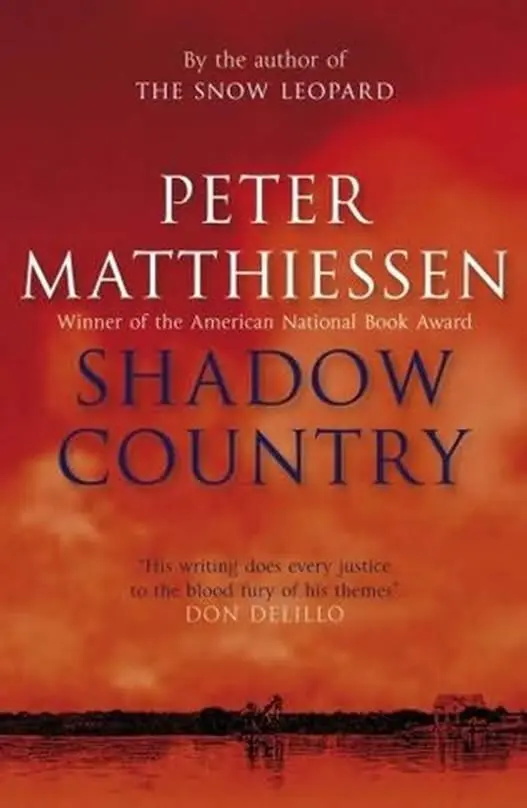
- Название:Shadow Country
- Автор:
- Жанр:
- Год:неизвестен
- ISBN:нет данных
- Рейтинг книги:3 / 5. Голосов: 1
-
Избранное:Добавить в избранное
- Отзывы:
-
Ваша оценка:
Shadow Country: краткое содержание, описание и аннотация
Предлагаем к чтению аннотацию, описание, краткое содержание или предисловие (зависит от того, что написал сам автор книги «Shadow Country»). Если вы не нашли необходимую информацию о книге — напишите в комментариях, мы постараемся отыскать её.
Peter Matthiessen's great American epic-Killing Mister Watson, Lost Man's River, and Bone by Bone-was conceived as one vast mysterious novel, but because of its length it was originally broken up into three books. In this bold new rendering, Matthiessen has cut nearly a third of the overall text and collapsed the time frame while deepening the insights and motivations of his characters with brilliant rewriting throughout. In Shadow Country, he has marvelously distilled a monumental work, realizing his original vision.
Inspired by a near-mythic event of the wild Florida frontier at the turn of the twentieth century, Shadow Country reimagines the legend of the inspired Everglades sugar planter and notorious outlaw E. J. Watson, who drives himself relentlessly toward his own violent end at the hands of neighbors who mostly admired him, in a killing that obsessed his favorite son.
Shadow Country traverses strange landscapes and frontier hinterlands inhabited by Americans of every provenance and color, including the black and Indian inheritors of the archaic racism that, as Watson's wife observed, "still casts its shadow over the nation."
Peter Matthiessen's lyrical and illuminating work in the Watson narrative has been praised highly by such contemporaries as Saul Bellow, William Styron, and W. S. Merwin. Joseph Heller said "I read it in great gulps, up each night later than I wanted to be, in my hungry impatience to find out more and more."
Shadow Country — читать онлайн бесплатно полную книгу (весь текст) целиком
Ниже представлен текст книги, разбитый по страницам. Система сохранения места последней прочитанной страницы, позволяет с удобством читать онлайн бесплатно книгу «Shadow Country», без необходимости каждый раз заново искать на чём Вы остановились. Поставьте закладку, и сможете в любой момент перейти на страницу, на которой закончили чтение.
Интервал:
Закладка:
We are no Eire-ish nor Sco-atch, nor are we Enga-lish-thus would the Old Squire tease his proud Sophia whenever she put on English airs, according to the recollections of her siblings. With Border folk, he would point out, who could determine who came from where, since none had agreed for seven hundred years where their domains lay? No, the Old Squire had declared, we are proud Borderers, the sons of Watt, and nothing more.
Mama’s cousin Selden Tilghman, the young cavalry officer, war hero, and classics scholar, lived alone on his family plantation, known as Deepwood. Detesting the notorious history of violence in his Tillman clan, attributing their uproar to inbreeding and prideful ignorance, Cousin Selden had reverted to the ancestral spelling in order to separate himself from “those amongst my kinsmen who have grown so contemptuous of learning that they no longer know the correct spelling of their own name.”
In Selden’s opinion, Mama told us, the early Watsons had probably arrived in the port of Philadelphia in the shiploads of Highland refugees from seven centuries of war and famine in the Border counties. These clannish and unruly Celts, as he portrayed them, had horrified the Quakers with outlandish speech and uncouth disrespect for all authority. Their women were notorious for short-cropped skirts, bare legs, and loose bodices, while the men mixed unabashed poverty and filth with a furious pride that hastened to avenge the smallest denigration or perceived injustice. Worse, they did this in the name of “honor,” a virtue which more mannerly colonials would never concede to such rough persons. Inevitably the Borderers were urged westward toward the backcountry of the Pennsylvania Colony, in the fervent hope that indigenous peoples even more primitive than themselves might do away with them.
The Borderers were a suspicious breed of feuders and avengers, cold-eyed and mistrustful of all strangers, or any who interfered with them in the smallest way. They fought their way through Indian territory with fatalistic indifference to hard faring and danger, spreading south like a contagion along the Appalachians into western Virginia and the Carolina uplands. Many were drovers of cattle and hogs, throwing up low cabins of wood or stones packed tight with earth, hunting and gathering the abounding game and fish, trading meat where possible for grain and iron, boozing and bragging and breeding, ever breeding. Scattering homesteads and ragged settlements south and west to the Great Smokies and beyond, massacring the aborigines wherever fortune smiled, they broadcast the seed of their headstrong clans without relinquishing a single dour trait or archaic custom. When times were hard, not a few would resort to traditional Border occupations-reivers and rustlers, highwaymen and common bushwhackers. The Border Watsons were of this stripe, Cousin Selden implied-quarrelsome ruffians disdainful of the law, obstreperous rebels against Church and Crown, as careless of good manners as of hardship and rude weather, not to speak of all the finer sentiments of the human heart. Or so, at least, Celtic ways were represented by Cousin Selden, whose mother had flowered amongst the Cavalier gentry of Maryland, and been chivalrously deflowered, too, her son supposed.
Selden’s amused, ironic views, well spiced by Mama, were regularly quoted to her children in their father’s presence. Though no match for his tart Ellen, Papa defended the Clouds Creek Watsons with a heartfelt rage. If the Watsons were mere Border rabble, he might bellow, then how would her precious Selden explain their prosperity in the New World? For whether by grant from the South Carolina Colony or Crown patent from King George, enlarged by enterprise, the first Carolina Watsons had acquired sixteen square miles-sixteen square miles!-of the best Clouds Creek country on the north fork of the Edisto River even before the muddy crossroads known as Edgefield Court House came into being. What was more, his late lamented mother Mary Lucretia Daniel for whom our little Minnie had been named was a direct descendant of President Jefferson’s great-aunt Martha. “Children, you have a proud heritage to uphold!” he exclaimed with passion, tossing his head dismissively in his wife’s direction as he spoke of her “traitorous” Tory antecedents and their “lily-livered longing,” as he called it, to be accepted by the Pickenses and Butlers and Brookses at the Court House.
“Spare your poor children these vulgarities, I beseech you,” his wife might protest, to hone her point that his credentials as a gentleman were suspect. Ellen Catherine Addison, after all, had been born into aristocratic circumstances, however straitened these might have become. It was scarcely her fault that her feckless husband had sold off all of her inheritance excepting her mother’s set of Scott’s Waverly novels, which was missing her own favorite, Ivanhoe. “How did I ever imagine,” she would sigh, “that this rough fellow would be my Ivanhoe!” Gladly would she play the piano for her husband-“to soothe your savage breast, dear,” she might add with a girlish peal-could such an instrument be found in a Watson dwelling, or fit into it, for that matter, since for all their prosperity, those Clouds Creek Watsons, eschewing the white-columned mansions of the Edgefield gentry, were content with large two-story versions of the rough-sawed timber cabins of their yeomen forebears.
“Yeomen?”
For his abuse and dismal failure as a father and provider as well as for her own exhaustion and privation, the erstwhile Miss Ellen C. Addison repaid her husband with sly mockery of those “darned old Watsons,” as she called them. Any Addison was better born, more educated and refined, and in every way more suited than any Watson to consort with the aristocracy at Edgefield Court House, not to speak of Charleston, far less England-thus would Mama prattle. We scarcely heard her, so frightened were we of the enraged and violent man in the chimney corner.
Mama blamed nothing on cruel providence but kept up her merciless good cheer in the worst of circumstances, as if otherwise our wretched family must go under. A topic that delighted her was the evangelical form of Protestant religion adopted by our country folk such as the Baptist Watsons, so unlike the discreet Episcopal persuasion favored at the Court House. In their “fellowshipping” at summer camp meetings, Mama had heard, the evangelicals lay about together in the grass, and not a few drank ale and wooed their females. Some might even take the time to be “born again,” said Mama, shaking her head. “When they’ve had enough preaching, the whole crowd joins in ‘the Great Shout,’ as I believe they call it, and something called ‘the Feast of the Fat Things.’ ” Winking at her children, Mama called out toward the porch, “Isn’t that what Baptists call it, Mr. Watson? Does our dear aunt Sophia participate in the Feast of the Fat Things?”
“Love Feast,” Papa snarled, after a heavy-breathing silence. My sister, close to hysterics over the Feast of the Fat Things, would run away and hide while I, ever more frightened, stood my ground, dreading the oncoming cataclysm.
Mama would be laughing in delight. “The Feast of the Fat Things-imagine! These upcountry weddings, children, you never saw such carryingson in all your life. The bride is usually with child-she is the Fat Thing, I suppose! They play all sorts of games, dance reels and jigs, and some rush about naked. They sing, ‘Up with your heels and down with your head, that is the way we make cockledy bread.’ Isn’t that quaint? And all the men dead drunk on their Black Betty-”
“Dammit, woman! That’s the name for the bottle-”
“-and after all this… love feasting?… these poor females settle down to their long, hard, dreary lives. To be sure, life is hard and utterly thankless for all women, children. But our backcountry women on dark isolated farms-‘too far away to hear the barking of the neighbor’s dog,’ as the old folks say-toiling like draft animals in the mud, with none of the culture and society of towns, nothing but silence and hostility and worse from brutish husbands-well, pagan or not, those poor creatures need that Feast of the Fat Things to bring a little light into their wretched lives, isn’t that so, Mr. Watson?”
Читать дальшеИнтервал:
Закладка:
Похожие книги на «Shadow Country»
Представляем Вашему вниманию похожие книги на «Shadow Country» списком для выбора. Мы отобрали схожую по названию и смыслу литературу в надежде предоставить читателям больше вариантов отыскать новые, интересные, ещё непрочитанные произведения.



Обсуждение, отзывы о книге «Shadow Country» и просто собственные мнения читателей. Оставьте ваши комментарии, напишите, что Вы думаете о произведении, его смысле или главных героях. Укажите что конкретно понравилось, а что нет, и почему Вы так считаете.