Peter Matthiessen - Shadow Country
Здесь есть возможность читать онлайн «Peter Matthiessen - Shadow Country» весь текст электронной книги совершенно бесплатно (целиком полную версию без сокращений). В некоторых случаях можно слушать аудио, скачать через торрент в формате fb2 и присутствует краткое содержание. Жанр: Современная проза, на английском языке. Описание произведения, (предисловие) а так же отзывы посетителей доступны на портале библиотеки ЛибКат.
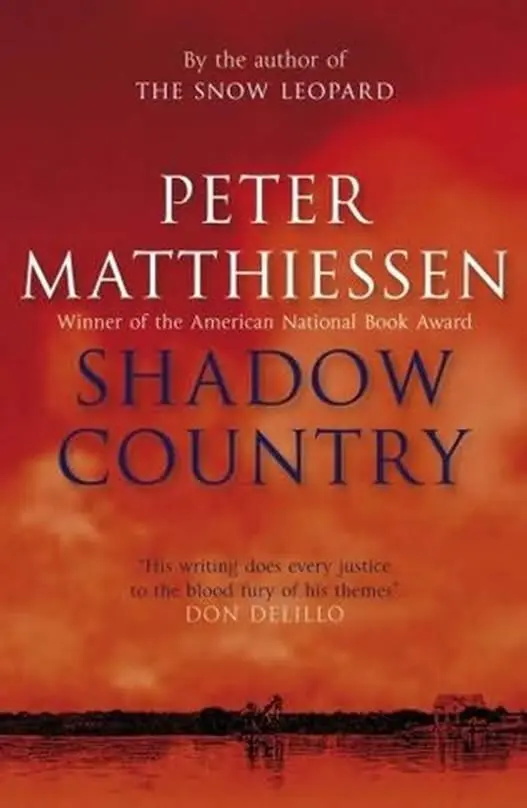
- Название:Shadow Country
- Автор:
- Жанр:
- Год:неизвестен
- ISBN:нет данных
- Рейтинг книги:3 / 5. Голосов: 1
-
Избранное:Добавить в избранное
- Отзывы:
-
Ваша оценка:
Shadow Country: краткое содержание, описание и аннотация
Предлагаем к чтению аннотацию, описание, краткое содержание или предисловие (зависит от того, что написал сам автор книги «Shadow Country»). Если вы не нашли необходимую информацию о книге — напишите в комментариях, мы постараемся отыскать её.
Peter Matthiessen's great American epic-Killing Mister Watson, Lost Man's River, and Bone by Bone-was conceived as one vast mysterious novel, but because of its length it was originally broken up into three books. In this bold new rendering, Matthiessen has cut nearly a third of the overall text and collapsed the time frame while deepening the insights and motivations of his characters with brilliant rewriting throughout. In Shadow Country, he has marvelously distilled a monumental work, realizing his original vision.
Inspired by a near-mythic event of the wild Florida frontier at the turn of the twentieth century, Shadow Country reimagines the legend of the inspired Everglades sugar planter and notorious outlaw E. J. Watson, who drives himself relentlessly toward his own violent end at the hands of neighbors who mostly admired him, in a killing that obsessed his favorite son.
Shadow Country traverses strange landscapes and frontier hinterlands inhabited by Americans of every provenance and color, including the black and Indian inheritors of the archaic racism that, as Watson's wife observed, "still casts its shadow over the nation."
Peter Matthiessen's lyrical and illuminating work in the Watson narrative has been praised highly by such contemporaries as Saul Bellow, William Styron, and W. S. Merwin. Joseph Heller said "I read it in great gulps, up each night later than I wanted to be, in my hungry impatience to find out more and more."
Shadow Country — читать онлайн бесплатно полную книгу (весь текст) целиком
Ниже представлен текст книги, разбитый по страницам. Система сохранения места последней прочитанной страницы, позволяет с удобством читать онлайн бесплатно книгу «Shadow Country», без необходимости каждый раз заново искать на чём Вы остановились. Поставьте закладку, и сможете в любой момент перейти на страницу, на которой закончили чтение.
Интервал:
Закладка:
When Lucius answered, “I’m sure he’ll be all right,” his stepmother nodded doubtfully. “Well. We have lots to be thankful for. I mean, Everybody has to live with some thing, isn’t that true?”
Seeing the fear in her face, he took her hand. “I dragged my kids under the store,” she murmured, holding his hand tight. “That’s how scared I was those men were going to kill us. And I worry that it was my fear that scared Ad worse than anything. He still hears those guns in his sleep, wakes up hysterical. He just can’t rid himself of the smell of those drowned chickens.” She pinched at the bridge of her nose. “Me, either. How many years?” Her voice had diminished to a whisper. “I’ll go to my grave with that stench of death, I’m sure.”
She gave him the Greek history. “That’s yours now, Lucius.” For his sake, Edna had revisited her life as Mrs. E. J. Watson but now she wanted him to go.
“I’m sorry you didn’t meet Mr. Burdett and Herkie Junior or see your little sisters.” From her doorway, waving a shy hand, she invited him to visit next time he came through, but probably she knew as well as he did that they would not meet again, which was all right, too. When he turned to wave, she only gazed at him, head cocked ever so slightly. Lucius? Why did you come? What do you want with us?
SOUTH
On a green and blue day, Lucius headed south to Arcadia on the Peace River. In his father’s day, as the new capital of Manatee County, Arcadia had claimed such frontier comforts as hard drink, whores, and gambling, knife fights, shootings, and common brawling: according to a local account, as many as four men had been killed in a single fight and fifty fights might occur in a single day. Untended stock on the county’s unfenced range had encouraged a spirit of free enterprise in which cattle were stolen by the herd, and in 1890, four luckless strangers, denying to the end that they were rustlers, were hanged without formalities from the nearest oak. Inevitably the range wars attracted desperadoes from the West, and death by knife and bullet was a commonplace when a fugitive from Arkansas named E. J. Watson turned up in Arcadia and, according to later memoirs by friend Ted Smallwood, slew “a bad actor” named Quinn Bass:
Watson said Bass had a fellow down whittling on him with his knife and Watson told Bass… he had worked on the man enough. And Bass got loose and came towards him and he begin putting the.38 S & W bullets into Bass and shot him down.
The date of Watson’s arrival in Arcadia, his livelihood and length of stay-Smallwood set down no such details, only that Watson had paid his way out of his scrape before leaving town.
At the county clerk’s office at the courthouse, a stately edifice on the main square, the town’s earliest Criminal Docket Book, exhumed from the basement, made no mention of a Watson. However, a LeQuinn Bass had been arrested on September 19, 1890, for carrying concealed weapons, and again on October 23 of the next year, this time for murder. Bass had been acquitted on November 6, 1893-his last appearance in the docket book. Since his surname was otherwise absent from this record of every felony committed in the new county between 1890 and 1905, only LeQuinn could have been the Quinn Bass of Smallwood’s account, yet his demise at the hands of E. J. Watson was nowhere recorded.
THE DOMESDAY BOOK
Arriving in Fort Myers the next day, Lucius found a note from Arbie- Rob! -at General Delivery saying that Lucius might find him in late afternoon at the bar of the Gasparilla Inn, where Lucius had arranged a supper meeting with Watt Dyer. In the meantime, he would visit the library and newspaper, noting Watson references and dates.
A sketch of Sheriff Frank Tippins in a local history attested that Tippins, “who arrested many desperate criminals during his career and acquired a statewide reputation for fearlessness,” had always been frustrated by the “unsolved killing of Ed Watson. Due to the fact that Watson was said to have killed the notorious Belle Starr, his murder attracted national attention and stories about him are still being printed.” Lucius was much encouraged by these references to the “unsolved killing” and “murder” of his father and also the mention of the thirty-three bullets removed from the riddled corpse, which reflected the sheriff ’s skepticism that an armed crowd of twenty or more men shooting a lone man to pieces had acted in self-defense.
At the Lee County sheriff ’s office, the stiff leaves of old court ledgers long unopened exhaled the breath of desiccation, and the sepia ink was as faint as the blue watermark. In these stained pages, the first name of interest was “Green Waller,” jailed in 1896, 1898, and 1901 for “larceny of hog.” Subsequently this dogged pig thief had found sanctuary at Chatham Bend, where he could commune with these estimable animals to his heart’s content. Waller also appeared in the Monroe County census for May 1910, where he was listed in the E. J. Watson household as servant and farmhand. His mountainous lover Miss Hannah Smith was registered as cook; field hand “John Smith” was the fugitive Leslie Cox. Last on the census list was “Lucius H. Watson, mullet fisherman.” His own name startled him, flying off the faded page like a medieval moth trapped in the Domesday Book.
As in Arcadia, Lucius was mystified by the dearth of information on his father. Sheriff Tippins’s records for 1910 made no reference whatever to the triple murder at Chatham Bend on October 10, nor to the murder of Ed Watson at Chokoloskee on the 24th, nor even to the court hearing in regard to that death held by Tippins two days later in Lee County Court: how was this possible? That the records were missing was all the more peculiar since these crimes had been prominently covered by the newspapers in Fort Myers and Tampa and both accounts had specified that the unnamed “negro” being held in connection with the Chatham massacre had spent a fortnight in the Fort Myers jail before being turned over to the Monroe County sheriff. Under the circumstances, it seemed incredible that in this official record (in which the miscreant’s race was invariably noted), there was no mention of any black man taken into custody in Lee County in October of 1910, nor any notation in the sheriff ’s fees book, which recorded disbursements for the transport and feeding of each prisoner.
The most notorious murder case in Tippins’s long career had been wiped from the record or it had never been transcribed. Either way, the culprit could only have been the deputy court clerk, Mr. E. E. Watson: was Eddie also responsible for his father’s absence from the criminal dockets in Arcadia?
To bulwark his request for old court records, Lucius had laid a copy of his History on the counter. The deputy had picked at the thick book as if fingering strange fruit, then closed it in unconcealed relief that he need not read it. “Got a man restin his bad bones back in our cells who might know quite a lot about that case. Him and Tippins loved to swap old yarns about Ed Watson so what he’d tell might have some truth to it if he’s feelin truthful.” The deputy chuckled as he led the way down the back hall. “The feds asked us to hold this feller but it ain’t nothin but harassment. County, state, and federal law knows all about him but none of ’em can nail him, he skitters out from under every time. Can’t even jail him on his income tax cause he don’t show no income on his books-ain’t got no books! Got all his money in old feed sacks someplace, wouldn’t surprise me. Yesterday he beat the charges same as always, he can walk out any time he wants, but he likes livin off the taxpayers while he’s up to town.”
Читать дальшеИнтервал:
Закладка:
Похожие книги на «Shadow Country»
Представляем Вашему вниманию похожие книги на «Shadow Country» списком для выбора. Мы отобрали схожую по названию и смыслу литературу в надежде предоставить читателям больше вариантов отыскать новые, интересные, ещё непрочитанные произведения.








Обсуждение, отзывы о книге «Shadow Country» и просто собственные мнения читателей. Оставьте ваши комментарии, напишите, что Вы думаете о произведении, его смысле или главных героях. Укажите что конкретно понравилось, а что нет, и почему Вы так считаете.