J.M. le Clézio - Desert
Здесь есть возможность читать онлайн «J.M. le Clézio - Desert» весь текст электронной книги совершенно бесплатно (целиком полную версию без сокращений). В некоторых случаях можно слушать аудио, скачать через торрент в формате fb2 и присутствует краткое содержание. Город: Jaffrey, Год выпуска: 2009, ISBN: 2009, Издательство: Verba Mundi Books, Жанр: Современная проза, на английском языке. Описание произведения, (предисловие) а так же отзывы посетителей доступны на портале библиотеки ЛибКат.
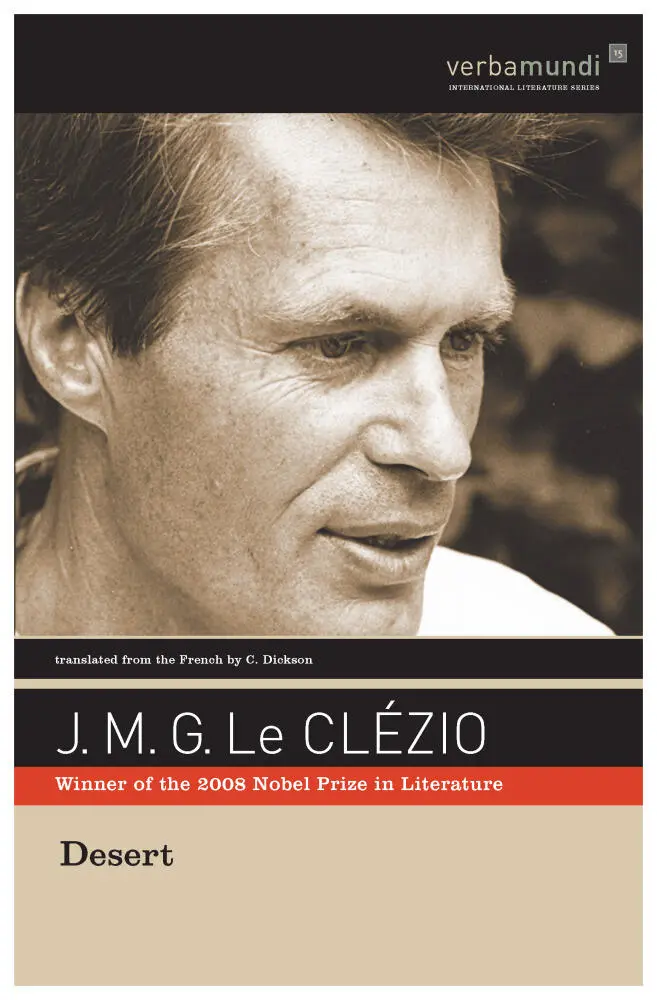
- Название:Desert
- Автор:
- Издательство:Verba Mundi Books
- Жанр:
- Год:2009
- Город:Jaffrey
- ISBN:978-1-56792-386-5
- Рейтинг книги:5 / 5. Голосов: 1
-
Избранное:Добавить в избранное
- Отзывы:
-
Ваша оценка:
Desert: краткое содержание, описание и аннотация
Предлагаем к чтению аннотацию, описание, краткое содержание или предисловие (зависит от того, что написал сам автор книги «Desert»). Если вы не нашли необходимую информацию о книге — напишите в комментариях, мы постараемся отыскать её.
Available for the first time in English translation, Desert is a novel composed of two alternating narratives, set in counterpoint. The first takes place in the desert between 1909 and 1912 and evokes the migration of a young adolescent boy, Nour, and his people, the Blue Men, notorious warriors of the desert. Driven from their lands by French colonial soldiers, Nour's tribe has come to the valley of the Saguiet El Hamra to seek the aid of the great spiritual leader known as Water of the Eyes. The religious chief sends them out from the holy city of Smara into the desert to travel still further. Spurred on by thirst, hunger, and suffering, Nour's tribe and others flee northward in the hopes of finding a land that can harbor them at last.
The second narrative relates the contemporary story of Lalla, a descendant of the Blue Men. Though she is an orphan living in a shantytown known as the Project near a coastal city in Morocco, the blood of her proud, obstinate tribe runs in her veins. All too soon, Lalla must flee to escape a forced marriage with an older, wealthy man. She travels to France, undergoing many trials there, from working as a hotel maid to becoming a highly-paid fashion model, and yet she never betrays the blood of her ancestors.
Desert — читать онлайн бесплатно полную книгу (весь текст) целиком
Ниже представлен текст книги, разбитый по страницам. Система сохранения места последней прочитанной страницы, позволяет с удобством читать онлайн бесплатно книгу «Desert», без необходимости каждый раз заново искать на чём Вы остановились. Поставьте закладку, и сможете в любой момент перейти на страницу, на которой закончили чтение.
Интервал:
Закладка:
In spite of their despair, Larhdaf and Saadbou wanted to attack the city, but the sheik refused to use force. The blue men of the desert were too weary now; they had been walking and fasting for too long. Most of the warriors were feverish, sick with scurvy, their legs covered with festering wounds. Their weapons didn’t even function anymore.
The people in the city were wary of the men from the desert, and the gates remained closed all day long. Those who tried nearing the ramparts had been met with gunfire: it was a warning.
So when he realized there was nothing left to hope for, that they would all die, one after the other, on the scorching riverbed, in front of the ramparts of the merciless city, Ma al-Aïnine gave the signal to move on northward. This time there was no praying or chanting or dancing. One after the other, slowly, like sick animals straightening up on their legs, teetering, the blue men left the riverbed, struck out again, walking toward the unknown.
Then the troop of the sheik’s warriors no longer looked the same. They walked along with the convoy of men and animals, as haggard as they were, their clothing in tatters, their eyes blank and feverish. Maybe they’d stopped believing in the reasons for this long march; they continued moving forward simply out of habit, at the end of their strength, ready to collapse at any minute. The women bent over as they walked, their faces hidden by their blue veils, and many of them no longer had a child on her back, because he’d been left in the red earth of the Souss Valley. Then, at the end of the convoy, which stretched out over the whole valley, were the children, the old people, the wounded warriors, everyone who walked slowly. Nour was among them, guiding the blind warrior. He didn’t even know where his family was anymore, lost somewhere in the cloud of dust. Only a few warriors were still mounted. The great sheik was traveling with them, on his white camel, wrapped in his cloak.
No one spoke. They walked on, each man keeping to himself, burned faces, feverish eyes trained on the red earth of the hills in the west, in order to spot the trail leading over the mountains to the city of Marrakech. They walked on with the light beating down on their skulls, their necks, making pain throb through their limbs, burning down into the very quick of their bodies. They could no longer hear the wind, or the sound of the people’s feet scuffing over the desert. They could only hear the sound of their hearts, the sound of their nerves, the pain whistling and grating behind their eardrums.
Nour could no longer feel the hand of the blind warrior gripping his shoulder. He was just moving forward, without knowing why, with no hope of ever stopping. Maybe the day his mother and father decided to leave the camps in the South, they had been condemned to wander for the rest of their lives on this endless march, from well to well, along dried valleys? But were there other lands on earth apart from these infinite stretches in which the dust mingled with the sky, stark mountains, sharp stones, rivers with no water, thorn bushes, each of which could bring death with the slightest wound? Each day, off in the distance, on the hillsides near the wells, the people saw more houses, fortresses of red mud surrounded with fields and palm groves. But they saw them as one sees mirages, shimmering in the burning hot air, remote, inaccessible. The inhabitants of the villages didn’t show themselves. They had fled into the mountains or they were hiding behind their ramparts, ready to combat the blue men of the desert.
At the head of the caravan, on their horses, the sons of Ma al-Aïnine pointed to the narrow opening of the valley surrounded by the chaos of the mountains.
“The trail! The trail to the North!”
So they walked through the mountains for days. The burning wind blew through the ravines. The blue sky was immense above the red rocks. There wasn’t a soul up there, not a person or an animal, only the tracks of a snake in the sand once in a while, or, very high up in the sky, the shadow of a vulture. They walked on without looking for life, without seeing a sign of hope. Like blind people, the men and women made their way along in single file, placing their feet in the footsteps that preceded them, mixed in with the herd animals. Who was guiding them? The dirt trail snaked through ravines, over rockslides, merged with dried torrent beds.
Finally, the travelers arrived on the edge of Oued Issene, swollen with melting snow. The water was lovely and pure; it leapt between the arid banks. But the people looked at it without emotion, because the water was not theirs; they could not retain it. They stayed on the banks of the stream for several days, while the warriors of the great sheik, accompanied by Larhdaf and Saadbou, went up the Chichaoua trail.
“Have we arrived, is this our land?” the blind warrior always asked. The cold water of the stream tumbled down over the rocks in cascades, and the path was getting more difficult. Then the caravan arrived in front of a Chleuh village at the end of the valley. The sheik’s warriors were waiting for them there. They had raised their large tent, and the sheiks of the mountains had sacrificed sheep to welcome Ma al-Aïnine. It was the village of Aglagla, at the foot of the high mountains. The people of the desert set up camp near the walls of the village, without even asking. That evening, children from the village came, bringing grilled meat and sour milk, and they were all able to eat their fill, which they hadn’t done in a long time. Then they lit big fires of cedar wood, because the night was cold.
Nour watched the flames dancing in the pitch-black night for a long time. There was chanting too, strange music the likes of which he’d never heard, sad and slow, accompanied by the sound of the flute. The men and women of the village asked for Ma al-Aïnine’s blessing, asked him to heal them of their illnesses.
Then the travelers started out for the other side of the mountains, in the direction of the holy city. It just might prove to be the place where the people of the desert would know an end to their suffering, according to what Ma al-Aïnine’s blue warriors said, because it was in Marrakech that Ma al-Aïnine had given his oath of allegiance to Moulay Hafid, the Leader of the Faithful, fourteen years earlier. It was there that the king had given the sheik a piece of land, so that he could build the house for teaching the Goudfia. And it was also in the holy city that the eldest son of Ma al-Aïnine was waiting for his father in order to join the holy war; and everyone venerated Moulay Hiba, he who was called Dehiba, the Particle of Gold, he who was called Moulay Sebaa, the Lion, for it was he whom they had chosen to be king of the lands of the South.
In the evening, when the caravan stopped and the fires were being lit, Nour led the blind warrior over to where Ma al-Aïnine’s warriors were sitting, and they listened to the stories of what had come to pass when the great sheik and his sons had arrived with the warriors from the desert, all mounted on swift camels, and how they had entered the holy city; they had been welcomed by the king along with Ma al-Aïnine’s two sons, Moulay Sebaa, the Lion, and Mohammed al-Shems, he who was called the Sun; they also told of the offerings the king had made, so the sheik could build the ramparts of the city of Smara; and the journey they had undertaken with such large herds of camels, they covered the entire plain, while the women and the children and the equipment and the food supplies were all loaded aboard the big steamship called Bashir, and sailed several days and several nights from Mogador to Marsa Tarfaya.
They also recounted the legend of Ma al-Aïnine, in their slightly singsong voices, and it was as if they were telling about a dream they had once had. The voice of the warriors mingled with the sound of the flames, and every now and again, Nour caught a glimpse of the frail shape of the old man through the plumes of smoke, like a flame, in the center of the camp.
Читать дальшеИнтервал:
Закладка:
Похожие книги на «Desert»
Представляем Вашему вниманию похожие книги на «Desert» списком для выбора. Мы отобрали схожую по названию и смыслу литературу в надежде предоставить читателям больше вариантов отыскать новые, интересные, ещё непрочитанные произведения.










Обсуждение, отзывы о книге «Desert» и просто собственные мнения читателей. Оставьте ваши комментарии, напишите, что Вы думаете о произведении, его смысле или главных героях. Укажите что конкретно понравилось, а что нет, и почему Вы так считаете.