J.M. le Clézio - Desert
Здесь есть возможность читать онлайн «J.M. le Clézio - Desert» весь текст электронной книги совершенно бесплатно (целиком полную версию без сокращений). В некоторых случаях можно слушать аудио, скачать через торрент в формате fb2 и присутствует краткое содержание. Город: Jaffrey, Год выпуска: 2009, ISBN: 2009, Издательство: Verba Mundi Books, Жанр: Современная проза, на английском языке. Описание произведения, (предисловие) а так же отзывы посетителей доступны на портале библиотеки ЛибКат.
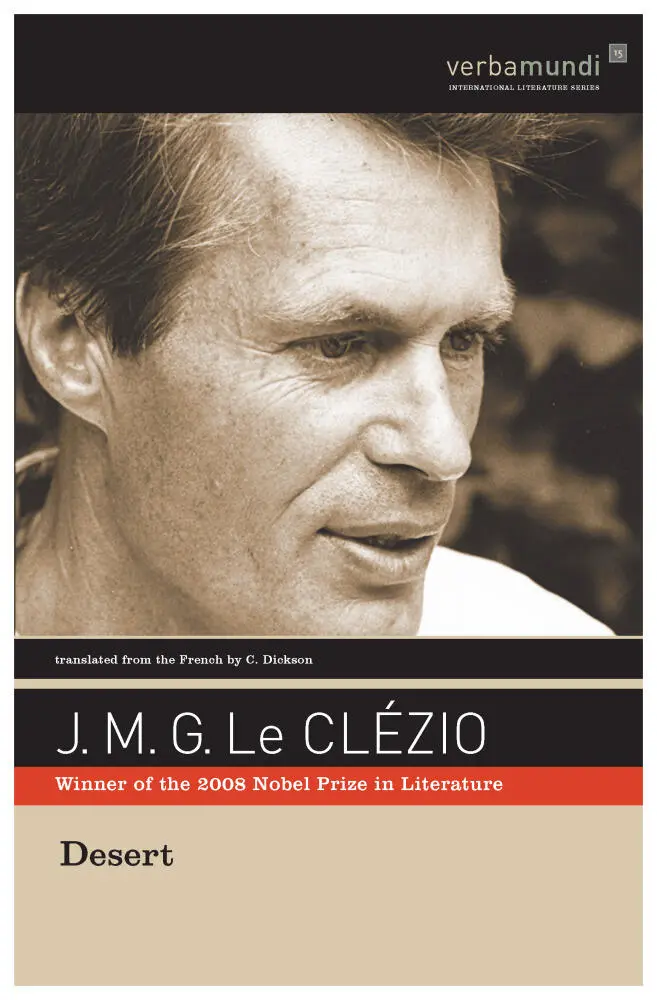
- Название:Desert
- Автор:
- Издательство:Verba Mundi Books
- Жанр:
- Год:2009
- Город:Jaffrey
- ISBN:978-1-56792-386-5
- Рейтинг книги:5 / 5. Голосов: 1
-
Избранное:Добавить в избранное
- Отзывы:
-
Ваша оценка:
Desert: краткое содержание, описание и аннотация
Предлагаем к чтению аннотацию, описание, краткое содержание или предисловие (зависит от того, что написал сам автор книги «Desert»). Если вы не нашли необходимую информацию о книге — напишите в комментариях, мы постараемся отыскать её.
Available for the first time in English translation, Desert is a novel composed of two alternating narratives, set in counterpoint. The first takes place in the desert between 1909 and 1912 and evokes the migration of a young adolescent boy, Nour, and his people, the Blue Men, notorious warriors of the desert. Driven from their lands by French colonial soldiers, Nour's tribe has come to the valley of the Saguiet El Hamra to seek the aid of the great spiritual leader known as Water of the Eyes. The religious chief sends them out from the holy city of Smara into the desert to travel still further. Spurred on by thirst, hunger, and suffering, Nour's tribe and others flee northward in the hopes of finding a land that can harbor them at last.
The second narrative relates the contemporary story of Lalla, a descendant of the Blue Men. Though she is an orphan living in a shantytown known as the Project near a coastal city in Morocco, the blood of her proud, obstinate tribe runs in her veins. All too soon, Lalla must flee to escape a forced marriage with an older, wealthy man. She travels to France, undergoing many trials there, from working as a hotel maid to becoming a highly-paid fashion model, and yet she never betrays the blood of her ancestors.
Desert — читать онлайн бесплатно полную книгу (весь текст) целиком
Ниже представлен текст книги, разбитый по страницам. Система сохранения места последней прочитанной страницы, позволяет с удобством читать онлайн бесплатно книгу «Desert», без необходимости каждый раз заново искать на чём Вы остановились. Поставьте закладку, и сможете в любой момент перейти на страницу, на которой закончили чтение.
Интервал:
Закладка:
“The great sheik was born far from here, to the south, in the country that is called Hodh, and his father was the son of Moulay Idriss, and his mother was a descendant of the Prophet. When the great sheik was born, his father named him Ahmed, but his mother named him Ma al-Aïnine, Water of the Eyes, because she had wept with joy when he was born….”
Nour listened in the night, beside the blind warrior, his head resting against a stone.
“When he turned seven, he recited the Koran without making a single mistake, so his father, Mohammed al-Fadel, sent him to the great holy city of Mecca, and on the way, the child performed miracles… He knew how to heal the sick, and to those who asked him for water, he said, the heavens will give you water, and immediately heavy rains streamed over the earth…”
The blind warrior was swaying his head slightly, as if he were marking time to the words, and Nour was drifting slowly off to sleep.
“Then people from all corners of the desert came to see the child who could perform miracles, and the child, the son of the great Mohammed Fadel ben Maminna, simply put a little saliva on the eyes of the sick person, he blew on his lips and the sick person immediately stood up and kissed the child’s hand, for he had been healed…”
Nour could feel the body of the blind warrior trembling against him, as he rocked his head slowly from shoulder to shoulder. It was the monotone voice of the storyteller and the wavering of the smoke and the flames: the earth itself seemed to be moving in time with the rhythm of the voice.
“So then the great sheik settled in the holy city of Chinguetti, at the Nazaran well, near al-Dakhla, to give his teachings, for he knew the science of the stars and of numbers, and the word of God. So the men of the desert became his disciples, and they were called Berik Allah, those who have received the blessing of God…”
The voice of the blue warrior droned on in the night, before the leaping dancing flames, with the smoke enveloping the men and making them cough. Nour listened to the stories of the miracles, the springs gushing forth in the desert, the rainwater covering the arid fields, and the words of the great sheik in the square of Chinguetti, or in front of his home in Nazaran. He listened to the beginning of Ma al-Aïnine’s long march through the desert, all the way to the smara, the brush land, where the great sheik had founded his city. He listened to the legend of his battles against the Spaniards, in al-Aaiún, in Ifni, in Tiznit, with his sons, Rebbo, Taaleb, Larhdaf, al-Shems, and the one who was called Moulay Sebaa, the Lion.
Thus, every evening, the same voice continued the legend, in the same way, half singing, and Nour forgot where he was, as if it were his own story that the blue man was telling.
On the other side of the mountains, they entered the great red plain, and walked northward, going from village to village. In each village, men with feverish eyes, women, children came to join the caravan and took the places of those who had died. The great sheik was out ahead on his white camel, surrounded by his sons and his warriors, and Nour could see the cloud of dust in the distance that seemed to be guiding them.
When they arrived before the great city of Marrakech, they did not dare go very close, so they set up camp near the dried river to the south. For two days the blue men waited, barely even moving, in the shelter of their tents and in huts of branches. The hot summer wind covered them with dust, but they waited, every last bit of their strength turned to waiting.
Finally, on the third day, Ma al-Aïnine’s sons came back. Next to them, on horseback, was a tall man, clothed like the warriors from the North, and his name passed over everyone’s lips: “Moulay Hiba, he who is called Moulay Dehiba, the Particle of Gold, Moulay Sebaa, the Lion.”
When the blind warrior heard this name, he began to tremble, and tears ran from his burnt eyes. He set off running straight ahead, arms outstretched, letting out a long cry, something like a high-pitched earsplitting wail.
Nour tried to catch him, but the blind man was running as fast as he could, tripping over stones, staggering over the dusty ground. The people of the desert stepped out of his path, and some were even frightened and turned their eyes away, because they thought the blind man was possessed by the devil. The blind warrior seemed to be consumed with immeasurable joy and suffering. Several times he fell to the ground, having stumbled over a root, or a stone, but each time he got back up and continued to run toward the place where Ma al-Aïnine and Moulay Hiba were, without being able to see them. Finally, Nour caught up with him, took him by the arm; but the man continued running and shouting, dragging Nour along with him. He ran straight ahead, as if he could see Ma al-Aïnine and his son, he was moving unfalteringly toward them. So then the sheik’s warriors grew frightened, they grabbed their rifles to stop the blind man from coming closer. But the sheik simply said: “Let them come.”
Then he dismounted his camel and walked up to the blind warrior.
“What do you want?”
The blind warrior threw himself on the ground, arms stretched out before him, and sobs wracked his body, choked him. Only the long, high-pitched wail still came from his throat, like a plaint. Then Nour spoke: “Grant him sight, great king,” he said.
Ma al-Aïnine looked at the man lying on the ground for a long time, his body shaken with sobs, his clothing in rags, his hands and feet bleeding from the journey. Without saying anything, he knelt down next to the blind man, laid his hand on the back of his neck. The blue men and the sons of the sheik remained standing. The silence was so great at that moment, Nour felt dizzy. A strange, unknown force was welling up from the dusty earth, enveloping the men in its whirl. It was the light of the setting sun perhaps, or the power of the gaze that had fallen upon the place, that was trying to find its way out, like trapped water. Slowly, the blind warrior raised himself up, his face appeared in the light, caked with sand and the water of his tears. Taking a corner of his sky-blue haik, Ma al-Aïnine wiped off the man’s face. Then he passed his hand over his forehead, over his burnt eyelids, as if he were trying to erase something. Moistening his fingertips with saliva, he rubbed the blind man’s eyelids, and blew softly on his face, without uttering a word. The silence lasted for such a long time that Nour couldn’t recall what had come before, what he had said. Kneeling in the sand next to the sheik, he was looking only at the blind warrior’s face, in which a new light seemed to be dawning. The man was no longer wailing. He was sitting very still in front of the sheik, arms held slightly out from his body, his damaged eyes open very wide, as if he were slowly becoming inebriated by the gaze of the sheik.
Then Ma al-Aïnine’s sons came, and Moulay Hiba also drew near, and they helped the old man to his feet. Very gently, Nour took the warrior by the arm, and had him stand also. The man started walking, leaning on the boy’s shoulder, and the light of the setting sun shone upon his face like golden dust. He did not speak. He moved along very slowly, like a man who had gone through a long illness, placing his feet squarely on the stony ground.
He was teetering a little, but his arms were no longer held out, and his body was free of suffering. The people of the desert were standing still in silence, watching him walk out toward the other end of the plain. There was no more suffering, and now his face was calm and gentle, and his eyes were filled with the golden light of the sun, which was touching the horizon. And on Nour’s shoulder, his hand had grown light, like that of a man who knew where he was going.
Читать дальшеИнтервал:
Закладка:
Похожие книги на «Desert»
Представляем Вашему вниманию похожие книги на «Desert» списком для выбора. Мы отобрали схожую по названию и смыслу литературу в надежде предоставить читателям больше вариантов отыскать новые, интересные, ещё непрочитанные произведения.











Обсуждение, отзывы о книге «Desert» и просто собственные мнения читателей. Оставьте ваши комментарии, напишите, что Вы думаете о произведении, его смысле или главных героях. Укажите что конкретно понравилось, а что нет, и почему Вы так считаете.