J.M. le Clézio - Desert
Здесь есть возможность читать онлайн «J.M. le Clézio - Desert» весь текст электронной книги совершенно бесплатно (целиком полную версию без сокращений). В некоторых случаях можно слушать аудио, скачать через торрент в формате fb2 и присутствует краткое содержание. Город: Jaffrey, Год выпуска: 2009, ISBN: 2009, Издательство: Verba Mundi Books, Жанр: Современная проза, на английском языке. Описание произведения, (предисловие) а так же отзывы посетителей доступны на портале библиотеки ЛибКат.
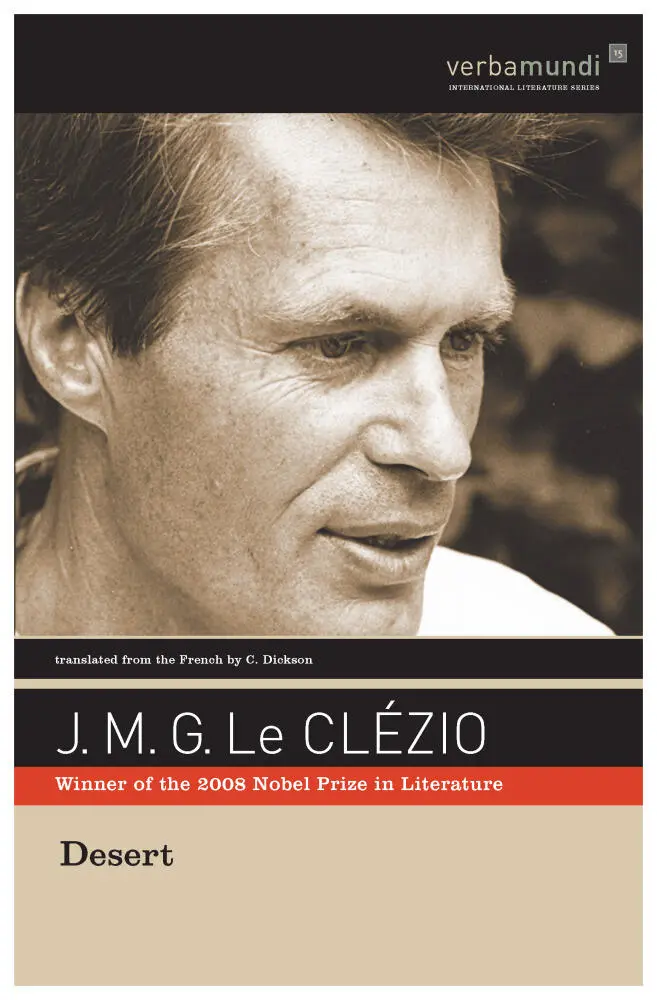
- Название:Desert
- Автор:
- Издательство:Verba Mundi Books
- Жанр:
- Год:2009
- Город:Jaffrey
- ISBN:978-1-56792-386-5
- Рейтинг книги:5 / 5. Голосов: 1
-
Избранное:Добавить в избранное
- Отзывы:
-
Ваша оценка:
Desert: краткое содержание, описание и аннотация
Предлагаем к чтению аннотацию, описание, краткое содержание или предисловие (зависит от того, что написал сам автор книги «Desert»). Если вы не нашли необходимую информацию о книге — напишите в комментариях, мы постараемся отыскать её.
Available for the first time in English translation, Desert is a novel composed of two alternating narratives, set in counterpoint. The first takes place in the desert between 1909 and 1912 and evokes the migration of a young adolescent boy, Nour, and his people, the Blue Men, notorious warriors of the desert. Driven from their lands by French colonial soldiers, Nour's tribe has come to the valley of the Saguiet El Hamra to seek the aid of the great spiritual leader known as Water of the Eyes. The religious chief sends them out from the holy city of Smara into the desert to travel still further. Spurred on by thirst, hunger, and suffering, Nour's tribe and others flee northward in the hopes of finding a land that can harbor them at last.
The second narrative relates the contemporary story of Lalla, a descendant of the Blue Men. Though she is an orphan living in a shantytown known as the Project near a coastal city in Morocco, the blood of her proud, obstinate tribe runs in her veins. All too soon, Lalla must flee to escape a forced marriage with an older, wealthy man. She travels to France, undergoing many trials there, from working as a hotel maid to becoming a highly-paid fashion model, and yet she never betrays the blood of her ancestors.
Desert — читать онлайн бесплатно полную книгу (весь текст) целиком
Ниже представлен текст книги, разбитый по страницам. Система сохранения места последней прочитанной страницы, позволяет с удобством читать онлайн бесплатно книгу «Desert», без необходимости каждый раз заново искать на чём Вы остановились. Поставьте закладку, и сможете в любой момент перейти на страницу, на которой закончили чтение.
Интервал:
Закладка:
Radicz stops talking. He’d like to ask Lalla a few things, about the child in her belly, but he doesn’t dare. He’s lit up another cigarette, and is smoking, and from time to time, he passes the cigarette to Lalla so she can have a puff. The two of them are looking out at the lovely sea, at the black islands like whales, and the toy boats moving slowly over the shimmering sea. From time to time, the wind blows so hard you’d think the sea and the sky were going to go tumbling over.
NOW LALLA IS LOOKING at her photographs in magazine articles, on the covers of fashion reviews. She looks at the reams of pictures, the contact sheets, the color layouts where her almost life-sized face appears. She thumbs through the magazines from back to front, holding them a little tilted, cocking her head to one side.
“Do you like them?” asks the photographer, sounding a little worried, as if it really mattered.
It makes her laugh, with her silent laughter that makes her extremely white teeth sparkle. She laughs about all of it, about the pictures, the magazines, as if it were a joke, as if it weren’t her you could see on those sheets of paper. To begin with, it really isn’t her. It’s Hawa, the name she’s given herself, the one she gave the photographer, and that’s what he calls her; that’s what he called her the first time he ran into her, in the stairways in the Panier, and brought her back to his place, to his big empty apartment on the ground floor of the new building.
Now Hawa is everywhere, on the pages of magazines, on the contact sheets, on the walls of the apartment. Hawa dressed in white, a black belt around her waist, alone in the middle of a shadeless rocky area; Hawa, in black silk, a scarf around her forehead, like an Apache; Hawa standing above the Mediterranean; Hawa in the midst of the crowd on Cours Belsunce, or else on the flight of stairs in front of the train station; Hawa dressed in indigo, barefoot on the asphalt of the esplanade, vast as a desert, with the outlines of storage tanks and smoking chimneys; Hawa walking, dancing; Hawa sleeping; Hawa with her handsome copper-colored face, with her long smooth body, shining in the light; Hawa eagle-eyed, with her heavy black hair cascading down over her shoulders, or smoothed back by the sea, like a Galalith helmet. But who is Hawa? Every day, when she wakes up in the large gray-white living room where she sleeps on an air mattress on the bare floor, she goes and washes up in the bathroom, not making a sound; then she climbs out the window and walks off aimlessly through the streets of the neighborhood; she walks as far as the sea. The photographer wakes up, opens his eyes but doesn’t move; he acts as if he hasn’t heard a thing, so as not to disturb Hawa. He knows that’s the way she is, that he mustn’t try to hold her back. He simply leaves the window open so she can come back in, like a cat. Sometimes she doesn’t come back till after dark. She slips into the apartment through the window. The photographer hears her, comes out of his laboratory and sits down beside her in the living room, to talk with her a little. He’s always moved when he sees her, because her face is so full of light and life, and he blinks his eyes a little, because in coming out of the dark laboratory, he’s a bit dazzled. He always thinks he has a lot of things to tell her, but when Hawa is there before him, he can’t recall what he wanted to say. She’s the one who talks; she tells about the things she’s seen, or heard, in the streets, and she eats a little as she’s talking, some bread she’s bought, some fruit, some dates that she brings back to the apartment by the pound.
The most extraordinary thing about it all is the letters: they come from all over, with Hawa’s name on the envelopes. They’re from magazines, fashion reviews that forward them after adding the photographer’s name and address. He’s both happy and unsettled at receiving all those letters. Hawa asks him to read them, and she always listens with her head cocked a little to one side, drinking mint tea (now the photographer’s kitchenette is full of boxes of gunpowder tea and jasmine tea and little bundles of mint). Sometimes the letters say extraordinary things, or really dumb things written by young girls who have seen Hawa’s picture somewhere and who talk to her as if they’d always known her. Or else letters from young boys who have fallen in love with her, and say she’s as beautiful as Nefertiti or an Incan princess, and they would love to meet her one day.
Lalla starts laughing:
“What liars!”
When the photographer shows her the pictures he’s just taken, Hawa with her almond-shaped eyes, shining like gems, and her amber-colored skin, sparkling with light, and her lips with a slightly ironic smile, and her sharp profile, Lalla Hawa starts laughing again, repeats, “What a liar! What a liar!”
Because she thinks it doesn’t look like her.
There are also serious letters that speak of contracts, money, appointments, fashion shows. The photographer makes all the decisions, takes care of everything. He calls the fashion designers, notes the appointments in his agenda, signs the contracts. He’s the one who chooses the designs, the colors, decides where the shots will be taken. Then he takes Hawa in his little red Volkswagen van, and they go far away, out where there are no houses, nothing but gray hills covered with thorny scrub, or to the delta of the great river, on the smooth beaches of the marshes, out where the water and the sky are the same color.
Lalla Hawa loves to travel in the photographer’s van. She watches the landscape slipping around the windows, the black road winding toward her, the houses, the gardens, the fallow fields unraveling on the side, whipping away. People are standing on the side of the road, with blank looks on their faces, as if in a dream. Maybe it is a dream that Lalla Hawa is living, a dream in which there’s no more day or night really, no more hunger or thirst, but shifting landscapes of chalk, brambles, crossroads, towns going by, with their streets, their monuments, their hotels.
The photographer never stops photographing Hawa. He changes cameras, measures the light, pushes the trigger. Hawa’s face is everywhere, everywhere. It’s in the sunlight, lit up as if with a halo in the winter sky, or in the depth of the night, it’s vibrating over the waves of radio sets, in telephone messages. The photographer closes himself up all alone in his laboratory, under his little orange lamp, and looks indefinitely at the face taking form on the paper in the developing pan. First the eyes, immense, two stains growing deeper, then the black hair, the curve of the lips, the outline of the nose, the shadow under the chin. The eyes are looking elsewhere, as Lalla Hawa always does, elsewhere, out on the other side of the world, and every time, the photographer’s heart speeds up, like the first time he caught sight of the light in her eyes in the Galères restaurant, or when he just happened to run into her again in the stairways of the old town.
She gives him her shape, her image, nothing else. Sometimes the contact of the palm of her hand, or an electric spark when her hair brushes against his body, and also her smell, slightly bitter, slightly stinging, like the smell of citrus fruit, and the sound of her voice, her clear laughter. But who is she? Maybe she’s just a pretext for a dream he’s chasing in his darkroom with his bellows cameras and his lenses that accentuate the shadow of her eyes, the shape of her smile a dream he and other men share about the pages of fashion reviews and glossy magazine pictures?
He takes Hawa by airplane to the city of Paris; they drive along in a taxi under the gray sky, by the Seine, on their way to business meetings. He takes pictures on the banks of the muddy river, on the large squares, on the endless avenues. He tirelessly photographs the handsome copper-colored face with the light flowing over it like water. Hawa wearing a black satin jumpsuit, Hawa wearing a midnight-blue trench coat, hair braided into a single thick tress. Every time his eyes meet Hawa’s, it makes his heart skip a beat, and that’s why he’s hurrying to take pictures, always more pictures. He moves forward, backs up, changes his camera, puts one knee to the ground. Lalla makes fun of him: “You look like you’re dancing.”
Читать дальшеИнтервал:
Закладка:
Похожие книги на «Desert»
Представляем Вашему вниманию похожие книги на «Desert» списком для выбора. Мы отобрали схожую по названию и смыслу литературу в надежде предоставить читателям больше вариантов отыскать новые, интересные, ещё непрочитанные произведения.










Обсуждение, отзывы о книге «Desert» и просто собственные мнения читателей. Оставьте ваши комментарии, напишите, что Вы думаете о произведении, его смысле или главных героях. Укажите что конкретно понравилось, а что нет, и почему Вы так считаете.