J.M. le Clézio - Desert
Здесь есть возможность читать онлайн «J.M. le Clézio - Desert» весь текст электронной книги совершенно бесплатно (целиком полную версию без сокращений). В некоторых случаях можно слушать аудио, скачать через торрент в формате fb2 и присутствует краткое содержание. Город: Jaffrey, Год выпуска: 2009, ISBN: 2009, Издательство: Verba Mundi Books, Жанр: Современная проза, на английском языке. Описание произведения, (предисловие) а так же отзывы посетителей доступны на портале библиотеки ЛибКат.
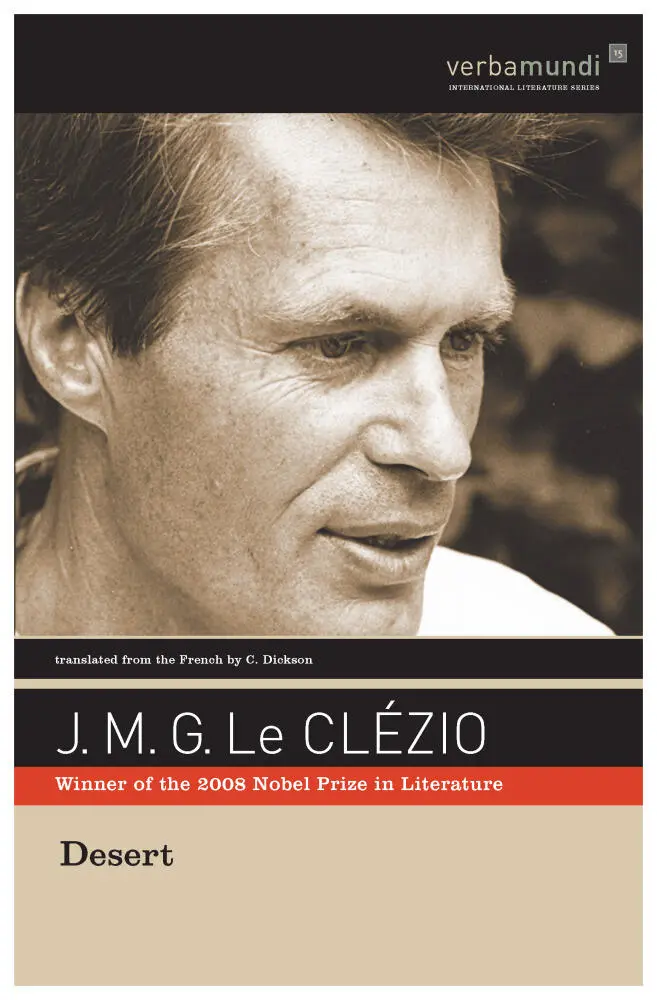
- Название:Desert
- Автор:
- Издательство:Verba Mundi Books
- Жанр:
- Год:2009
- Город:Jaffrey
- ISBN:978-1-56792-386-5
- Рейтинг книги:5 / 5. Голосов: 1
-
Избранное:Добавить в избранное
- Отзывы:
-
Ваша оценка:
Desert: краткое содержание, описание и аннотация
Предлагаем к чтению аннотацию, описание, краткое содержание или предисловие (зависит от того, что написал сам автор книги «Desert»). Если вы не нашли необходимую информацию о книге — напишите в комментариях, мы постараемся отыскать её.
Available for the first time in English translation, Desert is a novel composed of two alternating narratives, set in counterpoint. The first takes place in the desert between 1909 and 1912 and evokes the migration of a young adolescent boy, Nour, and his people, the Blue Men, notorious warriors of the desert. Driven from their lands by French colonial soldiers, Nour's tribe has come to the valley of the Saguiet El Hamra to seek the aid of the great spiritual leader known as Water of the Eyes. The religious chief sends them out from the holy city of Smara into the desert to travel still further. Spurred on by thirst, hunger, and suffering, Nour's tribe and others flee northward in the hopes of finding a land that can harbor them at last.
The second narrative relates the contemporary story of Lalla, a descendant of the Blue Men. Though she is an orphan living in a shantytown known as the Project near a coastal city in Morocco, the blood of her proud, obstinate tribe runs in her veins. All too soon, Lalla must flee to escape a forced marriage with an older, wealthy man. She travels to France, undergoing many trials there, from working as a hotel maid to becoming a highly-paid fashion model, and yet she never betrays the blood of her ancestors.
Desert — читать онлайн бесплатно полную книгу (весь текст) целиком
Ниже представлен текст книги, разбитый по страницам. Система сохранения места последней прочитанной страницы, позволяет с удобством читать онлайн бесплатно книгу «Desert», без необходимости каждый раз заново искать на чём Вы остановились. Поставьте закладку, и сможете в любой момент перейти на страницу, на которой закончили чтение.
Интервал:
Закладка:
Lalla would like to talk to him, tell him that Mr. Ceresola is dead, and that she’s never going to go back to work at the Hotel Sainte-Blanche, or in any of those rooms where death can strike at any minute and turn you into a wax mask; but there’s too much wind and too much noise to talk, so she shows Radicz the wad of rumpled banknotes in her hand.
“Look!”
Radicz opens his eyes wide, but he doesn’t ask any questions. Maybe he thinks Lalla stole the money, or worse yet.
Lalla puts the bills back into her coat pocket. That’s all that is left of the days she spent in the darkness of the hotel, scrubbing the linoleum with the couch-grass brush, sweeping the gray rooms that smell of sweat and tobacco. When she told the owner of the hotel she was leaving, he didn’t say anything either. He got out of his old bed, which was never made, and walked over to the safe at the back of his room. He took out the money, counted it, added a week’s advance, and gave it all to Lalla; then he went and lay back down again without saying anything else. He did all of that in a very leisurely fashion, in his pajamas, with his unshaven cheeks, and his dirty hair; then he went back to reading his newspaper again, as if nothing else were of any importance.
So now Lalla is drunk with freedom. She looks around, at the walls, the windows, the automobiles, the people, as if they were nothing but shapes, images, ghosts that the wind and the light would sweep away.
Radicz looks so unhappy that Lalla feels sorry for him.
“Come on!” She takes the boy by the hand, pulling him through the swirling crowd. Together they go into a very big store with bright light, not the beautiful light of the sun, but a harsh white glow, reflected in the profusion of mirrors. But that glare is also inebriating; it numbs and blinds you. With Radicz stumbling slightly behind her, Lalla goes through the perfume department, through cosmetics, wigs, and soaps; she stops almost everywhere, buys several different colored bars of soap that she has Radicz smell, then small bottles of perfume that she breathes in briefly as she walks along the aisles, and it makes her feel dizzy, almost nauseated. Red lipsticks, green eye shadow, black, ochre, foundation, brilliantine, creams, false eyelashes, false hair extensions — Lalla asks to be shown it all, and she shows it to Radicz, who doesn’t say anything; then she takes a long time choosing a little square bottle of brick-colored nail polish and a tube of bright red lipstick. She’s sitting on a tall stool, in front of a mirror, and trying out the colors on the back of her hand, while the salesgirl with strawlike hair gazes at her stupidly.
On the first floor, Lalla weaves through the clothing, still holding Radicz by the hand. She picks out a T-shirt, some blue denim work overalls, some canvas sandals, and red socks. She leaves her old, gray smock-dress and rubber sandals behind in the dressing room, but she holds on to the brown coat because she likes it. Now she walks more buoyantly, bouncing on the springy soles of the sandals, one hand in the pocket of her overalls. Her black hair falls in heavy curls on the collar of her coat, gleaming in the white electric light.
Radicz looks at her and thinks she’s beautiful, but he doesn’t dare tell her so. Her eyes are sparkling with joy. There’s something like a fiery glow to Lalla’s black hair and red copper face. Now it seems as if the electric light has brought the color of the desert sun back to life, as if she had stepped directly from the path out on the plateau of stones into the Prisunic store.
Maybe everything really has disappeared and the big store is standing alone in the midst of the boundless desert, just like a fortress of stone and mud. Yet it is the entire city that is surrounded by the sand, held tightly in its grips, and you can hear the superstructures of the concrete buildings snapping while cracks run up the walls and the plate glass mirrors of skyscrapers fall to the ground.
Lalla holds the burning force of the desert in her eyes. The light blazes on her black hair, on the thick tress she’s braiding in the hollow of her collarbone as she walks along. The light blazes in her amber-colored eyes, on her skin, on her high cheekbones, on her lips. And so, in the big store full of noise and white electricity, people step aside, stop as Lalla and Radicz the beggar go by. The women, the men stop, surprised, because they’ve never seen anyone like them. Lalla strides along in the middle of the aisle, wearing her dark overalls, her brown coat which opens to show her throat and her copper-colored face. She isn’t tall, and yet she seems huge as she moves down the center of the aisle and goes down the escalator to the ground floor.
It’s because of all the light streaming from her eyes, her skin, her hair, the almost supernatural light. Behind her comes the strange, skinny boy, in his men’s clothing, barefoot in his black leather shoes. His long black hair frames his hollow-cheeked, sunken-eyed triangular face. He tags behind silently, not moving his arms, walking a little bit sideways, the way cowering dogs do. People also look at him in surprise, as if he were a shadow detached from a body. Fear is visible on his face, but he tries to hide it with an odd smirking smile that looks more like a grimace.
At times, Lalla turns around, gives him a little wave, or takes his hand, “Come on!”
But the boy quickly lets himself fall behind. When they are outside again in the street, in the sun and the wind, Lalla asks him, “Are you hungry?”
Radicz looks at her with shiny feverish eyes.
“We’re going to eat now,” says Lalla. She shows him what’s left of the handful of rumpled bills in the pocket of her new overalls.
Along the wide straight avenues, people are walking, some hurriedly, others slowly, dragging their feet. The automobiles are still driving along near the sidewalks, as if they were on the lookout for something or someone, a place to park. There are swifts up in the cloudless sky; they swoop down the valleys of the streets giving shrill cries. Lalla is happy to be walking like that, holding Radicz’s hand, not saying anything, as if they were going off to the other side of the world and never coming back. She thinks about the lands across the sea, the red and yellow soil, the black rocks standing up tall in the sand like teeth. She thinks of the eyes of fresh water open on the sky, and of the taste of the chergui, which lifts up the thin skin of dust and makes the dunes move forward. She thinks of the Hartani’s cave again, up on top of the cliff, the place where she’d seen the sky, nothing but the sky. Now it was as if she were walking toward that land, along the avenues, as if she were going back. People step aside to let them pass, eyes squinting in the light, not understanding. She moves past them without seeing them, as if through a crowd of shadows. Lalla isn’t talking. She’s squeezing Radicz’s hand very tightly, walking straight ahead, toward the sun.
When they reach the sea, the wind is blowing even harder, heaving against them. The automobiles are honking aggressively, caught in the traffic jams around the harbor. Once again fear is visible on Radicz’s face, and Lalla holds his hand firmly, to reassure him. She mustn’t hesitate; if she does, the giddiness of the wind and the light will go away, leaving them on their own, and they won’t be brave enough to be free.
They walk down the wharves not looking at the ships with hollow clanking masts. The reflections of the water dance on Lalla’s cheek, setting her copper-colored skin, her hair aglow. The light around her is red, the red of burning embers. The boy looks at her, allows the heat emanating from Lalla to enter him, make him light-headed. His heart is pounding heavily, pulsing in his temples, in his neck.
Читать дальшеИнтервал:
Закладка:
Похожие книги на «Desert»
Представляем Вашему вниманию похожие книги на «Desert» списком для выбора. Мы отобрали схожую по названию и смыслу литературу в надежде предоставить читателям больше вариантов отыскать новые, интересные, ещё непрочитанные произведения.






Обсуждение, отзывы о книге «Desert» и просто собственные мнения читателей. Оставьте ваши комментарии, напишите, что Вы думаете о произведении, его смысле или главных героях. Укажите что конкретно понравилось, а что нет, и почему Вы так считаете.