J.M. le Clézio - Desert
Здесь есть возможность читать онлайн «J.M. le Clézio - Desert» весь текст электронной книги совершенно бесплатно (целиком полную версию без сокращений). В некоторых случаях можно слушать аудио, скачать через торрент в формате fb2 и присутствует краткое содержание. Город: Jaffrey, Год выпуска: 2009, ISBN: 2009, Издательство: Verba Mundi Books, Жанр: Современная проза, на английском языке. Описание произведения, (предисловие) а так же отзывы посетителей доступны на портале библиотеки ЛибКат.
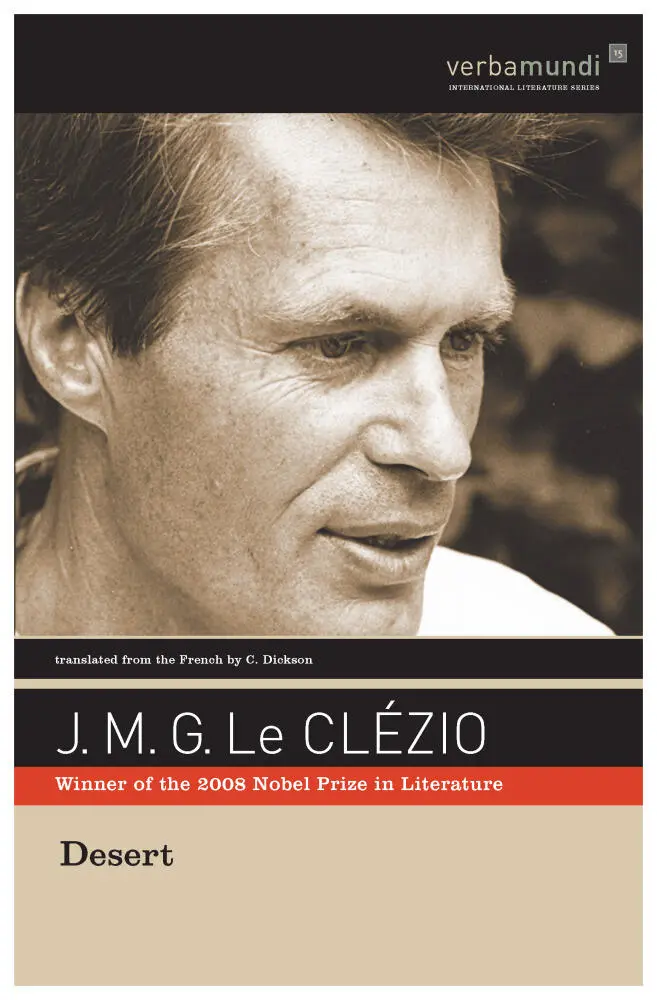
- Название:Desert
- Автор:
- Издательство:Verba Mundi Books
- Жанр:
- Год:2009
- Город:Jaffrey
- ISBN:978-1-56792-386-5
- Рейтинг книги:5 / 5. Голосов: 1
-
Избранное:Добавить в избранное
- Отзывы:
-
Ваша оценка:
Desert: краткое содержание, описание и аннотация
Предлагаем к чтению аннотацию, описание, краткое содержание или предисловие (зависит от того, что написал сам автор книги «Desert»). Если вы не нашли необходимую информацию о книге — напишите в комментариях, мы постараемся отыскать её.
Available for the first time in English translation, Desert is a novel composed of two alternating narratives, set in counterpoint. The first takes place in the desert between 1909 and 1912 and evokes the migration of a young adolescent boy, Nour, and his people, the Blue Men, notorious warriors of the desert. Driven from their lands by French colonial soldiers, Nour's tribe has come to the valley of the Saguiet El Hamra to seek the aid of the great spiritual leader known as Water of the Eyes. The religious chief sends them out from the holy city of Smara into the desert to travel still further. Spurred on by thirst, hunger, and suffering, Nour's tribe and others flee northward in the hopes of finding a land that can harbor them at last.
The second narrative relates the contemporary story of Lalla, a descendant of the Blue Men. Though she is an orphan living in a shantytown known as the Project near a coastal city in Morocco, the blood of her proud, obstinate tribe runs in her veins. All too soon, Lalla must flee to escape a forced marriage with an older, wealthy man. She travels to France, undergoing many trials there, from working as a hotel maid to becoming a highly-paid fashion model, and yet she never betrays the blood of her ancestors.
Desert — читать онлайн бесплатно полную книгу (весь текст) целиком
Ниже представлен текст книги, разбитый по страницам. Система сохранения места последней прочитанной страницы, позволяет с удобством читать онлайн бесплатно книгу «Desert», без необходимости каждый раз заново искать на чём Вы остановились. Поставьте закладку, и сможете в любой момент перейти на страницу, на которой закончили чтение.
Интервал:
Закладка:
Lalla knows the other lodgers by sight, but doesn’t know anything about them. They’re people who never stay long, Arabs, Portuguese, Italians, who only come to sleep. There are also a few who have stayed, but Lalla doesn’t like them — two Arabs on the first floor who look cruel, and who get drunk on wood alcohol. There’s the man who reads obscene magazines, and who leaves all those pictures of naked women on his unmade bed, so that Lalla will pick them up and look at them. He’s a Yugoslavian, whose name is Gregori. One day, Lalla went into his room, and he was there. He took her by the arm and wanted to knock her onto the bed, but Lalla started yelling, and he got scared. He let her go, shouting insults at her. Ever since that day, Lalla has never gone into his room while he’s there.
But none of those people really exist, except for the old man with his face eaten away. They don’t exist because they leave no trace of their passage, as if they were nothing but shadows, ghosts. When they leave one day, it’s as if they’d never come. The bed with canvas webbing is still the same, and the wobbly chair, the stained linoleum, the greasy walls where the paint is blistering, and the bare, flyspecked, electric lightbulb hanging at the end of its wire. Everything stays the same.
But most of all, it’s the light coming from outside, through the dirty windowpanes, the gray light from the interior courtyard, the pale reflection of the sun, and the sounds: sounds of radios, sounds of automobile motors on the main avenue, the voices of men arguing. Sounds of pipes squeaking, the sound of the toilet flushing, the stairs creaking, the sound of the wind rattling the metal gutters.
Lalla listens to all of those sounds, at night, lying on her bed, looking at the yellow spot of the electric lightbulb burning. The men can’t exist here, neither can children, nor any living thing. She listens to the sounds of the night as if she were inside a cave, and it’s as if she herself didn’t really exist anymore. In her belly, something is fluttering now, palpitating like an unfamiliar organ.
Lalla curls up in her bed, knees drawn up against her chin, and she tries to listen to the thing that is moving inside of her, that is beginning to take on life. There is still the fear, the fear that makes you flee through the streets and makes you bounce around from one corner to the next, like a ball. But at the same time, there is an odd wave of happiness, of warmth and light, that seems to be coming from far away, from beyond the seas and the cities, and binding Lalla to the beauty of the desert. Then, just as she does every night, Lalla closes her eyes, she breathes in deeply. Slowly, the gray light of the narrow room fades out, and the lovely night appears. It is inhabited with stars, cold, silent, lonely. She is resting on the boundless earth, on the stretch of immobile dunes. Next to Lalla is the Hartani, wearing his homespun robe, and his black copper face is shining in the starlight. It is his gaze that is coming all the way out to her, reaching her here, in this narrow room, in the sickly light of the electric lightbulb, and the Hartani’s gaze is moving inside of her, in her belly, awakening life. It’s been such a long time since he disappeared, such a long time since she went away, across the sea, as if she had been banished, and yet the gaze of the young shepherd is very forceful; she can feel him actually moving deep down inside, in the secrecy of her womb. Then they are the ones who disappear, the people in this city, the policemen, the men in the streets, the lodgers in the hotel, all of them disappear, and along with them, their city, their houses, their streets, their automobiles, their trucks, and there is nothing left but the stretch of desert where Lalla and the Hartani are lying together. They are both wrapped up in the large homespun robe, surrounded by the black night and the myriads of stars, and they are holding very tightly to one another, so as not to feel the cold creeping over the earth.
When someone dies in the Panier, the funeral shop on the ground floor of the hotel takes care of everything. At first Lalla thought it belonged to a relative of the hotel owner; but it’s just a business like all the others. At first, Lalla thought that people came to die at the hotel, and afterward, they were sent to the funeral home. There aren’t many people in the shop, only the boss, Mr. Cherez, two morticians, and the limousine driver.
When someone in the Panier is dead, the employees leave in the limousine, and they go to hang big black tapestries with silver teardrops on the door of the house. In front of the door, on the sidewalk, they set up a little table draped with a black cloth that also has silver tears on it. On the table, there is a saucer so that people can put a little card with their name on it when they go and visit the dead person.
When Mr. Ceresola died, Lalla knew right away, because she saw his son in the shop on the ground floor of the hotel. Mr. Ceresola’s son is a short, chubby little man with a bristly mustache who doesn’t have much hair, and he always looks at Lalla as if she were transparent. But Mr. Ceresola was different. He’s someone Lalla really likes. He’s an Italian, not very tall, but old and thin, and he walks painfully because of his rheumatism. He’s always dressed in a black suit that must be pretty old too, because the fabric is threadbare at the elbows, at the knees. With the suit, he wears old black leather shoes that are always well polished, and in cold weather, he adds a wool scarf and a cap. Mr. Ceresola has a very dry, wrinkled face, quite leathered from the open air, short white hair, and funny tortoiseshell glasses, repaired with bandage tape and string.
People in the Panier really like him because he’s polite and pleasant to everyone, and he has a dignified air about him with his old-fashioned black suit and his polished shoes. And also, everyone knows that he used to be a carpenter, a real master carpenter, and that he came from Italy before the war, because he didn’t like Mussolini. That’s the story he sometimes tells when he runs into Lalla in the street on his way to the grocery. He says he arrived in Paris without any money, just enough to pay for two or three nights in a hotel, and that he didn’t speak a word of French; so when he asked for some soap to wash with, he was shown a pot of hot water.
When Lalla runs into him, she helps him carry his packages because he has a hard time walking, especially when you have to go up the stairs leading to Rue du Panier. So as they walk along, he tells her about Italy, about his village, and the days when he worked in Tunisia, and the houses he built everywhere in Paris, in Lyon, in Corsica. He has a funny, somewhat loud voice, and Lalla has a hard time understanding his accent, but she enjoys hearing him speak.
Now he’s dead. When Lalla realized that, she looked so sad that Mr. Ceresola’s son glanced at her in astonishment, as if he were surprised that someone could care about his father. Lalla left very quickly, because she doesn’t much like to breathe in the air in the funeral home, or see all of those celluloid wreaths, those coffins, and above all those morticians who have mean eyes.
So then Lalla followed the streets, slowly, head bowed, and that’s how she ended up at the door to Mr. Ceresola’s house. Around the door were the tapestries and the little table with its black cloth and saucer. There was also a big blackboard above the door with two crescent-shaped letters like this:

Lalla goes into the house, she climbs the stairs with narrow steps, just as she used to do when she would carry Mr. Ceresola’s packages, slowly, stopping on each landing to catch her breath. She is so tired today, she feels so heavy, as if she were going to fall asleep, as if she were going to die when she reached the top floor.
Читать дальшеИнтервал:
Закладка:
Похожие книги на «Desert»
Представляем Вашему вниманию похожие книги на «Desert» списком для выбора. Мы отобрали схожую по названию и смыслу литературу в надежде предоставить читателям больше вариантов отыскать новые, интересные, ещё непрочитанные произведения.












Обсуждение, отзывы о книге «Desert» и просто собственные мнения читателей. Оставьте ваши комментарии, напишите, что Вы думаете о произведении, его смысле или главных героях. Укажите что конкретно понравилось, а что нет, и почему Вы так считаете.