J.M. le Clézio - Desert
Здесь есть возможность читать онлайн «J.M. le Clézio - Desert» весь текст электронной книги совершенно бесплатно (целиком полную версию без сокращений). В некоторых случаях можно слушать аудио, скачать через торрент в формате fb2 и присутствует краткое содержание. Город: Jaffrey, Год выпуска: 2009, ISBN: 2009, Издательство: Verba Mundi Books, Жанр: Современная проза, на английском языке. Описание произведения, (предисловие) а так же отзывы посетителей доступны на портале библиотеки ЛибКат.
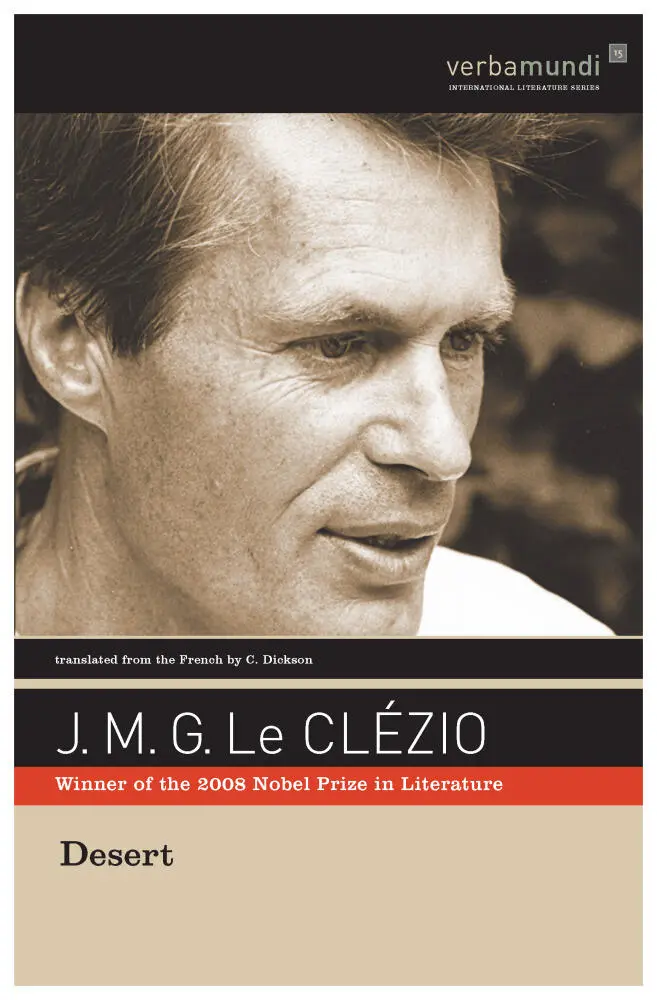
- Название:Desert
- Автор:
- Издательство:Verba Mundi Books
- Жанр:
- Год:2009
- Город:Jaffrey
- ISBN:978-1-56792-386-5
- Рейтинг книги:5 / 5. Голосов: 1
-
Избранное:Добавить в избранное
- Отзывы:
-
Ваша оценка:
Desert: краткое содержание, описание и аннотация
Предлагаем к чтению аннотацию, описание, краткое содержание или предисловие (зависит от того, что написал сам автор книги «Desert»). Если вы не нашли необходимую информацию о книге — напишите в комментариях, мы постараемся отыскать её.
Available for the first time in English translation, Desert is a novel composed of two alternating narratives, set in counterpoint. The first takes place in the desert between 1909 and 1912 and evokes the migration of a young adolescent boy, Nour, and his people, the Blue Men, notorious warriors of the desert. Driven from their lands by French colonial soldiers, Nour's tribe has come to the valley of the Saguiet El Hamra to seek the aid of the great spiritual leader known as Water of the Eyes. The religious chief sends them out from the holy city of Smara into the desert to travel still further. Spurred on by thirst, hunger, and suffering, Nour's tribe and others flee northward in the hopes of finding a land that can harbor them at last.
The second narrative relates the contemporary story of Lalla, a descendant of the Blue Men. Though she is an orphan living in a shantytown known as the Project near a coastal city in Morocco, the blood of her proud, obstinate tribe runs in her veins. All too soon, Lalla must flee to escape a forced marriage with an older, wealthy man. She travels to France, undergoing many trials there, from working as a hotel maid to becoming a highly-paid fashion model, and yet she never betrays the blood of her ancestors.
Desert — читать онлайн бесплатно полную книгу (весь текст) целиком
Ниже представлен текст книги, разбитый по страницам. Система сохранения места последней прочитанной страницы, позволяет с удобством читать онлайн бесплатно книгу «Desert», без необходимости каждый раз заново искать на чём Вы остановились. Поставьте закладку, и сможете в любой момент перейти на страницу, на которой закончили чтение.
Интервал:
Закладка:
Lalla sits down for a moment on the steps, sheltered by the stone balustrade. She looks at the ground stained with guano and the dusty earth in front of the parvis. The wind is blowing violently, whistling through the gratings. There is great loneliness here, like on a ship on the high seas. It is painful; it tightens in your throat and temples, makes sounds echo strangely, makes lights flicker in the distance, along the streets.
Later, when night has come, Lalla goes back up into the city. She crosses Place de Lenche, where men are crowding around the doorways of bars, takes Montée Accoules, her hand resting on the polished double iron railing she so likes. But even there, the anxiety doesn’t dissipate. It’s behind her, like one of the big dogs with its hair bristling, with a starved look, which prowls around in the gutters looking for a bone to gnaw on. It’s hunger, undoubtedly, hunger that gnaws at your belly, that hollows out its emptiness in your head, but hunger for everything, everything that is denied, inaccessible. It’s been such a long time since people have eaten their fill, such a long time since they’ve had any rest, or happiness, or love, anything other than cold basement rooms, where the fog of anxiety floats, anything other than those dark streets overrun with rats, oozing with fetid water, filled with piles of refuse. Misery.
As she walks along in the narrow grooves of the streets, Rue du Refuge, Rue des Moulins, Rue de Belles-Ecuelles, Rue de Montbrion, Lalla sees all the detritus as if it had been washed up by the sea, rusted tin cans, old papers, bits of bone, wilted oranges, vegetables, rags, broken bottles, rubber rings, bottle caps, dead birds with torn-off wings, squashed cockroaches, dust, dirt, decay. These are the marks of loneliness, of abandon, as if humans had already fled this city, this world, left them in the grips of disease, death, oblivion. As if there were only a few people left in this world, the misfortunate, who continue to live in those run-down houses, in those already tomblike apartments, while the emptiness blows in through the gaping windows, the chill of night that tightens chests, that veils the eyes of old people and children.
Lalla continues to walk through the rubble; she walks over fallen plaster. She doesn’t know where she’s going. She goes down the same street several times, around the high walls of the general hospital. Maybe Aamma is there, in the big underground kitchen with greasy transoms, running her sponge mop over the black floors that nothing will ever be able to clean? Lalla doesn’t want to go back to Aamma’s place, ever again. She wanders along dark streets as a drizzle begins to fall from the sky, because the wind has fallen silent. Men walk past, dark faceless shapes that also seem lost. Lalla steps aside to let them pass, disappears into doorways, hides behind stopped cars. When the street is empty once again, she comes out, continues walking silently, exhausted, drunk with sleep.
Yet she doesn’t want to sleep. Where would she be able to let herself go, forget herself? The city is too dangerous, and anxiety won’t let poor girls sleep like the children of rich people.
There are too many sounds in the dark silence, sounds of hunger, sounds of fear, of loneliness. There is the sound of the sodden voices of bums in the shelters, the sound of Arab cafés with their endless, monotonous music, and the slow laughter of hashish smokers. There is the terrifying sound of the mad man punching his wife hard with his fist, every night, and the high-pitched voice of the woman screaming at first, then whimpering and moaning. Lalla is hearing all of those sounds now, very clearly, as if they echoed on endlessly. There is one sound in particular that follows her everywhere, that gets inside of her head and her belly and always repeats the same affliction: it’s the sound of a child coughing, somewhere in the night, in the house next door, maybe it’s the son of the Tunisian woman who is so fat and so pale, with sort-of-crazed green eyes? Or maybe it’s some other child who’s coughing in a house a few streets away, and then another who answers from somewhere else, in an attic room with a hole in the roof, still another who can’t sleep in the freezing alcove, and another, as if there were scores, hundreds of sick children coughing in the night, making the same hoarse sound which is tearing up their throats and their lungs. Lalla stops, leaning her back against a door, and presses the palms of her hands against her ears with all of her might, to keep from hearing the coughing of the children barking out in the cold night from house to house.
Farther on, there is the curve in the street from where you can see, as though from a balcony, the intersection of the main avenues like the mouth of a river, and all the blinking, blinding lights. So Lalla climbs down the hill, following the stairways, she goes in through Passage de Lorette, walks across the large courtyard filled with the sound of radios and human voices, with walls blackened with smoke and poverty. She stops for a minute, her head turned toward the windows, as if someone were going to appear. But all that can be heard is the inhuman sound of a voice on the radio shouting something, slowly repeating the same sentence, “At the sound of this music the gods make their entrance!”
But Lalla doesn’t know what that means. The inhuman voice drowns out the sound of the children coughing, the sound of drunken men, and the whimpering woman. Then there is another dark passageway, like a corridor, and you come out on the boulevard.
Out there, for a moment, Lalla doesn’t feel the fear anymore, or the sadness. The crowd hurries along the sidewalks, eyes glittering, hands agile, feet pounding on the cement, hips swinging, garments rustling, charged with static electricity. Automobiles, trucks, motorcycles drive along on the pavement, headlights bright, and the reflections in the shop windows flash on and off constantly. Lalla lets herself be swept along by the movement of the people; she’s not thinking about herself now; she’s empty, as if she didn’t really exist anymore. That’s why she always comes back to the main avenues, to lose herself in the flow, to just drift along.
There are so many lights! Lalla watches them as she walks straight ahead. The blue, red, orangey, purple lights, the steady lights, the ones that move, the ones that dance in place like match flames. Lalla thinks about the star-filled sky, about the vast desert night, when she was lying on the hard sand next to the Hartani, and they were breathing softly, as if they had but one body. But it’s difficult to remember. Out here, you have to keep walking, walking along with the others, as if you knew where you were going, but there’s no end to the journey, no hiding place in a dip of the dunes. You have to keep walking so you won’t fall, so you won’t be trampled by the others.
Lalla goes all the way down to the end of the avenue, then walks back up another avenue, and yet another. There are still all the lights, and the sound of humans and their motors roars endlessly on. Then, all of a sudden, the fear returns, the anxiety, as if all the sounds of those tires and footsteps were tracing large concentric circles on the sides of a gigantic funnel.
Now Lalla can see them again: they’re out there everywhere, sitting against the blackened walls, hunched over on the ground amidst the excrement and the garbage: the beggars, the old blind people with outstretched hands, the young women with chapped lips, a child hanging on their flaccid breast, the little girls dressed in rags, faces covered with scabs, who cling to the clothing of passersby, old women, the color of soot, with tangled hair, all the people whom the hunger and the cold have driven out of their hovels, and who are pushed along like flotsam by the waves. They are there, in the middle of the indifferent city, in the head-splitting din of motors and voices, rain-soaked, windblown, uglier and poorer still in the wan light of the electric lightbulbs. They look at the people passing by with blurry eyes, their sad moist eyes which are constantly fleeing and turning back toward yours, like those of dogs. Lalla walks slowly past the beggars, looking at them with a knot in her throat and again, that terrible void is hollowing out its whirlwind there, in front of those discarded bodies. She’s walking so slowly that a beggar woman grabs her by the coat and tries to pull the young woman over to her. Lalla resists, forcefully pries away the fingers that are clutching at the cloth of her coat; she looks in pity and in horror at the face of the woman who is still young, cheeks swollen with alcohol, blotched red from the cold and, above all, those two blue, almost transparent, blind eyes, in which the pupils are no bigger than a pinhead.
Читать дальшеИнтервал:
Закладка:
Похожие книги на «Desert»
Представляем Вашему вниманию похожие книги на «Desert» списком для выбора. Мы отобрали схожую по названию и смыслу литературу в надежде предоставить читателям больше вариантов отыскать новые, интересные, ещё непрочитанные произведения.











Обсуждение, отзывы о книге «Desert» и просто собственные мнения читателей. Оставьте ваши комментарии, напишите, что Вы думаете о произведении, его смысле или главных героях. Укажите что конкретно понравилось, а что нет, и почему Вы так считаете.