J.M. le Clézio - Desert
Здесь есть возможность читать онлайн «J.M. le Clézio - Desert» весь текст электронной книги совершенно бесплатно (целиком полную версию без сокращений). В некоторых случаях можно слушать аудио, скачать через торрент в формате fb2 и присутствует краткое содержание. Город: Jaffrey, Год выпуска: 2009, ISBN: 2009, Издательство: Verba Mundi Books, Жанр: Современная проза, на английском языке. Описание произведения, (предисловие) а так же отзывы посетителей доступны на портале библиотеки ЛибКат.
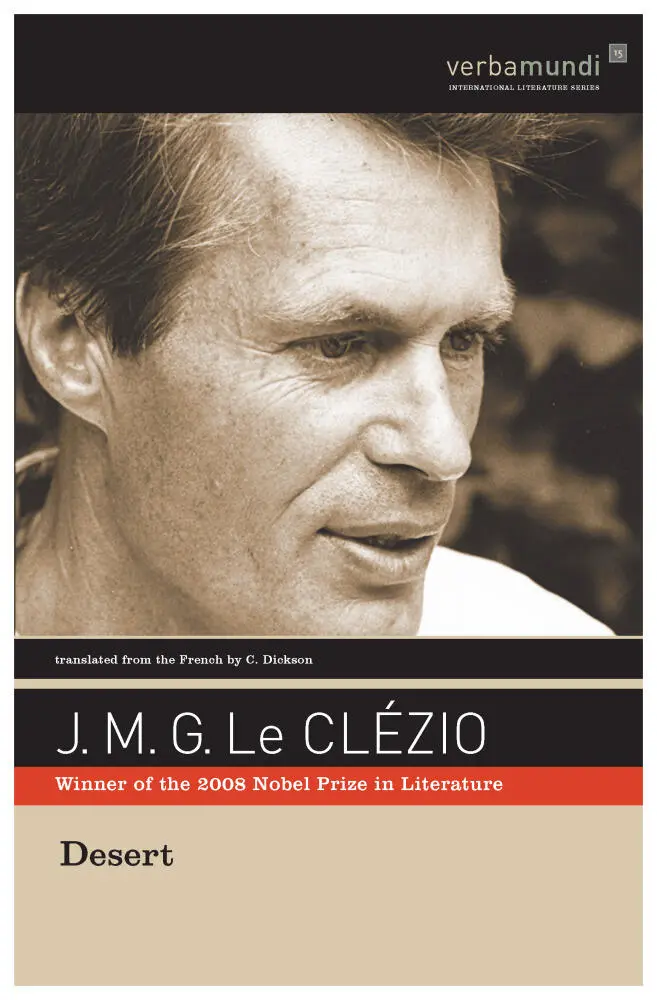
- Название:Desert
- Автор:
- Издательство:Verba Mundi Books
- Жанр:
- Год:2009
- Город:Jaffrey
- ISBN:978-1-56792-386-5
- Рейтинг книги:5 / 5. Голосов: 1
-
Избранное:Добавить в избранное
- Отзывы:
-
Ваша оценка:
Desert: краткое содержание, описание и аннотация
Предлагаем к чтению аннотацию, описание, краткое содержание или предисловие (зависит от того, что написал сам автор книги «Desert»). Если вы не нашли необходимую информацию о книге — напишите в комментариях, мы постараемся отыскать её.
Available for the first time in English translation, Desert is a novel composed of two alternating narratives, set in counterpoint. The first takes place in the desert between 1909 and 1912 and evokes the migration of a young adolescent boy, Nour, and his people, the Blue Men, notorious warriors of the desert. Driven from their lands by French colonial soldiers, Nour's tribe has come to the valley of the Saguiet El Hamra to seek the aid of the great spiritual leader known as Water of the Eyes. The religious chief sends them out from the holy city of Smara into the desert to travel still further. Spurred on by thirst, hunger, and suffering, Nour's tribe and others flee northward in the hopes of finding a land that can harbor them at last.
The second narrative relates the contemporary story of Lalla, a descendant of the Blue Men. Though she is an orphan living in a shantytown known as the Project near a coastal city in Morocco, the blood of her proud, obstinate tribe runs in her veins. All too soon, Lalla must flee to escape a forced marriage with an older, wealthy man. She travels to France, undergoing many trials there, from working as a hotel maid to becoming a highly-paid fashion model, and yet she never betrays the blood of her ancestors.
Desert — читать онлайн бесплатно полную книгу (весь текст) целиком
Ниже представлен текст книги, разбитый по страницам. Система сохранения места последней прочитанной страницы, позволяет с удобством читать онлайн бесплатно книгу «Desert», без необходимости каждый раз заново искать на чём Вы остановились. Поставьте закладку, и сможете в любой момент перейти на страницу, на которой закончили чтение.
Интервал:
Закладка:
But today, even the pink dome frightens her, as if there were a threat behind its narrow windows, or as if it were a tomb. Without looking back, she walks hurriedly away, goes down along the silent streets, toward the sea again. The wind comes in gusts, making the laundry snap, large white sheets with frayed edges, children’s clothing, men’s clothing, blue and pink women’s undergarments; Lalla doesn’t want to look at them because they display invisible bodies, legs, arms, breasts, like corpses with no heads. She walks down Rue Rodillat, and there too, those low windows covered with grilles, closed off with bars, where men, women, and children are prisoners. Lalla hears snatches of sentences from time to time, sounds of dishes or of cooking, or at times that nasal music, and she thinks of all the people who are prisoners, in cold dark rooms, with the cockroaches and the rats, all the people who will never see the light again, never breathe in the wind again.
Over there, behind that window with cracked blackened panes, there’s the fat infirm woman who lives alone with two scrawny cats, and who is always talking about her garden, her roses, her trees, about the tall lemon tree that produces the most beautiful fruit in the world — she, who has nothing but a cold dark cubbyhole and her two blind cats. This is Ibrahim’s house; he’s an old soldier from Oran who fought against the Germans, against the Turks, against the Serbs, out there in the places whose names he tirelessly repeats when Lalla asks him to: Thessalonica, Varna, Bjala. But won’t he die too, trapped in his crumbling house in which the dark slippery stairs almost trip him up at every step, where the walls weigh down on his thin chest like a wet coat? Over there too, the Spanish woman with six children who all sleep in the same room with the narrow window, and who wander the Panier neighborhood, dressed in rags, pale, always starving. There, in the house with the walls that seem to be damp with sickly sweat, right where that lizard is running, is the sick couple who cough so hard that sometimes Lalla wakes up with a start in the night, as if she could really hear them through all of the walls. Then the foreign couple: he’s Italian, she’s Greek, and he’s drunk every night, and every night he beats his wife, hits her hard in the head, just like that, without even getting mad, just because she’s there and looking at him with those teary eyes in her face swollen with fatigue. Lalla hates that man; she clenches her teeth when she thinks about him, but she’s also frightened of that calm and desperate drunkenness, of the woman’s submission, because that’s what can be seen in every stone and every stain in the cursed streets of this city, in every sign written on the walls of the Panier.
There is hunger everywhere, fear, cold poverty, like old, used, damp clothing, like old, withered, fallen faces.
Rue du Panier, Rue du Bouleau, Traverse Boussenoue, always the same scabby walls, the tops of the buildings brushed with cold light, the feet of the buildings where green water puddles, where piles of garbage rot. Here, there are no wasps or flies zooming freely through the air where the dust swirls. There is nothing but people, rats, cockroaches, everything that dwells in holes with no light, no air, no sky. Lalla prowls around the streets like an old black dog with its hair bristling, not being able to find its spot. She sits down for a minute on the steps of the stairway, next to a wall on the other side of which grows the only tree in town, an old fig tree rich with smells. She thinks for a second about the tree she used to love back when Old Naman would tell stories while he was repairing his nets. But, like an old arthritic dog, she can’t stay in one place for very long. She strikes out again through the dark labyrinth, as the light from the sky grows slowly dimmer. She sits back down for a moment on the bench in the little square where there is a preschool. There are days she really likes sitting there, watching the small children toddling around in the square, legs wobbling, arms held out on either side. But now, there’s nothing but shade, and on one of the benches, an old black woman in an ample colorful dress. Lalla goes over to sit beside her, tries to talk to her.
“Do you live here? Where are you from? What’s the name of your country?”
The old woman looks at her without understanding, then she gets frightened and covers her face with the skirt of her colorful dress.
At the back of the square, there is a wall that Lalla is very familiar with. She knows every stain on the roughcast, every crack, every dribble of rust. All the way up at the top of the wall are black chimney stacks, gutters. Under the roof, little shutterless windows with dirty windowpanes. Under old Ida’s window, laundry stiffened with rain and dust is hanging on a line. Under that, the windows of the gypsies. Most of the windowpanes are broken, some windows don’t even have wooden frames anymore, they’re nothing more than gaping black holes, like eye sockets.
Lalla stares at the dark openings, and once again she feels the cold and terrifying presence of death. She shudders. There is an immense void in this square, a whirl of emptiness and death that is coming from those windows, spiraling between the walls of the houses. On the bench next to her, the old mulattress isn’t moving, isn’t breathing. The only thing Lalla can see is her emaciated arm where the veins protrude like ropes, and her hand with long fingers stained with henna, holding the skirt of her dress up to her face on the side next to Lalla.
Maybe there’s some kind of trap here too? Lalla would like to stand up and run away, but she feels riveted to the plastic bench, as if in a dream. Night falls gradually over the city, shadows fill the square, blotting out the corners, the cracks, slipping into the windows through the broken panes. It’s cold now, and Lalla wraps herself tightly in her brown coat, she turns the collar up all the way to her eyes. But the cold creeps up through the rubber soles of her sandals, along her legs, to her bottom, to her lower back. Lalla closes her eyes to struggle against it, to stop seeing the emptiness whirling around the square, around the abandoned playground, before the blind eyes of the windows.
When she opens her eyes again, she’s alone. The old mulattress in the colorful dress has left without her noticing. Oddly enough, the sky and the earth are not as dark as before, as if night had receded.
Lalla continues walking along the narrow silent streets. She goes down stairways where the pavement has been smashed in with jackhammers. Cold sweeps along the street, making the sheet metal on the toolsheds bang.
When she comes out facing the sea, Lalla sees the day isn’t finished yet. There is a big bright spot above the cathedral, between the towers. Lalla runs across the avenue without even seeing the speeding automobiles, which honk their horns and flash their headlights. She slowly approaches the upper parvis, climbs the steps, slips between the columns. She remembers the first time she ever came to the cathedral. She was very frightened, because it was so huge and abandoned, like a cliff. Then Radicz the beggar showed her where he spends the night in summer, when the wind coming in from the sea is as warm as a breath. He showed her the place from where you can see the huge freighters coming into the harbor at night, with their red and green lights. He also showed her the place where you can see the moon and the stars, between the columns of the parvis.
But this evening it’s empty. The green and white stone is ice-cold, the silence is heavy, disturbed only by the distant whishing of automobile tires and the screeching of bats flitting about under the vaulted ceiling. The pigeons are already sleeping, perched all around on the cornices, huddling together.
Читать дальшеИнтервал:
Закладка:
Похожие книги на «Desert»
Представляем Вашему вниманию похожие книги на «Desert» списком для выбора. Мы отобрали схожую по названию и смыслу литературу в надежде предоставить читателям больше вариантов отыскать новые, интересные, ещё непрочитанные произведения.












Обсуждение, отзывы о книге «Desert» и просто собственные мнения читателей. Оставьте ваши комментарии, напишите, что Вы думаете о произведении, его смысле или главных героях. Укажите что конкретно понравилось, а что нет, и почему Вы так считаете.