Mo Yan - Sandalwood Death
Здесь есть возможность читать онлайн «Mo Yan - Sandalwood Death» весь текст электронной книги совершенно бесплатно (целиком полную версию без сокращений). В некоторых случаях можно слушать аудио, скачать через торрент в формате fb2 и присутствует краткое содержание. Город: Norman, Год выпуска: 2013, ISBN: 2013, Издательство: University of Oklahoma Press, Жанр: Современная проза, на английском языке. Описание произведения, (предисловие) а так же отзывы посетителей доступны на портале библиотеки ЛибКат.
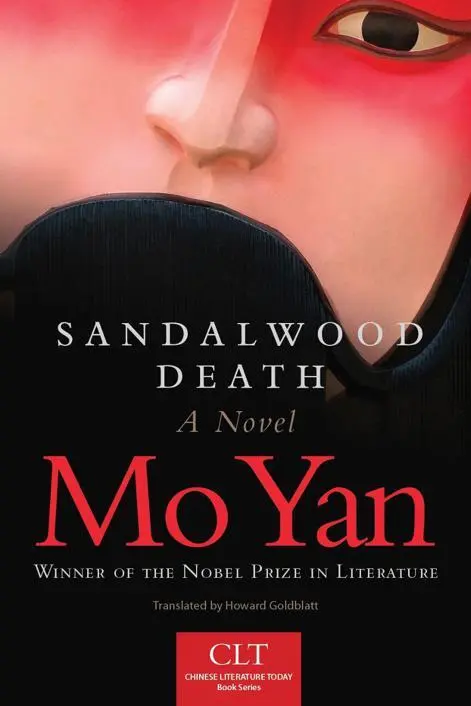
- Название:Sandalwood Death
- Автор:
- Издательство:University of Oklahoma Press
- Жанр:
- Год:2013
- Город:Norman
- ISBN:978-0-8061-4339-2
- Рейтинг книги:3 / 5. Голосов: 1
-
Избранное:Добавить в избранное
- Отзывы:
-
Ваша оценка:
Sandalwood Death: краткое содержание, описание и аннотация
Предлагаем к чтению аннотацию, описание, краткое содержание или предисловие (зависит от того, что написал сам автор книги «Sandalwood Death»). Если вы не нашли необходимую информацию о книге — напишите в комментариях, мы постараемся отыскать её.
Sandalwood Death Filled with the sensual imagery and lacerating expressions for which Mo Yan is so celebrated
brilliantly exhibits a range of artistic styles, from stylized arias and poetry to the antiquated idiom of late Imperial China to contemporary prose. Its starkly beautiful language is here masterfully rendered into English by renowned translator Howard Goldblatt.
Sandalwood Death — читать онлайн бесплатно полную книгу (весь текст) целиком
Ниже представлен текст книги, разбитый по страницам. Система сохранения места последней прочитанной страницы, позволяет с удобством читать онлайн бесплатно книгу «Sandalwood Death», без необходимости каждый раз заново искать на чём Вы остановились. Поставьте закладку, и сможете в любой момент перейти на страницу, на которой закончили чтение.
Интервал:
Закладка:
He recalled that his shifu kept a secret book with brittle, yellowing pages and crude drawings, with coded writing. According to Grandma Yu, the book, Secrets of a Penal Office , had been passed down by a Ming Dynasty grandma; it comprised lists of punishments, their concrete applications, matters to take into consideration, and copious illustrations. In a word, it was a classic text for executioners. Shifu pointed out to him and his fellow apprentices an illustration and accompanying text that described in detail the particulars of the slicing death, of which there were three levels. The first level required 3,357 cuts. For the second level it was 2,896, and for the third, 1,585. Regardless of how many cuts there were to be, he recalled hearing Shifu say, the final cut was the one that ended the prisoner’s life. So when the cutting began, the spacing between cuts must be precisely designed to fit the sex and physique of the condemned individual. If the prisoner died before the required number of cuts had been reached or was still alive after, the executioner had not done his job well. His shifu said that the minimum standard for the slicing death was the proportional size of the flesh removed—when placed on a scale, there should be only minimal differences. To that end, during an execution, the man with the knife must have his emotions under complete control. His mind must be clear and focused, his hand ruthless and resolute; he must simultaneously be like a maiden practicing embroidery and a butcher slaughtering a mule. The slightest hesitancy or indecision, even a spur-of-the-moment thought, would affect the hand in unwanted ways. This, the pinnacle of achievement, was exceedingly difficult to attain. The musculature of a human being varies from spot to spot in density and coherence. Knowing where to insert the knife, and with how much pressure, requires a skill that, over time, had become second nature. Gifted executioners, such as Elder Gao Tao and Elder Zhang Tang, sliced not with a knife and not with their hands, but with their minds and their eyes. Among the thousands of slicing deaths carried out down through the ages, none, it seems, had achieved perfection and been worthy of the term “masterpiece.” In virtually every case, what was accomplished was merely the dissection of a living human being. That appeared to explain why fewer cuts were required for slicing deaths in recent years. In the current dynasty, five hundred was the apex. And yet, precious few executions lasted nearly that long. Board of Punishments executioners, in respectful devotion to the sacred nature of this ancient profession, performed their duties in accordance with established practices handed down over time. But at the provincial, prefectural, sub-prefectural, and county levels, dragons and fish were all jumbled together—the good mixed with the bad—and most practitioners were hacks and local riffraff who did shoddy work and exerted minimal effort. If on a prisoner sentenced to five hundred cuts they made it to two or three hundred, that was considered a success. Most of the time, they chopped the victim into several chunks and quickly put him out of his misery.
Zhao Jia flung the second piece of meat cut from Qian’s body to the ground. To an executioner, the second piece of the victim is a sacrifice to the earth.
When Zhao was displaying the piece of meat on the tip of his knife for all to see, he was, he felt, the central figure, while the tip of his knife and the flesh stuck on it were the center of that center. The eyes of everyone in attendance, from the supremely prideful Excellency Yuan down to the most junior soldier in the formation, followed the progress of his knife, or, more accurately, the progress of Qian’s flesh impaled on that knife. When Qian’s flesh flew into the air, the observers’ eyes followed its ascent; when Qian’s flesh was flung to the ground, the observers’ eyes followed its descent. According to his shifu, in slicing deaths of old, every piece of flesh cut from the victim was laid out on a specially prepared surface, so that when the execution was completed, the official observer, along with members of the victim’s family, could come forward to count. One piece too many or too few was a serious transgression. According to his master, one slapdash executioner of the Song Dynasty made one too many cuts, and the complaint by the victim’s family cost him his life. Public executioner has always been a precarious profession, since a poor performance can itself be a death sentence. Consider: you must remove pieces of roughly the same size, the last cut must be the fatal one, and you must keep track of every cut you make. Three thousand three hundred and fifty-seven cuts require a full day, and there were times, by order of the sentencing authority, when the process was stretched out to three or as many as five days, making the work that much harder. A staunchly dedicated executioner invariably collapsed from fatigue at the end of a slicing death. As time went on, executioners heeded the travails of their predecessors by flinging away the excised flesh rather than laying it out for others to count. Old execution grounds were known for the wild dogs, crows, and vultures that prowled the area; slicing deaths provided feast days for these visitors.
He dipped a clean chamois into a basin of salty water and wiped the blood from Qian’s chest. The knife holes now resembled the fresh scars of severed tree branches. Then he made his third cut on Qian’s chest. Also about the size of a bronze coin, it was made in the shape of a fish scale. This fresh wound abutted the edge of one of the earlier wounds but retained its distinct shape. His shifu had said that this had a name of its own—the fish-scale cut, for that is exactly what it resembled. The flesh exposed by the third cut was a ghostly white, from which only a few drops of blood poked out, the sign of a good beginning; that augured well for the entire process, to his immense satisfaction. Shifu had said that a successful slicing death was marked by a modest flow of blood. He had told him that the blow to the heart before the first cut constricted the victim’s major arteries. Most of the blood was then concentrated in his abdomen and calves. Only then can you make a series of cuts, like slicing a cucumber, without killing the victim. Absent this technique, blood will flow unchecked, creating a terrible stench and staining the body, which has a powerful effect on the observers and destroys the symmetry of the cuts—a real mess. To be sure, a lifetime of experience had equipped these men with a talent to deal with any unanticipated situation. They were not easily flustered or caught unprepared. For instance, if a heavy flow of blood made cutting difficult or impossible, the immediate recourse was to empty a bucket of cold water on the victim. The shock would constrict his arteries. If that did not work, a bucket of vinegar would. According to the Compendium of Materia Medica , vinegar is an astringent whose properties work to stanch the flow of blood. If that too failed, removing a piece of flesh from each calf served as a bloodletting. This last technique, however, normally led to an early death from a loss of blood. But Qian’s arteries appeared to be well constricted. Zhao Jia could relax, for indications were that today’s affair had a good chance of success, and the bucket of aged Shanxi vinegar on the ground near the post would not be needed. In the unwritten code of the profession, the shop that supplied a bucket of vinegar received no payment for it and was required to give the executioner a “vinegar reclaim fee” if it was not used. The vinegar had to be donated by the merchant, not sold, and a fee for its non-use was an extravagantly unreasonable demand. And yet the Qing Dynasty placed greater value on ancestral precedents than on the law. However outmoded or irrational a practice, so long as there was a historical precedent, it could not and must not be abandoned. To the contrary, it gained increased inviolability over time. In Qing tradition, a criminal who was about to be executed enjoyed the privilege of sampling food and drink at any establishment passed on his way to the execution ground, free of charge. And the executioner enjoyed the privilege of receiving a free bucket of vinegar as well as a fee for not using it. By rights, the vinegar should have been returned to the shop that supplied it, but it was sold to a pharmacy instead, for now that it had soaked up the blood airs of the executed criminal, it was no longer ordinary vinegar, but a cure-all for the sick and dying, and had acquired the name “blessed vinegar.” Naturally, the pharmacy paid for this bucket of “blessed vinegar,” and since executioners were given no fees for the tasks they performed, they were forced to rely upon such earnings to make a living. He flung the third piece of flesh into the air, a sacrifice to the ghosts and gods. His apprentice announced:
Читать дальшеИнтервал:
Закладка:
Похожие книги на «Sandalwood Death»
Представляем Вашему вниманию похожие книги на «Sandalwood Death» списком для выбора. Мы отобрали схожую по названию и смыслу литературу в надежде предоставить читателям больше вариантов отыскать новые, интересные, ещё непрочитанные произведения.




Обсуждение, отзывы о книге «Sandalwood Death» и просто собственные мнения читателей. Оставьте ваши комментарии, напишите, что Вы думаете о произведении, его смысле или главных героях. Укажите что конкретно понравилось, а что нет, и почему Вы так считаете.