Enrique Vila-Matas - Dublinesque
Здесь есть возможность читать онлайн «Enrique Vila-Matas - Dublinesque» весь текст электронной книги совершенно бесплатно (целиком полную версию без сокращений). В некоторых случаях можно слушать аудио, скачать через торрент в формате fb2 и присутствует краткое содержание. Год выпуска: 2012, Издательство: NEW DIRECTIONS, Жанр: Современная проза, на английском языке. Описание произведения, (предисловие) а так же отзывы посетителей доступны на портале библиотеки ЛибКат.
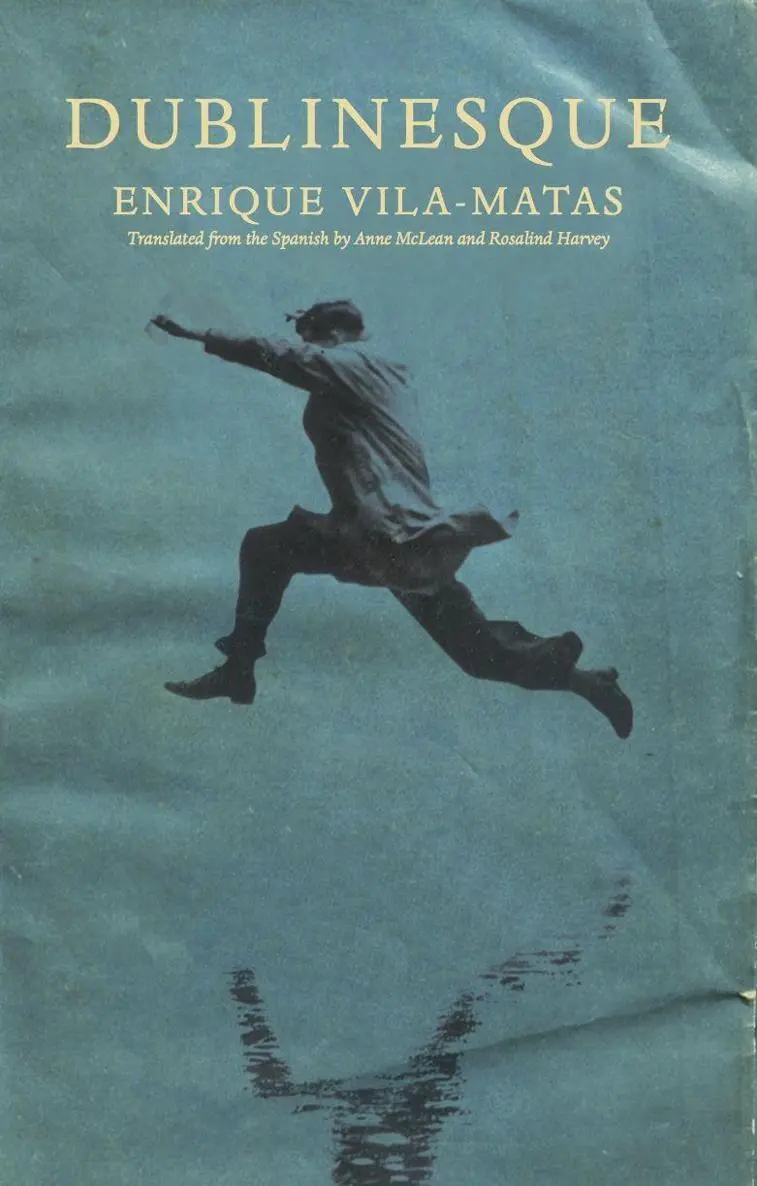
- Название:Dublinesque
- Автор:
- Издательство:NEW DIRECTIONS
- Жанр:
- Год:2012
- ISBN:нет данных
- Рейтинг книги:5 / 5. Голосов: 1
-
Избранное:Добавить в избранное
- Отзывы:
-
Ваша оценка:
Dublinesque: краткое содержание, описание и аннотация
Предлагаем к чтению аннотацию, описание, краткое содержание или предисловие (зависит от того, что написал сам автор книги «Dublinesque»). Если вы не нашли необходимую информацию о книге — напишите в комментариях, мы постараемся отыскать её.
One night, a renowned and now retired literary publisher has a vivid dream that takes place in Dublin, a city he’s never visited. The central scene of the dream is a funeral in the era of Ulysses. The publisher would give anything to know if an unidentified character in his dream is the great author he always wanted to meet, or the ghostly angel who abandoned him during childhood. As the days go by, he will come to understand that his vision of the end of an era was prophetic.
Enrique Vila-Matas traces a journey that connects the worlds of Joyce and Beckett, revealing the difficulties faced by literary authors, publishers, and good readers in a society where literature is losing influence. A robust work, Dublinesque is a masterwork of irony, humor, and erudition by one of Spain’s most celebrated living authors.
Dublinesque — читать онлайн бесплатно полную книгу (весь текст) целиком
Ниже представлен текст книги, разбитый по страницам. Система сохранения места последней прочитанной страницы, позволяет с удобством читать онлайн бесплатно книгу «Dublinesque», без необходимости каждый раз заново искать на чём Вы остановились. Поставьте закладку, и сможете в любой момент перейти на страницу, на которой закончили чтение.
Интервал:
Закладка:
How old he looks, how old he feels since he retired. And how dull it is not to drink. The world, in itself, is often tedious and lacks true emotion. Without alcohol, one is lost. Although he’d do well not to forget that it’s a wise person who monotonizes existence because then each small incident, if one knows how to read it in a literary way, has a wondrous quality. Never to forget this possibility of consciously monotonizing his life is the only or best solution he has left. Drinking might seriously damage his health. What’s more, he never found anything in alcohol, at the bottom of all those glasses, and nowadays can’t very well explain to himself what it was he was looking for there. Because he didn’t actually manage to avoid boredom, a feeling that always came back relentlessly. Although in interviews he had at times pretended he led an exciting publisher’s life; he used to make things up like crazy back then. Now he wonders what for. What good did it do him to make out that he had an extraordinary occupation and that he enjoyed it so much? Of course it was always better to be a publisher than to do nothing, like now. . Nothing? He’s planning a trip to Dublin, an homage, a funeral for a disappearing era. Is that nothing? How boring everything is, except thinking, thinking one is doing something. Or thinking what he’s thinking now: that it would be good to monotonize his life and try, wherever possible, to look for those hidden wonders in his daily life that, deep down, if he wants to, he’s perfectly capable of finding. Because isn’t he capable of seeing much more than what’s there in everything he experiences? At least all those years are worth something, all those years of understanding reading not just as a practice inseparable from his occupation as a publisher, but also as a way of being in the world: an instrument for interpreting, sequence after sequence, his day-to-day life.
He carries on getting ready for Dublin, and as his mind drifts, he ends up thinking about Irish writers. Nothing’s truer than the fact that he admires them more every day. He only ever published a couple of them, but it wasn’t because he wasn’t keen to publish more. For a long time, without success, he went after the rights for John Banville and Flann O’Brien. He thinks Irish writers are the most intelligent in terms of monotonizing and finding wonder in everyday tedium. In the last few days he’s read and re-read a few Irish authors — Elizabeth Bowen, Joseph O’Neill, Matthew Sweeney, Colum McCann — and his amazement at their capacity for writing astonishingly well has not diminished.
It’s as if the Irish had the gift of literature. He remembers that four years ago he saw one of them at a book fair in Guanajuato, Mexico, and discovered, among other things, that they didn’t have the Latin habit of talking about themselves. At a press conference, Claire Keegan replied almost angrily to a journalist who wanted to know what topics she wrote about in her novels: “I’m Irish. I write about dysfunctional families, miserable, loveless lives, illness, old age, winter, the gray weather, boredom, and rain.”
And at her side, Colum McCann concluded his colleague’s contribution, speaking in an exquisite plural, à la John Ford: “We don’t usually talk publicly about ourselves, we prefer to read.”
He sits thinking about how much he’d like to speak in the plural like this all the time, like John Ford, like the Irish writers. To say to Celia, for instance:
“We don’t think it’s a bad idea that you’re thinking of becoming a Buddhist. But we also think it might become a point of dispute and rupture.”
•
He knows Ricardo once felt like he was at the gates to the center of the world, but that he was ejected from this place by a radical slam of the door by Tom Waits. He doesn’t know, meanwhile, what Javier’s center might be. He phones him.
“Sorry,” he says, “but even though it’s not an odd-numbered day I wanted to talk to you, I want you to tell me if you remember any especially great moments in your life, some moment when you felt at the center of the world.”
An imposing silence at the other end of the phone. Maybe his sarcastic remark about the odd-numbered day has annoyed his friend. There is a silence that seems as if it might go on forever. Until at last, after a terrible, long sigh, Javier says:
“My first love, Riba, my first love. When I saw her for the first time, it was love at first sight. The center of the universe.”
Riba asks him what she was doing, his first love, when he saw her that first time. Was she perhaps walking like Dante’s Beatrice down a Florentine street?
“No,” Javier says, “I fell in love watching her peeling sweet potatoes in her parents’ kitchen, and I remember she was missing a tooth. . ”
“A tooth?”
Riba decides to take it all tragically seriously, despite the fact that Javier might just be joking. It’s not long before he realizes he’s made the right choice. His friend isn’t joking at all.
“Yes, you heard right,” Javier says, his voice quivering. “She wasn’t even peeling potatoes, but sweet potatoes, mind you, and the poor girl was missing a tooth.”
“Love’s like that,” Javier adds, faraway and philosophical. “The first sight of the beloved, although it might seem trivial, is capable of leading us to the strongest of passions, and even at times to suicide. Nothing’s as irrational as passion, believe you me.”
Since Riba has the impression of having inappropriately unearthed a dark drama, he takes the first opportunity in the conversation to say goodbye, thinking it’s always better to talk to Javier on odd-numbered days, when it’s he, on his own initiative, who calls.
“Have you ever eaten sweet potato?” Javier asks when they’ve practically already finished their farewells, and were both about to hang up.
Riba doesn’t like the thought of not replying. But the fact is he doesn’t answer. He hangs up. He pretends the line has been cut off. My god, he thinks, imagine, talking to me about sweet potatoes. Poor Javier. A love affair is always an interesting topic, but mixed with food it’s indigestible.
He already knows that, at the center of the world, Ricardo had a door harshly slammed in his face by Tom Waits. And that good old Javier, meanwhile, saw a girl peeling something. As for young Nietzky, in his case it might all be different, and the question of the center of things may not be important, given that, after all — almost without realizing it Riba slips into a torrential inner world at the mere mention of New York — he already lives in this center, lives there without any trouble, lives right in the very center of the world. But who knows what’s happening in his mind when young Nietzky’s left alone in the center of the center of the center of his world, and thinks. What might go through his head, for example, when the light’s purity bathes the windows of the skyscrapers, which are like blue, transparent skies pointing toward a superior sky over there in Central Park? What does he really know about Nietzky? And about the superior sky of Central Park in New York?
He tries to forget all this, because it’s complicated and because it’s Wednesday and now he’s at his parents’ house and hasn’t properly heard what his mother’s just said.
“I asked you if everything’s all right,” she repeats. “You look distracted.”
How fast time goes by, he thinks. It’s Wednesday again. Love, illness, old age, gray weather, boredom, rain. All the Irish writers’ themes seem to be highly topical in his parents’ living room. And outside, the drizzle adds to this impression.
Illness, old age, boredom, unbearable grayness. Nothing that’s not common knowledge on the face of the earth. The stark contrast between the wake-like atmosphere in his parents’ house and Nietzky’s torrential inner world seems enormous.
Читать дальшеИнтервал:
Закладка:
Похожие книги на «Dublinesque»
Представляем Вашему вниманию похожие книги на «Dublinesque» списком для выбора. Мы отобрали схожую по названию и смыслу литературу в надежде предоставить читателям больше вариантов отыскать новые, интересные, ещё непрочитанные произведения.



Обсуждение, отзывы о книге «Dublinesque» и просто собственные мнения читателей. Оставьте ваши комментарии, напишите, что Вы думаете о произведении, его смысле или главных героях. Укажите что конкретно понравилось, а что нет, и почему Вы так считаете.