Selma Dabbagh - Out of It
Здесь есть возможность читать онлайн «Selma Dabbagh - Out of It» весь текст электронной книги совершенно бесплатно (целиком полную версию без сокращений). В некоторых случаях можно слушать аудио, скачать через торрент в формате fb2 и присутствует краткое содержание. Город: London, Год выпуска: 2011, ISBN: 2011, Издательство: Bloomsbury Publishing, Жанр: Современная проза, на английском языке. Описание произведения, (предисловие) а так же отзывы посетителей доступны на портале библиотеки ЛибКат.
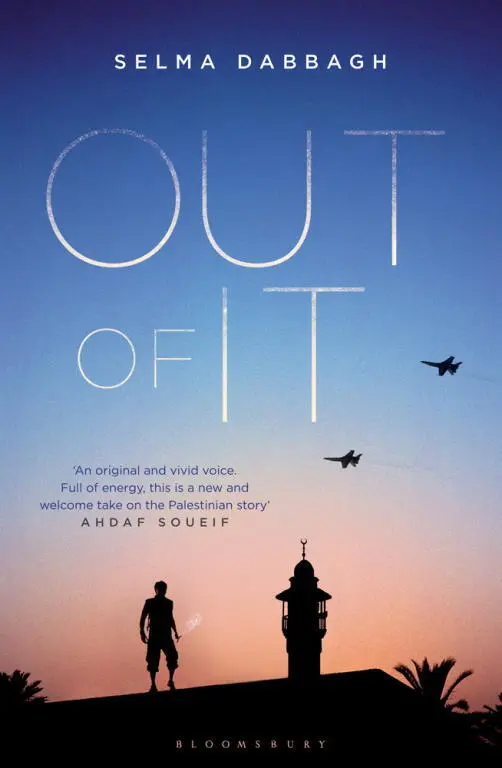
- Название:Out of It
- Автор:
- Издательство:Bloomsbury Publishing
- Жанр:
- Год:2011
- Город:London
- ISBN:978-1-4088-2430-6
- Рейтинг книги:5 / 5. Голосов: 1
-
Избранное:Добавить в избранное
- Отзывы:
-
Ваша оценка:
Out of It: краткое содержание, описание и аннотация
Предлагаем к чтению аннотацию, описание, краткое содержание или предисловие (зависит от того, что написал сам автор книги «Out of It»). Если вы не нашли необходимую информацию о книге — напишите в комментариях, мы постараемся отыскать её.
Meanwhile Sabri, the oldest brother of this disparate Palestinian family works on a history of Palestine from his wheelchair as their mother pickles vegetables and feuds with their neighbours.
Written with extraordinary humanity and humour, and moving between Gaza London and the Gulf, Out of It is a tale that redefines Palestine and its people. It follows the lives of Rashid and Iman as they try to forge paths for themselves in the midst of occupation, religious fundamentalism and the divisions between Palestinian factions. It tells of family secrets, unlikely love stories and unburied tragedies as it captures the frustrations and energies of the modern Arab world.
Out of It — читать онлайн бесплатно полную книгу (весь текст) целиком
Ниже представлен текст книги, разбитый по страницам. Система сохранения места последней прочитанной страницы, позволяет с удобством читать онлайн бесплатно книгу «Out of It», без необходимости каждый раз заново искать на чём Вы остановились. Поставьте закладку, и сможете в любой момент перейти на страницу, на которой закончили чтение.
Интервал:
Закладка:
‘No matter. You’ll do. It’s not deep. Here, clean your hands with the bandage. We have lots of bandages, they’re old but they’re sterile, from my son.’ She indicated Sabri to Eva with the nod of her head; he was examining Eva while pretending to be absorbed by the news. ‘We have more bandages. I’ve sterilised these already with detergent on a flame.’ Their mother held out two narrow metal crochet hooks to Eva and held her fat, dry thumb up in front of Eva’s face and cut across it with the forefinger of her other hand. ‘Only this far down. I’ve sterilised the needle already for the stitching.’
It was easier once Eva was in front of him, looking into the wound, with the light in place. She had done worse things before. In London, she had been instructed to remove all kinds of objects from patients’ rectal passages: coke bottles, vibrators and potatoes. That was worse. This was a clean, shallow wound, not unlike a tightly pursed mouth, with the bullet, a shiny little tube pointing up at her. The scraps of fabric were harder, but she was able to pick them out with tweezers. Once out, the suturing was always pleasurable; she knew she had a neat hand and this wound closed up perfectly.
In the south she had seen the effect of the dum dum bullets, their ends cut so that they would scatter inside the body. It was starting to get to her, the dirtiness of it all, but at that point in time, dabbing disinfectant on to the delicately sown wound of an unconscious patient, it was offset many, many times over. Khalil fed greedily from Eva’s look of satisfaction. Sabri’s mother claimed the victory as her own. ‘See, I told you that we could do it!’ she said, moving back on to the sofa after she had looked closely at the stitching and picked up the bullet, twisting it around under the light.
No one spoke for some time until the advertisements followed the news: Now New! New! Detergent for You! a family sang over a sparkling alpine kitchen. Ping! went the sparkles! Ping! went the stars on the floor.
‘Managed to get a lift both down and back,’ Khalil said, ‘I’m glad we didn’t have to leave it any longer. It’s getting rough down there.’ Khalil broke the silence that seemed to have come about due to the awkwardness between the two women.
‘When did you come here?’
‘How did he get shot?’ Iman and Eva asked each other two different questions at the same time while the television family went forth into the snow-capped mountains. Iman waited for an answer rather than giving one.
‘When did you come here?’ she asked again.
‘It seems like for ever, but it was only ten days ago. I’ve volunteered for three months. It’s been crazy. Tonight we meant to stay but it went mad. They say it was sixty houses they knocked down, but we think it was more – they did the whole area. It looks like they did that around here, too? I just can’t believe they get away with it. We meant to stay in one of the threatened houses tonight but yesterday one of us, this young Jewish girl, Irene, she got shot at. She’s fine, but none of us had ever been shot at before, and then Khalil came and convinced our organisers to stop; they were pretty much there already. We kind of knew that there was nothing we could do.’ Eva stopped talking. It was as though she didn’t know where she was.
‘Are you all right?’ Iman asked, goading herself into a guise of friendship with this girl that she found awkward to put on, after all the time spent criticising her at close quarters. But it seemed like this was a different girl in many ways.
‘I feel completely overwhelmed,’ Eva started. ‘Utterly overwhelmed. We were so happy last Tuesday. I can’t forget that feeling, like nothing I have ever had: the closeness we, the volunteers, all felt together and with the families. We kept smiling at each other and hugging each other, as if we needed to confirm with each other what we had gone through, how good it felt. I can never forget that evening, the memory of it will be sacred until I die; nothing I ever did before compares with that. It scares me that I could’ve lived without coming close to ever feeling that.’
Sabri had gestured to Khalil that he and Eva should take the two-seater sofa and Khalil had guided Eva towards it. She did not seem to notice that she had sat down.
‘And that was only Tuesday, but it seems so long ago, so long ago. I don’t think I’ve slept since then. The noise of the bulldozers – you don’t understand – well, you do, but it’s new for me, it just rolls through my head all the time, I can’t sleep. On Tuesday all we did, and it seems almost pathetic now, but we stopped two houses being demolished, we all stood in front of them and chanted and managed to get the soldiers to back off (but they are not soldiers, they are boys – can you believe how young they are? They say they listen to music in their headsets while they ride around in those bulldozers. Is that true?). And it was like we were crazy-drunk. We felt so good after that, but now they’ve gone too. The houses we saved, they’ve been demolished. I’m talking too much, aren’t I? I’m sorry, but I just can’t get it straight in my head.’
‘It’s not something that you ever get “straight in your head,”’ Sabri said, turning away from the television screen to look at Eva. ‘It is too wrong to be justified, too screwed up to be straightened out. If you force yourself to understand it in any way that leads you to justify it then you are fucked and we are lost.’
‘Yes, sure,’ Eva nodded eagerly. ‘Absolutely. Got it.’
Chapter 46
Rashid had gone down to the beach, trying to find somewhere to have a smoke, now that the roof was out of bounds to him. But it had not felt safe down by the shore at all. There were trucks of armed men speeding over the tarmac and bumping over the sand dunes. Open trucks overloaded with men in uniforms, their guns spiked up at the sky, some masked, some bearded, some ridiculously young but all restless (restless, jubilant, both), and all of them spoiling for something, some release from it all. Some attack on the other. Rashid had smoked fast and deep behind the wooden pavilion where sweets and footballs were sold during the day, smoked too fast and he was not as used to it as he had been. The effect was bad: a desperate, bleary body and an overly anxious brain.
It came over him suddenly as an extended epiphany:
that the trucks were only speeding so that they could find him, Rashid;
that there were armed men everywhere looking for him, Rashid;
that every car shadow held a man crouched with their guns readied, searching for him, Rashid;
that the cars parked down the side of the beach were all wired up, waiting (again) for him to touch them so that they could blast him, Rashid, into the sky in a chute of flames.
The dunes hid tanks and bulldozers; each helicopter searched for him with its beam; the gunships pointed at him and him alone, Rashid.
Rashid had found himself walking fast, bent and angular, his eyes watery with the sea wind, teary with blown sand. He walked with his shoulders held low, in a silly attempt to make himself small. There was a rainy spray spitting at him and the wind that carried it tugged at his clothes, pushed him back as he came to the crest of the dunes, wriggling like a stranded eel. The house was miles from him across a treacherous terrain that he had lost faith in crossing. He felt himself ant-like and squashable beneath the weight of the swarmy sky.
How he got home, he was not sure, but he did it. He had done it. And once there, he held on to the door handles to his home offering a prayer of gratitude to them and to God (whom he found at times like this) while cursing Mahmoudi’s spiked shit to hell. But when no one in the living room looked up as he came through the door, it made him wonder whether he was there after all, and then he saw that his body was there already, splayed backwards over a chair, stripped down to the waist, drugged, half-naked with his jeans covered in blood.
Читать дальшеИнтервал:
Закладка:
Похожие книги на «Out of It»
Представляем Вашему вниманию похожие книги на «Out of It» списком для выбора. Мы отобрали схожую по названию и смыслу литературу в надежде предоставить читателям больше вариантов отыскать новые, интересные, ещё непрочитанные произведения.









Обсуждение, отзывы о книге «Out of It» и просто собственные мнения читателей. Оставьте ваши комментарии, напишите, что Вы думаете о произведении, его смысле или главных героях. Укажите что конкретно понравилось, а что нет, и почему Вы так считаете.