Selma Dabbagh - Out of It
Здесь есть возможность читать онлайн «Selma Dabbagh - Out of It» весь текст электронной книги совершенно бесплатно (целиком полную версию без сокращений). В некоторых случаях можно слушать аудио, скачать через торрент в формате fb2 и присутствует краткое содержание. Город: London, Год выпуска: 2011, ISBN: 2011, Издательство: Bloomsbury Publishing, Жанр: Современная проза, на английском языке. Описание произведения, (предисловие) а так же отзывы посетителей доступны на портале библиотеки ЛибКат.
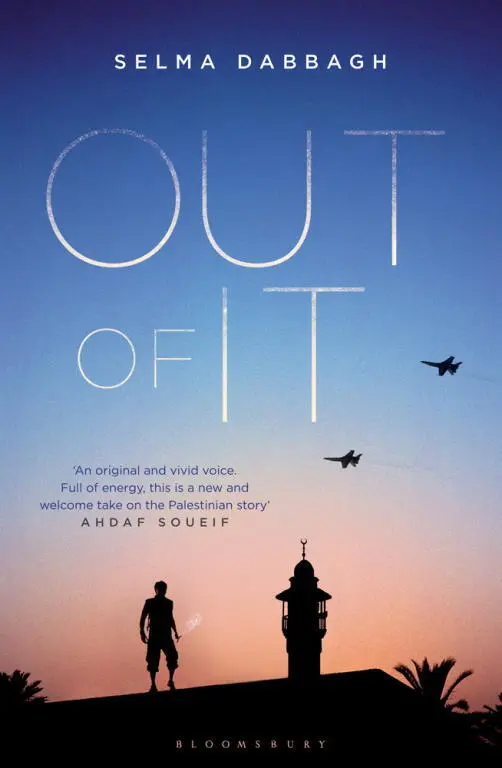
- Название:Out of It
- Автор:
- Издательство:Bloomsbury Publishing
- Жанр:
- Год:2011
- Город:London
- ISBN:978-1-4088-2430-6
- Рейтинг книги:5 / 5. Голосов: 1
-
Избранное:Добавить в избранное
- Отзывы:
-
Ваша оценка:
Out of It: краткое содержание, описание и аннотация
Предлагаем к чтению аннотацию, описание, краткое содержание или предисловие (зависит от того, что написал сам автор книги «Out of It»). Если вы не нашли необходимую информацию о книге — напишите в комментариях, мы постараемся отыскать её.
Meanwhile Sabri, the oldest brother of this disparate Palestinian family works on a history of Palestine from his wheelchair as their mother pickles vegetables and feuds with their neighbours.
Written with extraordinary humanity and humour, and moving between Gaza London and the Gulf, Out of It is a tale that redefines Palestine and its people. It follows the lives of Rashid and Iman as they try to forge paths for themselves in the midst of occupation, religious fundamentalism and the divisions between Palestinian factions. It tells of family secrets, unlikely love stories and unburied tragedies as it captures the frustrations and energies of the modern Arab world.
Out of It — читать онлайн бесплатно полную книгу (весь текст) целиком
Ниже представлен текст книги, разбитый по страницам. Система сохранения места последней прочитанной страницы, позволяет с удобством читать онлайн бесплатно книгу «Out of It», без необходимости каждый раз заново искать на чём Вы остановились. Поставьте закладку, и сможете в любой момент перейти на страницу, на которой закончили чтение.
Интервал:
Закладка:
Chapter 4
Iman found a changed world around her when she came outside. The sea was still ahead of her, the university building behind, the city curling around to her left. A hut next to the corniche that sold beach balls and puffy orange crisps still had its placard with prices screwed on to its side. Everything was where it had been the night before, but the air was now thick with the smell of metal filings. Smoke leaked out of the places where the earth had been hit, as though the horizon itself had been punctured; whorls of it twisted and expanded, walling them in. She could not place herself in that landscape. It seemed ominous, extreme, almost fake. It had been a visitation. The thought of Manar now made her panic. Manar was a visitation and now it was all over: the voice, the face, the darkness, the smoke and then the end. Over .
The peachy campus buildings were not where she thought she would be when she saw all of this: the beginning of the end. A disembodied face in cheap, dark fabric. A role for you. We have a role for you.
She was seeing things. Hearing things. She had been up all night and now the weird high of fatigue was making her delusional.
The strikes were far from her home. She had taken that in at first glance. The smoke was far from their place. Her family would be OK. She found that she was breathing again, albeit cautiously, as though it was something that could only be done with deliberation.
But there, under it all, below the smoke, the air was soft, almost balmy. The clouds were ruffled over the sea and the scratches of jet trails were already dissolving up into the atmosphere. Close around her it was quiet, still, fresh. The streets were empty.
It was not over. It was not the end. Her family was safe. She was being melodramatic.
She walked towards her home, past buildings that without the daytime crush that normally surrounded them appeared serene. The workers who had permits to pass through tunnels of wire and cattle gates to jobs on the other side had already done so. The rest, the unemployed and the underemployed, still slept. The streets without their people were new, foreign, hers. Graffiti spread over the walls and the shuttered shops. Tree trunks were wrapped tight with posters of the dead.
There really was no one around at all. The curtains of smoke had created a veiled world around her that she had never been in before.
Iman sat on the playground wall away from the signs of donors promising reconstruction. A ginger cat strutted out in front of her and lay on its side, making a show of its belly, before it gathered that Iman was no fun at all and gave her its back. It leapt up on to the wall further down, lifting its head to squeeze its eyes at the growing light.
This was her lot. This was her life, the life of her father, her mother, her brothers. This was their lot, their country, their place in the world. This was what she had come back for and it was for her to find a meaningful role within it. At the time she had decided to join her family in Gaza there had been change, hope, peace agreements, agreements that, however faulty, had enabled what before had always seemed impossible. And she had returned valiantly, triumphantly to find that there was no role offered to her at all, except for that of wife and mother, both of which were pushed at her constantly.
The religious lot gave her the creeps though. Superior as well, that Manar. We have a role for you . Who were they? What group? They chose her? For what exactly?
It was quiet enough for her to smoke, right there in public, sitting on a low wall in the street. No one would see her. With her cigarettes, she pulled out a creased brochure for a centre for the disabled that she had visited months ago. The walls for the centre had been covered with pictures of bandaged children holding up their stumps and smiling at the camera, their mouths full of tubes. The brochure provided double, triple and quadruple digit figures of amputees in loopy script together with advertisements for prosthetics: ‘Liberation 2000 Lower Limb Range’, ‘Empowerment Arms and Hands’.
‘A disaster,’ the receptionist had said when Iman had visited. ‘My boss, he doesn’t think. An organisation for the disabled on the third floor with no lift?’ She had plied Iman with paperwork. ‘You can help us – you were educated abroad, write us a proposal, get us moved. Up and down the stairs all day I am, the entrance jammed up with wheelchairs, the neighbours complaining.’
That was what she would do, Iman thought, smoothing out the brochure. Something small. She could write a proposal. It was a start. Forget Manar and her group.
She hurried with the lighter and the flame, on too high a setting, leapt up to singe a strand of curls, creating a stink in her nose.
She realised as she sat there with the knowledge that the house was all right, that it had really got to her, the extent of her agitation about her family. Now it had passed, she felt the calm, the cigarette, the morning air, the sense that the world hadn’t completely exploded, that the destruction was only partial. The type of elation that followed on from despair was lifting her out of it.
Someone was watching her. She could feel it as she sat there.
She looked up at the buildings. The shutters were blank. There was no one on the street. Iman got up, dropped her cigarette and paced across the road pretending that she had purpose, somewhere to go, that she hadn’t been sitting, smoking on a playground wall in the aftermath of a bombing. There was mud on the road, the paving slabs broken. She took a small leap over some cracks around a tree’s roots then, sensing again with the sickening pump of a lost heartbeat that someone was watching her, looked up.
It was her brother Rashid… but it wasn’t. The same profile, height, slimness, but not the same stance or clothes, nor the same look.
The man was wearing a rough green jacket with large pockets and toggles like those on a child’s jacket, and was propped up, shoulder blades resting against the wall, as if this was New York or Paris and he had just come out for a smoke in a back street. He looked stuck on to the scene; everything close to the ground was sunken and sepia, but to Iman the jacket’s green was somehow out there with the sky in this other world where trees were allowed to respond to light, a world where Mediterranean sunrises were allowed to just be.
He rocked on to his feet as she approached and gave her a familiar look, although she was sure she had never seen him before. Long and gaunt like Rashid, he had the high-cheekboned looks of a North African and the posture of a foreigner. He also had a gun.
By taking a step backwards he indicated that she could pass in front of him on the dry pavement. As he did so, his gun hit against a shutter sending a metallic judder down the street. She stepped so close to him that she would have been able to smell him, had she inhaled any breath at all, and then she was past him and he had not moved. He made no effort to follow her but he was still watching when she turned back to check.
Iman’s family lived in the upstairs apartment of a two-storey block that had been one of eight of the same style. The buildings stood on a road that could, with a little imagination, once have been described as leafy.
Now the Mujahed home, unclad and progressive in style, with its long, triangular wall on its flat roof, stood alone in the middle of a tented wasteland. To Iman, it appeared to sit in an elephant’s graveyard of arched steel and clumps of concrete. Bent strands of metal twisted up, catching the pink light of dawn, and appeared like the legs of buried flamingos. Light caught on fragments of sheets and toys held down by slices of painted walls.
Читать дальшеИнтервал:
Закладка:
Похожие книги на «Out of It»
Представляем Вашему вниманию похожие книги на «Out of It» списком для выбора. Мы отобрали схожую по названию и смыслу литературу в надежде предоставить читателям больше вариантов отыскать новые, интересные, ещё непрочитанные произведения.









Обсуждение, отзывы о книге «Out of It» и просто собственные мнения читателей. Оставьте ваши комментарии, напишите, что Вы думаете о произведении, его смысле или главных героях. Укажите что конкретно понравилось, а что нет, и почему Вы так считаете.