Maggie Helwig - Girls Fall Down
Здесь есть возможность читать онлайн «Maggie Helwig - Girls Fall Down» весь текст электронной книги совершенно бесплатно (целиком полную версию без сокращений). В некоторых случаях можно слушать аудио, скачать через торрент в формате fb2 и присутствует краткое содержание. Город: Toronto, Год выпуска: 2008, ISBN: 2008, Издательство: Coach House Books, Жанр: Современная проза, Триллер, на английском языке. Описание произведения, (предисловие) а так же отзывы посетителей доступны на портале библиотеки ЛибКат.
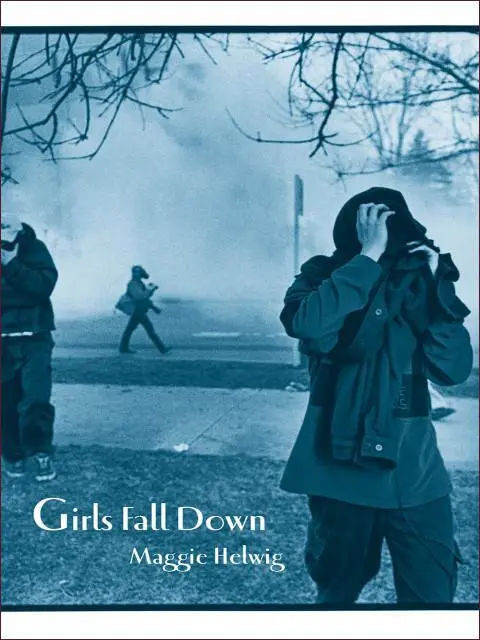
- Название:Girls Fall Down
- Автор:
- Издательство:Coach House Books
- Жанр:
- Год:2008
- Город:Toronto
- ISBN:978-1-55245-196-0
- Рейтинг книги:3 / 5. Голосов: 1
-
Избранное:Добавить в избранное
- Отзывы:
-
Ваша оценка:
Girls Fall Down: краткое содержание, описание и аннотация
Предлагаем к чтению аннотацию, описание, краткое содержание или предисловие (зависит от того, что написал сам автор книги «Girls Fall Down»). Если вы не нашли необходимую информацию о книге — напишите в комментариях, мы постараемся отыскать её.
Alex was witness to this first episode. He’s a photographer: of injuries and deaths, for his job at the hospital, and of life, in his evening explorations of every nook and cranny of the city. Alex is a diabetic, now facing the very real possibility of losing his sight, and he’s determined to create a permanent vision of his city through his camera lens. As he rushes to take advantage of his dying sight, he encounters an old girlfriend – the one who shattered his heart in the eighties, while she was fighting for abortion rights and social justice and he was battling his body’s chemical demons. But now Susie-Paul is fighting her own crisis: her schizophrenic brother has been missing for months, and the streets of Toronto are more hostile than ever.
Maggie Helwig, author of the critically lauded
, has fashioned a novel not of bold actions but of small gestures, showing how easy and gentle is the slide into paranoia, and how enormous and terrifying is the slide into love. This is a remarkable novel: romantically and politically charged, utterly convincing in its portrait of our individual and societal instability, and steadfast in its faith in redemption.
Girls Fall Down — читать онлайн бесплатно полную книгу (весь текст) целиком
Ниже представлен текст книги, разбитый по страницам. Система сохранения места последней прочитанной страницы, позволяет с удобством читать онлайн бесплатно книгу «Girls Fall Down», без необходимости каждый раз заново искать на чём Вы остановились. Поставьте закладку, и сможете в любой момент перейти на страницу, на которой закончили чтение.
Интервал:
Закладка:
‘You’re probably going to get head lice,’ said the other nurse to Alex.
‘What the hell was up with that bird?’ asked the orderly with the pillow. ‘I mean, have we got a big hole in the wall somewhere or what?’
‘There’s going to be an inquiry over this one.’
‘Just don’t sue us about the lice, okay, Alex?’
His scalp was throbbing when he got home, his head smelling of disinfectant and Polysporin. He felt shaky still, but unable to sit down. He didn’t think he wanted to cook himself anything for dinner. Didn’t want to stay home at all, really. He’d spoken to his ophthalmologist that morning and it hadn’t been very encouraging.
He could have phoned Susie. He thought about phoning Susie, but he found himself instead with his camera on Bloor Street. He’d tell her about the bird sometime. She would like to hear about it. But not now, not quite so soon, not so he looked like he needed her.
He did have to eat something before he started working, so he went into the tiny falafel shop by the movie theatre. An older woman, heavy-set, was sitting in one of the plastic chairs, wearing a deep green velvet head scarf and peeling a mandarin orange, and as he came in she looked up and smiled at him, soft, familiar, as if he were a loved relative, or as if the pigeon had marked him, in some way recognizable only to a few. He smiled back, nervously, and she stretched out half the orange towards him; he shook his head, but she pressed it into his hand, the orange and gold-washed flesh of it shining under the fluorescent light. He broke off a segment and lifted it to his mouth, the juice sharp and sweet, a wordless agreement between strangers in the city.
There was one night when Dissonance was in production that a phone call had come in, and Chris had waved Susie into the office to take it. Alex was at one of the tables studying a page layout, and he watched her, resting her head on one hand as she talked, biting her lip anxiously, twirling her hair around one finger. Chris seemed to get impatient as the call went on and started gesturing for her to hang up, but she shook her head. He spoke again, more sharply – Alex could hear his voice through the glass, though not the words – and she put her hand over the receiver and whispered something back at him, her face pale and tight. It was too long for Alex to keep sitting there; he had to go back into the darkroom.
He had just finished shooting a stat on the process camera when she knocked tentatively on the inner door.
‘It’s okay,’ he called, switching on the light. ‘You can come in.’ She sat down on the stool, her feet pulled up, tucking her knees under her chin.
‘You all right?’ he asked.
‘Why wouldn’t I be?’
‘I don’t know. You tell me.’
She was wearing an oversized white shirt and torn jeans, a jagged metal necklace, army boots. She put her head to one side, her cheek against her knee.
‘Do you think it would be easy to lose your mind?’ she said, picking at a flake of nail polish at the corner of her index finger.
He lifted out a sheet of photographic paper and ran it into the developing machine. The room smelled of chemicals and stale marijuana smoke.
‘It could be,’ he said.
‘Does it scare you?’
The stat came out of the developer, a little darker than he’d wanted. Maybe he should shoot it again.
He had never thought about losing his mind, not really; he had enough to think about when a small needle of insulin was the only barrier between him and rapid death. ‘Not so much as some things,’ he said – and then pre-empting her, because she would have asked, ‘I just mean things in general.’
She nodded. ‘Okay.’ He had one of his mixed tapes on in the background, a song from Big Star’s last album playing, ragged and needy. ‘If somebody loves you,’ she said, and Alex was glad that he was facing away from her because he could feel the rush of heat in his face, ‘what kind of rights does that give them?’
It took him a while to gather his breath to speak. ‘Probably none,’ he said quietly, turning a dial on the machine.
‘Yeah. Maybe that wasn’t what I meant.’
‘I have to turn the lights out,’ he said, and he pushed the switch, and they were in red-tinged darkness. The flash from the process camera blurred across them and flared out. He reached out a hand in the crimson dark and stroked her hair, and he knew that his fingers were wet with the developing fluid, that she would carry the smell of the darkroom with her for the rest of the night. Her face in red shadow. He thought her eyes were closed, though he couldn’t be sure.
He stepped backwards and turned on the light. ‘Yeah,’ he said. ‘Yeah, well. I have to run this through the developer now.’
‘Yes,’ she said. ‘All right,’ and slid down from the stool, turning towards the door.
Laser photocoagulation is performed as an outpatient procedure. Each individual treatment should take less than one hour. Your ophthalmologist will tell you how many treatments your particular condition will require. If you have been diagnosed with proliferative retinopathy, you will probably require two or more treatments at two-week intervals.
You may experience some discomfort during and after the treatment. You will be given anaesthetic drops before treatment, which should minimize the discomfort. If your eyes are still causing you discomfort one week after the treatment, inform your ophthalmologist.
You may experience blurred vision immediately after the treatment. This should go away by itself. DO NOT attempt to drive home after the treatment. You should bring a friend to the clinic who can take you home. If your vision continues to be blurry for several days, inform your ophthalmologist.
‘I have an appointment for Monday morning,’ said Alex, putting the pamphlet back in his bag as they walked, after dark, towards Pottery Road. ‘That in itself is disturbing. I don’t like them treating it as an urgent case.’
‘Do you want me to come?’
‘No, I’ll be okay. I’ll just take a taxi back. But I did want to ask you – if you happen to be free. I wanted to take some photos of you this weekend.’ They passed by a man wearing a surgical mask, white gloves on his hands. ‘I know I’m being superstitious. It’s not going to make a big difference, not the first series of treatments, only if I have to, only if it comes back. So it’s not really that important but – I’d like to do it, if you have the time.’
Susie nodded. ‘I was going to spend tomorrow in the library. But Sunday, if you want.’
‘Late morning? The light’s good in the late morning.’
‘Sure. Whenever.’
Under snow-covered trees, they made their way down the hill, past the concrete divider with the black word FEAR on the side. High drifts surrounded the prancing wooden ponies of Fantasy Farms, and the glowing flower man was breathing out clouds of ice crystals, clutching a bouquet of plastic roses to his chest. Into the sketchy dreams of the city’s sunken veins, across the Don.
They climbed the steep hill at Bayview, scrambling and sliding up the slope where the brush cover was most scattered, sinking into the snow. By the time they reached the top, snow had clumped in Alex’s gloves and the creases of his coat, his boots had filled with a cold layer of it, freezing his ankles. He ran quickly over the railway track, thinking how he hated crossing it, though it was small and narrow and there was clearly no train anywhere nearby; he felt sure, irrationally sure, that an engine would loom up from nowhere and flatten him.
‘Should I wait up here?’ he asked, as they reached the sharp downslope, just above Derek’s underpass. Across the valley, he could see an array of lights, and above them a soft red glow in the sky, the city’s permanent day.
Читать дальшеИнтервал:
Закладка:
Похожие книги на «Girls Fall Down»
Представляем Вашему вниманию похожие книги на «Girls Fall Down» списком для выбора. Мы отобрали схожую по названию и смыслу литературу в надежде предоставить читателям больше вариантов отыскать новые, интересные, ещё непрочитанные произведения.









Обсуждение, отзывы о книге «Girls Fall Down» и просто собственные мнения читателей. Оставьте ваши комментарии, напишите, что Вы думаете о произведении, его смысле или главных героях. Укажите что конкретно понравилось, а что нет, и почему Вы так считаете.