Maggie Helwig - Girls Fall Down
Здесь есть возможность читать онлайн «Maggie Helwig - Girls Fall Down» весь текст электронной книги совершенно бесплатно (целиком полную версию без сокращений). В некоторых случаях можно слушать аудио, скачать через торрент в формате fb2 и присутствует краткое содержание. Город: Toronto, Год выпуска: 2008, ISBN: 2008, Издательство: Coach House Books, Жанр: Современная проза, Триллер, на английском языке. Описание произведения, (предисловие) а так же отзывы посетителей доступны на портале библиотеки ЛибКат.
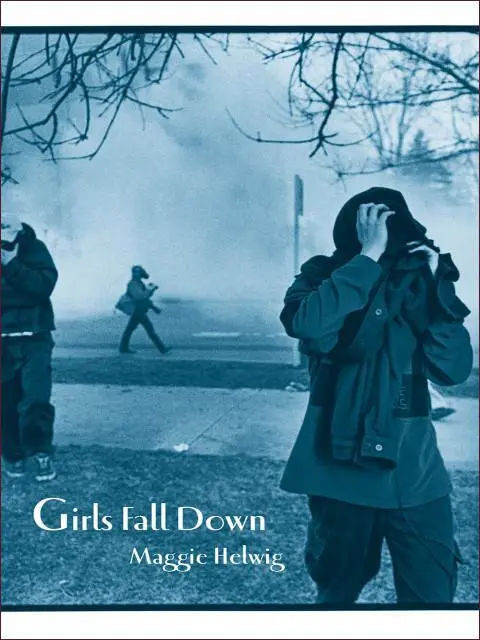
- Название:Girls Fall Down
- Автор:
- Издательство:Coach House Books
- Жанр:
- Год:2008
- Город:Toronto
- ISBN:978-1-55245-196-0
- Рейтинг книги:3 / 5. Голосов: 1
-
Избранное:Добавить в избранное
- Отзывы:
-
Ваша оценка:
Girls Fall Down: краткое содержание, описание и аннотация
Предлагаем к чтению аннотацию, описание, краткое содержание или предисловие (зависит от того, что написал сам автор книги «Girls Fall Down»). Если вы не нашли необходимую информацию о книге — напишите в комментариях, мы постараемся отыскать её.
Alex was witness to this first episode. He’s a photographer: of injuries and deaths, for his job at the hospital, and of life, in his evening explorations of every nook and cranny of the city. Alex is a diabetic, now facing the very real possibility of losing his sight, and he’s determined to create a permanent vision of his city through his camera lens. As he rushes to take advantage of his dying sight, he encounters an old girlfriend – the one who shattered his heart in the eighties, while she was fighting for abortion rights and social justice and he was battling his body’s chemical demons. But now Susie-Paul is fighting her own crisis: her schizophrenic brother has been missing for months, and the streets of Toronto are more hostile than ever.
Maggie Helwig, author of the critically lauded
, has fashioned a novel not of bold actions but of small gestures, showing how easy and gentle is the slide into paranoia, and how enormous and terrifying is the slide into love. This is a remarkable novel: romantically and politically charged, utterly convincing in its portrait of our individual and societal instability, and steadfast in its faith in redemption.
Girls Fall Down — читать онлайн бесплатно полную книгу (весь текст) целиком
Ниже представлен текст книги, разбитый по страницам. Система сохранения места последней прочитанной страницы, позволяет с удобством читать онлайн бесплатно книгу «Girls Fall Down», без необходимости каждый раз заново искать на чём Вы остановились. Поставьте закладку, и сможете в любой момент перейти на страницу, на которой закончили чтение.
Интервал:
Закладка:
A few streets over it was there again, FEAR, on the side of a little florist’s shop. All the things she could never do, the places she couldn’t go. The kind of person she could never be.
The girl stood in a park at the north end of Rosedale, her hands in the pockets of her coat, fingering the can of tuna, watching figures pass under the wide blurred halo of the lights. A woman with a fawn-coloured pug on a leash, the collar of her own coat pulled up around her face. A jogger with a scarf tied over his mouth, fingerless gloves on his bunched hands, his running shoes kicking up snow. The girl looked at an empty bench near the bushes, the damp mahogany-stained wood showing some decay at the edges. She turned her head to either side, as if checking for watchers, then moved reluctantly, uneasily, towards the bench. She took a five-dollar bill from her pocket and put it on the wooden seat, then pinned it down with the can, a strange coded offering. Walking away from the bench, she waited at the verge of the park for a while longer, looking as if she expected a great bird, perhaps, to arrive and carry her gifts away. But she couldn’t stay out forever, she had homework to do, parents who kept her mostly to a curfew. The tuna and the money were still sitting on the bench when she left. She would never be able to know who would take them, or what meaning someone might see in the gesture.
On Dufferin near Lake Shore Boulevard, two police officers arrested a man in a turban who had left his bicycle leaning unattended against a wall, with plastic bags hanging from the handlebars.
If you were frightened enough, they could look like something else, those bags. Bulky packages, brown paper with grease stains. It could be groceries. It could be terror.
The policemen pushed the man onto his knees on the sidewalk as he came back to his bicycle, and bent his hands behind him, binding them with cuffs.
They drove along Lake Shore for a while, and then they stopped at a Tim Horton’s, and one officer stayed in the car with the man while the other went inside to buy coffee and a box of maple-glazed Timbits. The officer in the car asked the man if he thought he was a smart guy. The man said no, he did not think that he was a smart guy at all.
As they went east, the sidewalk was lit up with a small flame, and on the steps of a small office building a circle of women were passing a burning coil of sweetgrass between them, wafting the smoke with their hands. The police car slowed to watch the ceremony, but didn’t stop.
They drove further east, and then turned south, driving through blocks of boarded-up lots and a small sad diner with a neon canary above the door, down to the ports. The man realized now that they were taking him to Cherry Beach, and he knew what this meant, he had heard about what the police did at Cherry Beach. They drove on, past the green ice-edged water of the canals, the metal heft of container ships, bars that advertised themselves with drawings of martinis and dancing girls, and stopped by a stand of bare trees near the edge of the water. The officers pulled the man out of the car and he stumbled, his hands still cuffed behind his back, and they watched him as he struggled up and walked, at their orders, towards the lake. There was a small hut leaning over the water, its white paint cracking, and a half-submerged picnic table. At the shoreline the water was frozen, a lace of hard ice, shards and peaks, and it caught the distant light and cast it back in a faint shimmer. The man went down on his knees by the pebbled shore, and lowered his head, and waited for the clubs to descend.
Towards morning, a girl fell down at Yonge and Eglinton, and the sun rose on the hazmat squad.
II
There were mornings when Alex turned on his radio with the thought, almost the assumption, that he would hear about a major terrorist attack in one of the central cities, London or Paris or Los Angeles. Somehow it was not a thought that brought any sense of fear with it, nothing much stronger than curiosity, and up to this point he had never actually been proved right. But it had been that way since what happened in New York; any daily routine, now, could contain this news.
He remembered that he’d been late getting to work, the morning it had happened; he’d been standing in line at the bank, and had gradually realized that the line was moving so slowly because the tellers kept leaving their posts to cluster around a small radio. As he got closer to the desk he’d been able hear bits of the broadcast, stories of airplanes and skyscrapers. ‘Ah geez,’ one of the tellers had muttered, a huge man with a shiny bald head. ‘I just hope they don’t start a war over this, you know?’
So it was like that now, catastrophe inevitable at the most empty moments. Everyone waiting, almost wanting it, a secret, guilty desire for meaning. Their time in history made significant for once by that distant wall of black cloud.
But there was no such news this morning, Susie gone before dawn and Alex sitting by the radio with a cup of coffee, trying to pay attention; it was all about UN weapons inspectors and fluctuating currencies, an outbreak of Marburg virus in a tiny distant country, and a confusing story about an arrest in connection with incidents not precisely named. The subway, he guessed, and wondered who they’d found and what they were thinking.
The small explosion of order in his own life happened later that day, ephemeral and unexpected, when a bird somehow entered the hospital, in a way that no one was ever able, later on, to understand. When Alex arrived, unsummoned but pulled away from his lunch break by rumours of excitement, it had been contained in an empty room where it huddled in a corner, grey feathers fluffed angrily out, a disoriented disease vector, potential reservoir of avian flu, West Nile, any number of other infections.
‘Just let me kill the fucker!’ an orderly in a mask and industrial gloves was shouting, grabbing for the pigeon as it leapt from his hands, its wings slicing upwards.
Alex slipped unnoticed into the room, and knelt with his camera as the pigeon exploded towards the ceiling in a scatter of fluff and droppings, crashed into an IV stand, and started to make a break for the door before someone slammed it shut. The orderly ran at the bird with a canvas bag and it veered up again, greeny-white shit falling into another orderly’s long hair. ‘Jesus!’ she screamed, her hands flying up.
The pigeon began to spiral, high out of reach, and the orderly dropped the bag and picked up a mop, began stabbing the wooden handle at the bird. ‘Open a window!’ someone else called. ‘Open a window, let it out!’
‘They don’t open that way!’ yelled the first orderly, and a male nurse, seeming now in a state of pure panic, picked up a chair and bashed at the window, trying to break it.
‘Kill it, kill it, we have immuno-compromised patients in here!’
‘How in God’s name did it get in?’
‘Alex, Jesus Christ!’ The long-haired orderly backed into him. ‘Don’t take pictures of this.’
‘Personal use only,’ said Alex, as the pigeon wheeled in lunatic circles, wings beating into the walls. Then it sank downwards, bright amethyst slivers of light splintering from its chest, and dug its festering claws into Alex’s hair.
‘Fucking hell!’ he shouted, stumbling forward, the thin talons piercing his scalp.
‘It’s gone on the attack!’ cried an orderly.
Alex fell onto his knees, his teeth sinking into his lip, his hands beating uselessly at his head as the window gave way.
‘Oh, good going, Stuart,’ snapped another nurse. ‘I hope you know you’re paying for that.’
An orderly swung a pillow at the bird and it lifted off from Alex’s head, leaving him bent on the floor, tears of pain in his eyes. The pillow still waving, a white flag, and the bird was herded towards the window and out, suddenly hesitating in the air and almost returning, before Stuart began cramming bedclothes into the gap.
Читать дальшеИнтервал:
Закладка:
Похожие книги на «Girls Fall Down»
Представляем Вашему вниманию похожие книги на «Girls Fall Down» списком для выбора. Мы отобрали схожую по названию и смыслу литературу в надежде предоставить читателям больше вариантов отыскать новые, интересные, ещё непрочитанные произведения.








Обсуждение, отзывы о книге «Girls Fall Down» и просто собственные мнения читателей. Оставьте ваши комментарии, напишите, что Вы думаете о произведении, его смысле или главных героях. Укажите что конкретно понравилось, а что нет, и почему Вы так считаете.