Maggie Helwig - Girls Fall Down
Здесь есть возможность читать онлайн «Maggie Helwig - Girls Fall Down» весь текст электронной книги совершенно бесплатно (целиком полную версию без сокращений). В некоторых случаях можно слушать аудио, скачать через торрент в формате fb2 и присутствует краткое содержание. Город: Toronto, Год выпуска: 2008, ISBN: 2008, Издательство: Coach House Books, Жанр: Современная проза, Триллер, на английском языке. Описание произведения, (предисловие) а так же отзывы посетителей доступны на портале библиотеки ЛибКат.
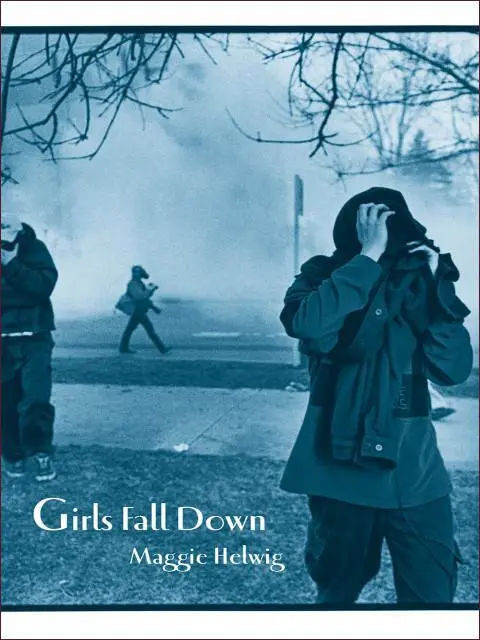
- Название:Girls Fall Down
- Автор:
- Издательство:Coach House Books
- Жанр:
- Год:2008
- Город:Toronto
- ISBN:978-1-55245-196-0
- Рейтинг книги:3 / 5. Голосов: 1
-
Избранное:Добавить в избранное
- Отзывы:
-
Ваша оценка:
Girls Fall Down: краткое содержание, описание и аннотация
Предлагаем к чтению аннотацию, описание, краткое содержание или предисловие (зависит от того, что написал сам автор книги «Girls Fall Down»). Если вы не нашли необходимую информацию о книге — напишите в комментариях, мы постараемся отыскать её.
Alex was witness to this first episode. He’s a photographer: of injuries and deaths, for his job at the hospital, and of life, in his evening explorations of every nook and cranny of the city. Alex is a diabetic, now facing the very real possibility of losing his sight, and he’s determined to create a permanent vision of his city through his camera lens. As he rushes to take advantage of his dying sight, he encounters an old girlfriend – the one who shattered his heart in the eighties, while she was fighting for abortion rights and social justice and he was battling his body’s chemical demons. But now Susie-Paul is fighting her own crisis: her schizophrenic brother has been missing for months, and the streets of Toronto are more hostile than ever.
Maggie Helwig, author of the critically lauded
, has fashioned a novel not of bold actions but of small gestures, showing how easy and gentle is the slide into paranoia, and how enormous and terrifying is the slide into love. This is a remarkable novel: romantically and politically charged, utterly convincing in its portrait of our individual and societal instability, and steadfast in its faith in redemption.
Girls Fall Down — читать онлайн бесплатно полную книгу (весь текст) целиком
Ниже представлен текст книги, разбитый по страницам. Система сохранения места последней прочитанной страницы, позволяет с удобством читать онлайн бесплатно книгу «Girls Fall Down», без необходимости каждый раз заново искать на чём Вы остановились. Поставьте закладку, и сможете в любой момент перейти на страницу, на которой закончили чтение.
Интервал:
Закладка:
‘The difference between chemicals and emotions?’ Susie lifted her hand, palm up.
‘Neurotransmitters,’ she said. ‘The dopamine hypothesis. Serotonin. I know all about these things, Alex. The neuroendocrine system, I get that. But what does that mean? This is my brother. This is who he is. There is no real Derek somewhere else. That brain is real. And it suffers.’
‘I know.’ He could hear traffic in the distance, but the street was still and empty.
‘We’re all the same as Derek, you know. In the end, we are. We’re all just trying to hammer together some kind of self around the chemical reactions.’ She ran a hand across her eyes. ‘Look at us. You get angry for no reason when you’re going hypo. I stole a flashlight tonight because I got drunk. Is that real? Is that chemical? What’s the difference? You fell in love with me back at Dissonance because you were smoking too much pot.’
‘No,’ said Alex. ‘No. That wasn’t why.’
But the truth was that he had, back then, never known why, and never wondered; his emotions had been instant and opaque and he had expected nothing else. He had known so little about her.
‘Why didn’t you ever call me?’ he asked, his voice very low.
‘It was too hard,’ murmured Susie, staring out at the street. ‘It was just too hard.’
He raised his arm, and the motion had the weird dreamy slowness of an inevitable act. With the mingled hunger and sickness of someone going back to a familiar drug, he stroked her hair away from her face. He kissed her neck and tasted salt. She turned towards him and reached up, her mouth soft against his.
‘Oh no,’ he whispered, after a while. ‘No, this is a very bad idea.’
‘Yes,’ said Susie, running her hands down his chest.
He bent and touched his lips to her hair. ‘This is a train wreck,’ he said. And then he was kissing her again, she was sucking his tongue, pulling him further into her mouth, and it went on forever, and he thought that he could dissolve in this, in this sweetness, the joints of his body coming undone. Wrecked, addicted, gone.
In her bedroom they stood apart from each other for a moment, still fully clothed, hesitant, and he was much more afraid now than he had been in his twenties, older than he should be and far too aware of all the things that could go wrong. Then she moved towards him, and he lifted her small burning hand and licked the drying blood from her palm.
Plague Days
I
Derek Rae’s life in the ravine is, after its manner, a life well-organized. His time is measured by the regular catastrophe of the trains passing over his head, thunderous and dirty, an assault of noise. The days and weeks are shaped by weather, the poison sun and debilitating humidity of late summer shading slowly into the long cold nights and the sheltering snow.
He doesn’t know that the girls are falling down. It is a shame, perhaps, that no one has told him, because Derek is closer to the heart of the problem than anyone thinks. But this is how it is, he doesn’t take the subway, he doesn’t read the newspapers.
Though Derek is radically isolated, he is not in fact quite without human contact. He is known to the street nurses, for instance, who bring him the bottles of water and tins of Ensure that now constitute his entire diet; the nurses have not passed this information on to his sister because Derek does not speak to them, so they are unable to determine whether they have his consent.
Sometimes he comes out of his tent and sits in Chorley Park, but he does not think he will do that again after what happened the last time.
When it becomes most urgently necessary – no longer very often – he will cross over to Broadview and ask for change until he can afford to visit one of the city’s more desperate and undiscriminating sex workers. His library is made up mostly of books and magazines he has found lying in bus shelters or coffee shops, though in a few cases he has stolen them from the public library, because books are a singularly pressing requirement, the one thing left that resembles his vanished life. Sometimes he finds mittens and hats discarded on the hiking path, and these sustain him in the coldest weather.
None of this represents the truth of Derek’s existence, his passions and his miseries, the battles he wages all alone against pains and fears and the forces of universal gravitation. The raw courage that is required of him every day. His hard-won choice to continue living, when so many possibilities to stop are offered at every hand, the cars on the highway, the trains on the tracks, an end to the daily loss. None of this represents Derek’s soul, scraped bloody, howling, fighting always to hang on, a solitary superhuman ordeal, unacknowledged by the world, unrewarded.
These things are known. Somewhere, they are known. But they are not to be spoken of.
And up and down the city, people pursued their lives, their own small braveries and defeats; they walked dogs and drilled holes in the street, wiped the noses of other people’s children. At the corner of Bloor and Spadina, just before dawn, a shirtless man pulled out a knife and began to cut his arms and chest, spilling gouts of raspberry blood on the sidewalk, and as the police took him away he spoke of crimes against order, of the subway cars falling apart in rot and atomic disintegration, entropy calling them home.
Later, at this same corner, a woman would stagger and fall, and hives would break out on her face. The panhandlers who sat on the newspaper boxes, blind drunk at ten in the morning, laughed at first, and then watched her twisting on the street, biting her own lip until she drew blood, and one of them ran and pounded his fist on the window of the bagel shop until he saw the waitress pick up the phone to call 911. Then he ran, staggering and falling with his friends, to the park down the block. They lay on the dead grass of the park and laughed again and wept.
In the hospital, the burned man dreamed of paper snowflakes, clean-edged and white and cool, falling to cover his bed. His body a field, extending through space. He lay beneath the blue light of the dream, the taste of dirt and honey in his mouth, and the paper snow filled the concave vault of space, this man his own world in his opiate sleep, the fire on the far horizon.
The first thing Alex thought when he woke up was that he had to make sure Susie was still there; and she was, though she had pulled the covers over her head and was nearly invisible. Of course, it was her apartment, so the chances of her leaving in the night were minimal. He moved closer to her, in the warm envelope of the duvet, running one hand along the curve of her spine and pressing his face into the soft skin of her neck, but she didn’t seem close to waking, and his second and much more rational thought was that he didn’t know what time it was, and he needed to find his insulin kit immediately.
He pushed himself out of the bed with an abrupt silent movement. The bedroom was chilly and dark, a heavy curtain over the window; he found his underpants and jeans near the bed, then crept into the middle of the room, going more by touch than anything else, and located his coat, and the fabric purse in the pocket. There was more light in the hallway. He left the bedroom, easing the door closed behind him, and sat on the hall floor to check his sugar. It was too high for a morning level, and it must have been much higher in the night. That was no good. Not as instantly life-threatening as a hypo, but it was the high levels that did the lasting harm, that set the capillaries overgrowing behind his retinas, that threatened neuropathy, kidney problems, heart failure.
Acting automatically, he calculated his dosage, drew up the clear fluid into a syringe and injected, tucked the used needle back into the kit. But this was a whole new problem; now he needed to eat within the next half-hour, preferably sooner, or his sugar would plummet.
Читать дальшеИнтервал:
Закладка:
Похожие книги на «Girls Fall Down»
Представляем Вашему вниманию похожие книги на «Girls Fall Down» списком для выбора. Мы отобрали схожую по названию и смыслу литературу в надежде предоставить читателям больше вариантов отыскать новые, интересные, ещё непрочитанные произведения.











Обсуждение, отзывы о книге «Girls Fall Down» и просто собственные мнения читателей. Оставьте ваши комментарии, напишите, что Вы думаете о произведении, его смысле или главных героях. Укажите что конкретно понравилось, а что нет, и почему Вы так считаете.