Maggie Helwig - Girls Fall Down
Здесь есть возможность читать онлайн «Maggie Helwig - Girls Fall Down» весь текст электронной книги совершенно бесплатно (целиком полную версию без сокращений). В некоторых случаях можно слушать аудио, скачать через торрент в формате fb2 и присутствует краткое содержание. Город: Toronto, Год выпуска: 2008, ISBN: 2008, Издательство: Coach House Books, Жанр: Современная проза, Триллер, на английском языке. Описание произведения, (предисловие) а так же отзывы посетителей доступны на портале библиотеки ЛибКат.
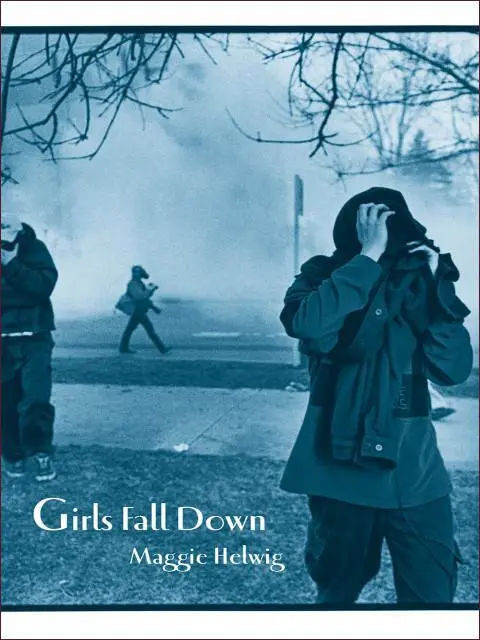
- Название:Girls Fall Down
- Автор:
- Издательство:Coach House Books
- Жанр:
- Год:2008
- Город:Toronto
- ISBN:978-1-55245-196-0
- Рейтинг книги:3 / 5. Голосов: 1
-
Избранное:Добавить в избранное
- Отзывы:
-
Ваша оценка:
Girls Fall Down: краткое содержание, описание и аннотация
Предлагаем к чтению аннотацию, описание, краткое содержание или предисловие (зависит от того, что написал сам автор книги «Girls Fall Down»). Если вы не нашли необходимую информацию о книге — напишите в комментариях, мы постараемся отыскать её.
Alex was witness to this first episode. He’s a photographer: of injuries and deaths, for his job at the hospital, and of life, in his evening explorations of every nook and cranny of the city. Alex is a diabetic, now facing the very real possibility of losing his sight, and he’s determined to create a permanent vision of his city through his camera lens. As he rushes to take advantage of his dying sight, he encounters an old girlfriend – the one who shattered his heart in the eighties, while she was fighting for abortion rights and social justice and he was battling his body’s chemical demons. But now Susie-Paul is fighting her own crisis: her schizophrenic brother has been missing for months, and the streets of Toronto are more hostile than ever.
Maggie Helwig, author of the critically lauded
, has fashioned a novel not of bold actions but of small gestures, showing how easy and gentle is the slide into paranoia, and how enormous and terrifying is the slide into love. This is a remarkable novel: romantically and politically charged, utterly convincing in its portrait of our individual and societal instability, and steadfast in its faith in redemption.
Girls Fall Down — читать онлайн бесплатно полную книгу (весь текст) целиком
Ниже представлен текст книги, разбитый по страницам. Система сохранения места последней прочитанной страницы, позволяет с удобством читать онлайн бесплатно книгу «Girls Fall Down», без необходимости каждый раз заново искать на чём Вы остановились. Поставьте закладку, и сможете в любой момент перейти на страницу, на которой закончили чтение.
Интервал:
Закладка:
The singer grabbed her mike from the stand and sang a long wordless cry and crossed the line of tape, dancing out into the audience and vanishing among their bodies.
Build ourselves a town
And then we’ll watch it all come down
Susie-Paul spun into his arms like a collision, and pulled his head down and kissed him hard in the middle of the dance floor. And it wasn’t what he wanted but it was the best he was going to get. He squeezed her against him and kept kissing her, the other people on the dance floor tripping over them, knocking them sideways, the night going on everywhere.
And suddenly nothing was urgent or desperate as he had thought it would be; as if the frantic pulse that had been beating at the back of his skull for the last year had abruptly calmed. He knew so completely that this was all he could ever hope for.
For a while they were kissing at the bus stop, muffled in their winter clothes, sucking warmth from each other, and when he drew away from her to breathe, the moisture on his lips began to freeze and sting.
He locked Queen Jane in the kitchen upstairs and unzipped Susie’s dress. The skin of her shoulders was smooth and slightly freckled and tasted like sweat and yeast. He went down on his knees and ran his tongue up her thigh. Their bodies slick and wet in the hot basement, the taste of her on his lips, her mouth sliding over him, and the borders of everything turned fluid, time and space and movement. Far away from himself and falling, broken open inside her.
And then sometime during the night he started up from the bed in quick panic, his heart pounding and sweat pouring down his back. Hypo. Grabbed at the can of Coke on his desk and drank it fast, spilling part of it on the floor, and waited for the shaking to stop, and nearly wept because his blood could never leave him alone, because he could never, not for one minute, be free of this.
Susie-Paul tossed and muttered, and he went back to her, his fingers reaching between her legs, and woke her slowly, and they slid into each other again, the heat of her skin.
She left in the morning while he was still sleeping.
He wasn’t sure what he had expected after that. But not complete silence. She had stayed in town for three more days, he learned later, but he never heard from her. When he called her house – he hadn’t ever done this before – there was no one there at first. In the end he reached Chris, and by then she was already gone.
He knew exactly when she had left because he found out from Chris, the two of them managing to establish a very brief and unsatisfactory friendship based entirely on having been dumped by the same woman. Chris believed that Alex and Susie had been lovers for several months at least, and Alex never bothered to tell him otherwise.
He did think that she would phone him sometime, or write to him or at least send a postcard. Not so much because they’d slept together. He could accept that this was an anomaly and meant very little; but they had been friends. And he wanted to know, he was worried about her, she had seemed so damaged, and talked strangely; maybe she really was sick somehow – and then he thought of AIDS, and was ashamed of the thought, but it was true that he had been wholly careless. And he was by no means sure who else she had slept with.
She wouldn’t do that, though. She was not the sort of person who would do that. He tried to keep this in the back of his mind where he kept all his other irrational fears about her – cancer, suicide. He didn’t know why she didn’t write. At the end of that strange awful year a man in Montreal picked up a rifle and went out hunting feminists, and fourteen women were dead, and he knew she had said she was going to Vancouver and anyway all the dead women were named, but he thought of that too, blood on her white lace dress. It couldn’t be true, of course. But he wished she would write and tell him so.
Dissonance came out less and less often through the winter, and finally stopped altogether. For a while he managed to increase his hours at SuperPhoto so that he could pay his rent, and borrowed money from his parents to cover his insulin, but he knew he would have to find a better job somehow.
Finally, in the spring, he heard at several removes – from Adrian, who had heard it from Evelyn’s cousin – that she was indeed in Vancouver, working as a canvasser for Greenpeace, and seemed to be more or less okay. He forced himself to go to the clinic and get tested, and he was clean, and he tried to believe that he had never expected anything else.
A few weeks later he was at the hospital to see his endocrinolo-gist, and there was a notice on a bulletin board inviting people with photographic expertise to apply for a job, and he tied back his hair and went for an interview.
There no was precise point at which he understood that he would not hear from her again.
III
In the indigo evening, a woman knelt on her front steps with a rag and a tin of cleanser, her hands red and raw, scrubbing the stairs again and again. Every time that she started to think she was finished she would see a spot she couldn’t remember cleaning, and again her mind would fill with the possibility of contagion, of the people collapsing on the subway, and what they carried with them when they left and walked into the city. She would think of vials of Asian flu inadvertently opened, of sarin and tabun deliberately released, of some tiny particle borne towards her, tracked into the house, onto the floor where her children walked, some flake of poison, of illness, of malign intent. She poured more cleanser onto the rag, dipped it in a bucket of water, and scraped it again across the stone, weeping, exhausted, shaking with cold.
She was an intelligent woman, she knew that this behaviour was somewhere within the range of an obsessive-compulsive disorder. She knew that there was no possible contaminant that would cling to her front steps or kill them all with a single molecule. She knew, as well, that the burning pain in her shoulder was the result of tension and cold, not a heart attack, not the effect of a neurotoxin. But this knowledge was useless. Her knuckles frozen white, the skin of her fingertips chafed away till they almost bled.
Inside the house, the sound system was playing, the music meant to convince her that this was less than torture, a bearable household chore. Leonard Cohen’s vampire voice singing ‘Ain’t No Cure for Love,’ over and over. She dipped the rag in the bucket again, shook the tin of cleanser over the steps, wondered what breathing it in was doing to her lungs, as the night gathered around her.
‘You don’t mind me coming along with you?’
It was Friday afternoon, and Alex was kneeling by a butcher’s stall in St. Lawrence Market, under the high ceiling of the old hall, when Susie arrived. He had been photographing a man packing up trays of meat as the market closed for the day, working on the contrast between the slick deep redness of the steaks and the thin and papery skin on the man’s gnarled hands.
‘It’s okay, it’s good you called,’ said Alex, putting the camera back into his bag. ‘Besides, I bet this is something you don’t even know about.’
‘What, raw meat?’ asked Susie, looking towards the butcher’s stand. ‘I know more about raw meat than you do.’
‘No, this was just me killing time. We’ll be going north from here.’
‘And this doesn’t bother you at all?’ asked Susie, with a gesture towards the heaps of ground pork, the glistening coils of sausage.
‘Bodies in space, Suzanne,’ said Alex, standing up. ‘It’s all bodies in space.’
They walked out of the hall and crossed the street. She was wearing a rather elegant black and white batik dress and a red quilted jacket, not quite warm enough for the weather. ‘I have to go to a party for some American hotshot later,’ she said, shrugging, aware that he’d noticed. ‘House of a major donor to the university, up in Rosedale. Filipina maids handing around wine and smoked salmon. And academic backbiting.’
Читать дальшеИнтервал:
Закладка:
Похожие книги на «Girls Fall Down»
Представляем Вашему вниманию похожие книги на «Girls Fall Down» списком для выбора. Мы отобрали схожую по названию и смыслу литературу в надежде предоставить читателям больше вариантов отыскать новые, интересные, ещё непрочитанные произведения.












Обсуждение, отзывы о книге «Girls Fall Down» и просто собственные мнения читателей. Оставьте ваши комментарии, напишите, что Вы думаете о произведении, его смысле или главных героях. Укажите что конкретно понравилось, а что нет, и почему Вы так считаете.