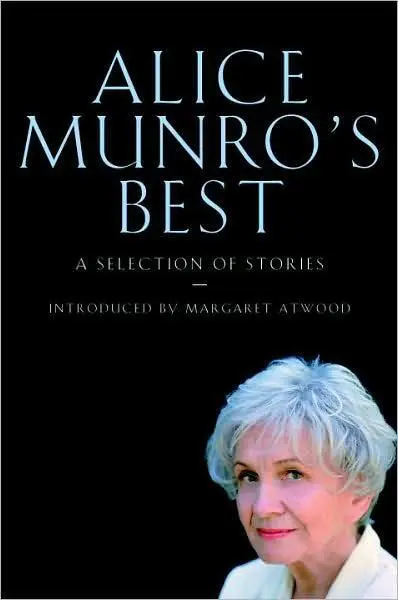
Alice Munro - Alice Munro's Best
Здесь есть возможность читать онлайн «Alice Munro - Alice Munro's Best» весь текст электронной книги совершенно бесплатно (целиком полную версию без сокращений). В некоторых случаях можно слушать аудио, скачать через торрент в формате fb2 и присутствует краткое содержание. Город: Toronto, Год выпуска: 2008, ISBN: 2008, Издательство: McClelland & Stewart, Жанр: Современная проза, на английском языке. Описание произведения, (предисловие) а так же отзывы посетителей доступны на портале библиотеки ЛибКат.
- Название:Alice Munro's Best
- Автор:
- Издательство:McClelland & Stewart
- Жанр:
- Год:2008
- Город:Toronto
- ISBN:9780771065200
- Рейтинг книги:3 / 5. Голосов: 1
-
Избранное:Добавить в избранное
- Отзывы:
-
Ваша оценка:
Alice Munro's Best: краткое содержание, описание и аннотация
Предлагаем к чтению аннотацию, описание, краткое содержание или предисловие (зависит от того, что написал сам автор книги «Alice Munro's Best»). Если вы не нашли необходимую информацию о книге — напишите в комментариях, мы постараемся отыскать её.
This splendid gift edition is sure to delight Alice Munro’s growing body of admirers, what Atwood calls her “devoted international readership.” Long-time fans of her stories will enjoy meeting old favourites, where their new setting in this book may reveal new sides to what once seemed a familiar story; devoted followers may even dispute the exclusion of a specially-beloved story. Readers lucky enough to have found her recently will be delighted, as one masterpiece succeeds another.
The 17 stories are carefully arranged in the order in which she wrote them, which allows us to follow the development of her range. “A Wilderness Station,” for example, breaks “short story rules” by taking us right back to the 1830s then jumping forward more than 100 years. “The Albanian Virgin” destroys the idea that her stories are set in B.C. or in Ontario’s “Alice Munro Country.” And “The Bear Came Over the Mountain,” the story behind the film
, takes us far from the world of young girls learning about sex into unflinching old age.
This is a book to read slowly, savouring each story. It deserves a place in every Canadian book-lover’s library.
Alice Munro's Best — читать онлайн бесплатно полную книгу (весь текст) целиком
Ниже представлен текст книги, разбитый по страницам. Система сохранения места последней прочитанной страницы, позволяет с удобством читать онлайн бесплатно книгу «Alice Munro's Best», без необходимости каждый раз заново искать на чём Вы остановились. Поставьте закладку, и сможете в любой момент перейти на страницу, на которой закончили чтение.
Интервал:
Закладка:
“Oh, it was not a matter of principle,” Louisa said. “That I kept the Library open. It was a more personal reason than you think.”
Then she laughed and promised him a peculiar story. “Oh, the whisky must have loosened my tongue,” she said.
“I am not a gossip,” said Jim Frarey.
She gave him a hard laughing look and said that when a person announced they weren’t a gossip, they almost invariably were. The same when they promised never to tell a soul.
“You can tell this where and when you like just as long as you leave out the real names and don’t tell it around here,” she said. “That I hope I can trust you not to do. Though at the moment I don’t feel as if I cared. I’ll probably feel otherwise when the drink wears off. It’s a lesson, this story. It’s a lesson in what fools women can make of themselves. So, you say, what’s new about that, you can learn it every day!”
She began to tell him about a soldier who had started writing letters to her from overseas. The soldier remembered her from when he used to go into the Library. But she didn’t remember him. However, she replied in a friendly way to his first letter and a correspondence sprang up between them. He told her where he had lived in the town and she walked past the house so that she could tell him how things looked there. He told her what books he’d read and she gave some of the same kind of information. In short, they both revealed something of themselves and feelings warmed up on either side. On his side first, as far as any declarations went. She was not one to rush in like a fool. At first, she thought she was simply being kind. Even later, she didn’t want to reject and embarrass him. He asked for a picture. She had one taken, it was not to her liking, but she sent it. He asked if she had a sweetheart and she replied truthfully that she did not. He did not send any picture of himself nor did she ask for one, though of course she was curious as to what he looked like. It would be no easy matter for him to have a picture taken in the middle of a war. Furthermore, she did not want to seem like the sort of woman who would withdraw kindness if looks did not come up to scratch.
He wrote that he did not expect to come home. He said he was not so afraid of dying as he was of ending up like some of the men he had seen when he was in the hospital, wounded. He did not elaborate, but she supposed he meant the cases they were just getting to know about now — the stumps of men, the blinded, the ones made monstrous with burns. He was not whining about his fate, she did not mean to imply that. It was just that he expected to die and picked death over some other options and he thought about her and wrote to her as men do to a sweetheart in such a situation.
When the war ended, it was a while since she had heard from him. She went on expecting a letter every day and nothing came. Nothing came. She was afraid that he might have been one of those unluckiest of soldiers in the whole war — one of those killed in the last week, or on the last day, or even in the last hour. She searched the local paper every week, and the names of new casualties were still being printed there till after New Year’s but his was not among them. Now the paper began to list as well the names of those returning home, often printing a photo with the name, and a little account of rejoicing. When the soldiers were returning thick and fast there was less room for these additions. And then she saw his name, another name on the list. He had not been killed, he had not been wounded — he was coming home to Carstairs, perhaps was already there.
It was then that she decided to keep the Library open, though the flu was raging. Every day she was sure he would come, every day she was prepared for him. Sundays were a torment. When she entered the Town Hall she always felt he might be there before her, leaning up against the wall awaiting her arrival. Sometimes she felt it so strongly she saw a shadow that she mistook for a man. She understood now how people believed they had seen ghosts. Whenever the door opened she expected to look up into his face. Sometimes she made a pact with herself not to look up till she had counted to ten. Few people came in, because of the flu. She set herself jobs of rearranging things, else she would have gone mad. She never locked up until five or ten minutes after closing time.And then she fancied that he might be across the street on the Post Office steps, watching her, being too shy to make a move. She worried of course that he might be ill, she always sought in conversation for news of the latest cases. No one spoke his name.
It was at this time that she entirely gave up on reading. The covers of books looked like coffins to her, either shabby or ornate, and what was inside them might as well have been dust.
She had to be forgiven, didn’t she, she had to be forgiven for thinking, after such letters, that the one thing that could never happen was that he wouldn’t approach her, wouldn’t get in touch with her at all? Never cross her threshold, after such avowals? Funerals passed by her window and she gave no thought to them, as long as they were not his. Even when she was sick in the hospital her only thought was that she must get back, she must get out of bed, the door must not stay locked against him. She staggered to her feet and back to work. On a hot afternoon she was arranging fresh newspapers on the racks and his name jumped out at her like something in her feverish dreams.
She read a short notice of his marriage to a Miss Grace Horne. Not a girl she knew. Not a Library user.
The bride wore fawn silk crêpe with brown-and-cream piping, and a beige straw hat with brown velvet streamers.
There was no picture. Brown-and-cream piping. Such was the end, and had to be, to her romance.
But on her desk at the Library, a matter of a few weeks ago, on a Saturday night after everybody had gone and she had locked the door and was turning out the lights, she discovered a scrap of paper. A few words written on it. I was engaged before I went overseas. No name, not his or hers. And there was her photograph, partly shoved under the blotter.
He had been in the Library that very evening. It had been a busy time, she had often left the desk to find a book for somebody or to straighten up the papers or to put some books on the shelves. He had been in the same room with her, watched her, and taken his chance. But never made himself known.
I was engaged before I went overseas.
“Do you think it was all a joke on me?” Louisa said. “Do you think a man could be so diabolical?”
“In my experience, tricks like that are far more often indulged in by the women. No, no. Don’t you think such a thing. Far more likely he was sincere. He got a little carried away. It’s all just the way it looks on the surface. He was engaged before he went overseas, he never expected to get back in one piece but he did. And when he did, there is the fiancée waiting — what else could he do?”
“What indeed?” said Louisa.
“He bit off more than he could chew.”
“Ah, that’s so, that’s so!” Louisa said. “And what was it in my case but vanity, which deserves to get slapped down!” Her eyes were glassy and her expression roguish. “You don’t think he’d had a good look at me any one time and thought the original was even worse than that poor picture, so he backed off?”
“I do not!” said Jim Frarey. “And don’t you so belittle yourself.”
“I don’t want you to think I am stupid,” she said. “I am not so stupid and inexperienced as that story makes me sound.”
“Indeed I don’t think you are stupid at all.”
“But perhaps you think I am inexperienced?”
This was it, he thought — the usual. Women after they have told one story on themselves cannot stop from telling another. Drink upsets them in a radical way, prudence is out the window.
Читать дальшеИнтервал:
Закладка:
Похожие книги на «Alice Munro's Best»
Представляем Вашему вниманию похожие книги на «Alice Munro's Best» списком для выбора. Мы отобрали схожую по названию и смыслу литературу в надежде предоставить читателям больше вариантов отыскать новые, интересные, ещё непрочитанные произведения.




Обсуждение, отзывы о книге «Alice Munro's Best» и просто собственные мнения читателей. Оставьте ваши комментарии, напишите, что Вы думаете о произведении, его смысле или главных героях. Укажите что конкретно понравилось, а что нет, и почему Вы так считаете.