Robert McGill - Once We Had a Country
Здесь есть возможность читать онлайн «Robert McGill - Once We Had a Country» весь текст электронной книги совершенно бесплатно (целиком полную версию без сокращений). В некоторых случаях можно слушать аудио, скачать через торрент в формате fb2 и присутствует краткое содержание. Город: Toronto, Год выпуска: 2013, ISBN: 2013, Издательство: Alfred A. Knopf Canada, Жанр: Современная проза, Историческая проза, на английском языке. Описание произведения, (предисловие) а так же отзывы посетителей доступны на портале библиотеки ЛибКат.
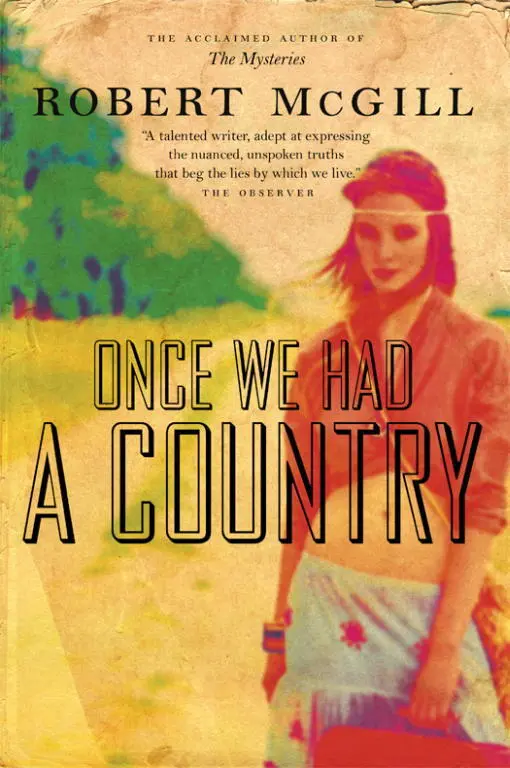
- Название:Once We Had a Country
- Автор:
- Издательство:Alfred A. Knopf Canada
- Жанр:
- Год:2013
- Город:Toronto
- ISBN:978-0-307-36122-6
- Рейтинг книги:3 / 5. Голосов: 1
-
Избранное:Добавить в избранное
- Отзывы:
-
Ваша оценка:
Once We Had a Country: краткое содержание, описание и аннотация
Предлагаем к чтению аннотацию, описание, краткое содержание или предисловие (зависит от того, что написал сам автор книги «Once We Had a Country»). Если вы не нашли необходимую информацию о книге — напишите в комментариях, мы постараемся отыскать её.
re-imagines the impact of the Vietnam War by way of the women and children who fled with the draft dodgers.
It’s the summer of 1972. Maggie, a young schoolteacher, leaves the United States to settle with her boyfriend, Fletcher, on a farm near Niagara Falls. Fletcher is avoiding the Vietnam draft, but they’ve also come to Harroway with a loftier aim: to start a commune, work the land and create a new model for society. Hopes are high for life at Harroway; equally so for Maggie and Fletcher’s budding relationship, heady as it is with passion, jealousy and uncertainty. As the summer passes, more people come to the farm—just not who Maggie and Fletcher expected. Then the US government announces the end of the draft, and Fletcher faces increasing pressure from his family to return home. At the same time, Maggie must deal with the recent disappearance of her father, a missionary, in the jungle of Laos. What happened in those days before her father vanished, and how will his life and actions affect Maggie’s future?
is a literary work of the highest order, a novel that re-imagines an era we thought we knew, and that compels us to consider our own belief systems and levels of tolerance.
Once We Had a Country — читать онлайн бесплатно полную книгу (весь текст) целиком
Ниже представлен текст книги, разбитый по страницам. Система сохранения места последней прочитанной страницы, позволяет с удобством читать онлайн бесплатно книгу «Once We Had a Country», без необходимости каждый раз заново искать на чём Вы остановились. Поставьте закладку, и сможете в любой момент перейти на страницу, на которой закончили чтение.
Интервал:
Закладка:
Then she notices the girls at the far edge of the lawn, sitting under a maple tree. There’s a pair of them hidden there, each perched on a beach towel and wearing a swimsuit, each with skinny legs that look ghostly in the shade. Maggie’s on the verge of calling out to them when she sees what they’re doing. One of them, red-haired with broad shoulders, is smoking a joint. The other, thin with long black hair, holds a beer bottle. They can’t be more than sixteen.
Maggie thinks of carrying on, not saying anything, pretending not to see.
“Good afternoon!” she shouts instead.
The girls freeze. The thin one tries to hide the bottle behind her back. The other lets her hand drop casually to her side and puts on a toothy smile. Maggie walks up to the gate and leans on it, trying to affect an affable pose.
“My name’s Maggie,” she says, then points in the direction of the farmhouse. “I’m one of your new neighbours.”
“My dad’s not home,” says the thin girl.
“That’s all right. I just wanted to introduce myself.”
The girls look at each other. Without speaking, they seem to manage some communication between them, and they smile at one another before turning back to her.
“I’m Jane,” says the red-haired one.
“I’m June,” says the other. “We’re twins. But not identical. The other kind.”
“Jane and June,” repeats Maggie, unable to disguise her disbelief. “How old are you?”
“Ancient,” says the red-haired girl, and laughs.
“So you’re old enough to be smoking and drinking that stuff,” says Maggie. She feels stupid saying it.
“Smoking?” says the red-haired girl. “What’s that?”
“What’s drinking?” says the other one, pronouncing the word as if for the first time. Raising the beer bottle to her lips, she takes a long slug.
The red-haired girl regards Maggie with a severe expression. “You must be confused. Maybe it’s sunstroke. Maybe you’ve gone senile. How old are you, anyhow? Fifty?”
Maggie feels her face burn. She thinks of telling them she’s twenty-four, but she suspects that for them twenty-four might as well be fifty.
“My dad said you people are hippies,” says the thin girl.
“They can’t be,” says the red-haired one. “Hippies aren’t so square.”
“You going to rat us out?” says the thin one, and the red-haired girl shoots her a disapproving look, as if she has broken the rules by asking a straightforward question.
Maggie shakes her head. “That’s not my job.”
“Then quit staring and beat it, will you?” says the red-haired girl. She raises the joint to her mouth and puffs, looking Maggie straight in the eye.
Without another word, Maggie starts off toward Virgil again, furious with them and with herself. Bested by a couple of teenagers. They must be the ones who got into the farmhouse, who spray-painted the peace sign on the wall. Maybe the first night it was one of them at the bottom of the stairs. She shouldn’t let them carry on like that. She should go back later and talk to the father.
Or maybe they’re right. Maybe she’s just square.
Curtains of grey sky are gathering on the horizon when she reaches the highway. The wind picks up; lilac bushes buck and toss by the roadside. A gust wrenches her hat from her head, lifts it over a fence, and sends it loping across the pasture beyond. Instead of chasing it, she presses onward.
Eventually she reaches a small church with a steeple and thick stone buttresses. The sign out front says it’s Catholic, and she thinks of going in but can’t fathom why she would. It begins to rain. Within seconds, torrents of it are bouncing on the asphalt so hard they seem to jet from the earth. With a hand shielding her face, she looks toward the distant roofs of the village, then back at the church. Lightning and thunder explode together. She runs toward the front doors.
Inside, a crucified Christ watches over the altar and a few rows of pews. A pale light penetrates the water streaming down the windows, while a stained glass Saint Francis preaches to the birds, his eyes childlike and angled toward heaven.
At first she remains near the entrance, wringing out her hair and tugging loose her top where it lies against her midriff. Then she passes into the sanctuary, her gaze rising to the dusky ceiling with its rafters and arching ribs. Rumbles of thunder are the only sound. She walks up the aisle, slowly pausing at the altar to cross herself before proceeding past the baptismal font and back down along the far side. The wooden floor is neither painted nor varnished, but the upholstery on the kneelers looks newly plush, and someone has gone row by row through the pews to space the prayer books evenly.
At the confessional along the wall, she stops.
“Father?” she whispers, pushing aside the drape. There’s the barest of murmurs from the storm, along with the drip of water from her skirt. She steps inside and kneels. “Bless me, Father, for I have sinned. Father? Is there really no one there?” With her knuckles she raps on the panelled wall.
“Piss off,” she says quietly. “Goddamn,” she continues with more volume. “Shit-cunt-asshole,” she exclaims, then feels idiotic, no better than those girls.
From outside the booth, there’s a noise like a door closing. Cocking her head, she calls out a hello. When there’s no response, she pulls back the drape and scans the building. All is still. Beginning to shiver, she makes her way toward the front door, stopping at an alcove where a few votive candles stand beside a collection box. She bends over in search of something with which to light them. As she does, a voice booms out.
“You, girl! Get away from this!” A thin, balding man in a cassock is hurrying toward her. He looks almost forty, with thick, angry eyebrows. “You have no shame?” His accent is clipped, Eastern European. He turns and shouts, “Lenka, call police station.” A woman with a beehive piled atop her head has appeared in a side door by the altar and gives the barest of nods.
The priest reaches for Maggie and grabs her by the arm. Instinctively, she tries to wrench loose of his grip.
“What did I do?” she cries.
“You know what you do.”
“I don’t know! I really don’t!” Her skin’s still wet and she slips away. Reaching to seize her, he fastens onto a strap of her top. It rips loudly, freezing them both. Then he lets go and steps back.
“I only came in here to pray,” she says, holding the strap in place with one hand. “It was raining!” But when she turns to go, he blocks the door.
“Where do you come from?” he asks. “You are one of the draft dodgers at Harroway.” He speaks these words carefully, whether out of some difficulty in pronouncing them or with a particular disdain for such people, it isn’t clear.
“Who told you that?” she demands.
“The man with you,” replies the priest with a tight smile. “He speaks to storekeepers in Virgil. This place is the same as everywhere, people like the gossip.”
“We’re not draft dodgers,” she says. “We’re working for the Morgan Sugar Company.”
The priest seems uninterested in this distinction.
“Stealing is serious thing.” He raises a handkerchief to wipe the sweat from his brow. “Authorities send you back to U.S.A.”
“Father, it’s a misunderstanding. I’m Catholic, really! My dad’s a missionary.” The priest’s face remains stern. “Oh, never mind!” With her free arm she gestures toward the alcove. “Tell me what I was stealing. Candles?”
“You hide something behind your back.”
Reaching around, she pulls out her letter. The ink has bled so that the name and address are illegible. As she goes to offer it for his inspection, the wet paper wilts in her hand.
Читать дальшеИнтервал:
Закладка:
Похожие книги на «Once We Had a Country»
Представляем Вашему вниманию похожие книги на «Once We Had a Country» списком для выбора. Мы отобрали схожую по названию и смыслу литературу в надежде предоставить читателям больше вариантов отыскать новые, интересные, ещё непрочитанные произведения.




Обсуждение, отзывы о книге «Once We Had a Country» и просто собственные мнения читателей. Оставьте ваши комментарии, напишите, что Вы думаете о произведении, его смысле или главных героях. Укажите что конкретно понравилось, а что нет, и почему Вы так считаете.