Jennifer DuBois - Cartwheel
Здесь есть возможность читать онлайн «Jennifer DuBois - Cartwheel» весь текст электронной книги совершенно бесплатно (целиком полную версию без сокращений). В некоторых случаях можно слушать аудио, скачать через торрент в формате fb2 и присутствует краткое содержание. Город: New York, Год выпуска: 2013, ISBN: 2013, Издательство: Random House, Жанр: Современная проза, Триллер, на английском языке. Описание произведения, (предисловие) а так же отзывы посетителей доступны на портале библиотеки ЛибКат.
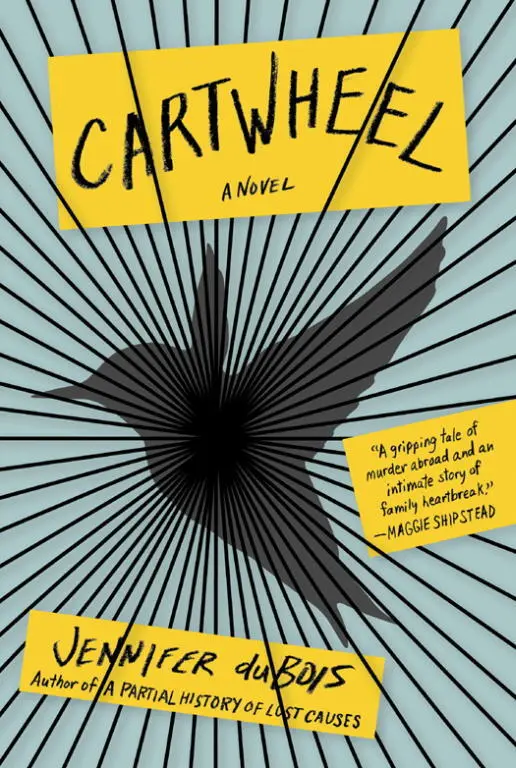
- Название:Cartwheel
- Автор:
- Издательство:Random House
- Жанр:
- Год:2013
- Город:New York
- ISBN:9780812995879
- Рейтинг книги:3 / 5. Голосов: 1
-
Избранное:Добавить в избранное
- Отзывы:
-
Ваша оценка:
Cartwheel: краткое содержание, описание и аннотация
Предлагаем к чтению аннотацию, описание, краткое содержание или предисловие (зависит от того, что написал сам автор книги «Cartwheel»). Если вы не нашли необходимую информацию о книге — напишите в комментариях, мы постараемся отыскать её.
is a suspenseful and haunting novel of an American foreign exchange student arrested for murder, and a father trying to hold his family together. Cartwheel When Lily Hayes arrives in Buenos Aires for her semester abroad, she is enchanted by everything she encounters: the colorful buildings, the street food, the handsome, elusive man next door. Her studious roommate Katy is a bit of a bore, but Lily didn’t come to Argentina to hang out with other Americans.
Five weeks later, Katy is found brutally murdered in their shared home, and Lily is the prime suspect. But who is Lily Hayes? It depends on who’s asking. As the case takes shape—revealing deceptions, secrets, and suspicious DNA—Lily appears alternately sinister and guileless through the eyes of those around her: the media, her family, the man who loves her and the man who seeks her conviction. With mordant wit and keen emotional insight,
offers a prismatic investigation of the ways we decide what to see—and to believe—in one another and ourselves.
In
, duBois delivers a novel of propulsive psychological suspense and rare moral nuance. No two readers will agree who Lily is and what happened to her roommate.
will keep you guessing until the final page, and its questions about how well we really know ourselves will linger well beyond.
Starred Review
A
Pick for Biggest Books of the Fall • A Pick for
’ Most Anticipated Books of 2013
From
“A tabloid tragedy elevated to high art.”
—
“[A] compelling, carefully crafted, and, most importantly, satisfying novel.”
—
Lily Hayes, 21, is a study-abroad student in Buenos Aires. Her life seems fairly unexceptional until her roommate, Katy, is brutally murdered, and Lily, charged with the crime, is remanded to prison pending her trial. But is she guilty, and who is Lily, really? To find answers to these questions, the novel is told from multiple points of view—not only that of Lily but also that of her family; of sardonic Sebastien, the boy with whom she has been having an affair; and of the prosecutor in the case. In the process, it raises even more questions. What possible motive could Lily have had? Why, left momentarily alone after her first interrogation, did she turn a cartwheel? And has she, as her sister asserts, always been weird? In her skillful examination of these matters, the author does an excellent job of creating and maintaining a pervasive feeling of foreboding and suspense.
Sometimes bleak, duBois’ ambitious second novel is an acute psychological study of character that rises to the level of the philosophical, specifically the existential. In this it may not be for every reader, but fans of character-driven literary fiction will welcome its challenges. Though inspired by the Amanda Knox case,
is very much its own individual work of the author’s creative imagination. —Michael Cart
Cartwheel — читать онлайн бесплатно полную книгу (весь текст) целиком
Ниже представлен текст книги, разбитый по страницам. Система сохранения места последней прочитанной страницы, позволяет с удобством читать онлайн бесплатно книгу «Cartwheel», без необходимости каждый раз заново искать на чём Вы остановились. Поставьте закладку, и сможете в любой момент перейти на страницу, на которой закончили чтение.
Интервал:
Закладка:
Lily rolled over and stifled a groan. She’d been childish, she saw now; she’d wanted everyone to be liberated and generous with one another, and somewhere along the way, she’d started believing that that meant people actually would be. Why had she believed this? Was it because she’d watched too many reruns of Friends growing up? In which everyone jumped in and out of bed with one another but no one got hurt and the truly sacred, eponymous relationship—friendship—remained intact? Or maybe Lily’s problem was her parents’ fault; perhaps it was some kind of inherited naïveté. Maybe it stemmed from Maureen and Andrew’s allegedly hippie-ish youth (though the only supporting evidence for this characterization was Maureen’s claim that she’d gone barefoot for the entire summer of 1971), or maybe it somehow came from Andrew’s outmoded, overly sanguine scholarly worldview—all the end-of-history-Francis-Fukuyama shit he’d committed to twenty years ago and now had to wearily, disingenuously maintain in article after article. Lily did not know. All she knew was that she was going to admit it when she was wrong. It was true that in her generation people didn’t have to be cruel and deceitful in order to get what they wanted—unless being cruel and deceitful was what they wanted, in which case they had a whole new vista of opportunity to be that way. Whenever Lily herself had juggled dates, she had done it because she really liked a few men at once—she wanted to talk about politics with one of them and she wanted to talk about music with another and with a third she wanted to go on playful midnight adventures to search for free furniture on the street when the first of the month came and everybody moved out of their apartments. And in this spirit, Lily had done new things: She went to a rally for a union, even though she’d always found labor issues terribly dull; she found a child’s abandoned skunk piñata on the street and kept it in her dorm for half a year; she attended a concert of an intolerable band whose music was like the forceful overthrowing of the concept of music, and after a while she found herself dancing, actually dancing, even though she still didn’t like the songs. The reason Lily didn’t want a boyfriend was because she actually cared for all of these men. They were all her friends, and Lily’s friends mattered to her; she was not in love with any of them, but she would have given any one of them a kidney. She understood now that this was not how Sebastien felt about her. A situation like theirs arose not because a man liked too many women, but because he hated too many.
Lily was, she realized, monstrously thirsty. She padded down the ladder and went to the bathroom to guzzle water directly from the faucet. When she stood up, she caught sight of herself in the mirror and startled. What was wrong with her face? Her eyes were raccooned with makeup, of course, but that wasn’t it. Last night Lily had thought she looked a bit fierce—masquerading semi-convincingly as the kind of girl that she was secretly intimidated by—and normally in the mornings after a night out she just looked goofy, like a person whose Halloween costume had fallen apart because they were having too much fun at the party. What was it that looked different now? Lily leaned closer and studied her face. Recently, faint sickle-shaped lines had appeared around her mouth; Lily had known, on some level, that these were wrinkles—fetal wrinkles, proto-wrinkles, whatever—but still she’d regarded them up until now as temporary blemishes, something she might yet grow out of, like acne. She pulled away from the mirror. The lines were barely visible, but they were there, and they were, she realized, part of the reason she looked different: She looked older. Not old, of course—but old enough to seem a little less victorious in sloppiness, like a person whose immaculate beauty has faded enough that their stern glasses finally really do look dowdy. In the morning light—makeup smeared, hair disastrous—Lily didn’t seem like a person whose costume was unimportant. She seemed like a person whose costume was very important indeed. Lily bent and scrubbed her face, leaving black streaks on the hand towel, then furiously scrubbed at that until the motion stopped her. She threw the towel helplessly in the hamper, trying not to think about who might find it, and retreated back down the hallway.
The sun was still coiling around the bedroom, gathering itself up into corners, as Lily climbed back into bed. There was a ray of light on her pillow. Maybe it wasn’t violating at all, the way the light snuck in like this—maybe it was lovely. It meant that there could be beauty, benevolent and unasked for and all around you, even if you didn’t know it. There was something bittersweet about this, but perhaps there was also something hopeful. Soon enough, Lily would be on the other side of breaking up with Sebastien. And soon enough, Lily would be awake early enough for this light; she vowed to remember it, to set an alarm to gratefully greet it. But not today. Today, she was tired. And so Lily lay back down—deliciously, guiltily, with the decadent weariness of the newly old—and sank back into sleep.
When Lily woke again, it was ludicrously late, the light outside her window already aging. Sleeping into the afternoon always gave Lily a dreadful feeling—as though she’d wasted an entire life, not only part of a day—and she bolted upright. She looked at the clock and scoffed. It was almost three-thirty. There was a real possibility she was going to be late for work.
Ten minutes later Lily was racing along Avenida Cabildo; above her, the skies were opening up into an uncharacteristic late afternoon rain, contributing to her general sense of persecution. She arrived at Fuego soaking wet but only five minutes late. Javier was sitting at the end of the bar poring over some papers. He shot Lily a subtle smirk. She ducked her head and hurried to grab her apron, trying to look diligent and humble. But when she glanced back in Javier’s direction, she saw that he was motioning her over to him. This felt ominous, though Lily reminded herself that absolutely everything today felt ominous. She walked to the end of the bar.
“Hey, Javier,” she said. “What’s up?”
“Feeling okay today, Lily?”
She laughed ruefully and bobbled her hand back and forth. “Not too bad. A little tired.”
“Well, don’t worry about that. You can go home now.”
“What?” Lily gestured toward the break room, where the schedule was posted on the wall. “I’m on the schedule for tonight.”
“I know, Lily,” said Javier. “But it’s not working out.”
“What?” Lily felt like she’d bitten on a blade. “Why?”
“I expect my customers to make scenes, not my waitresses.”
“What?” Had Lily made a scene? Maybe, by very, very puritan standards, she had. “But it was my birthday,” she said, inanely.
“Well, your birthday present is you got to make a scene,” said Javier. “Happy birthday. Now you’re fired.”
“But I mean, I wasn’t even working. I mean, I was off the clock.”
“Yes. It was a favor for you.”
“Doesn’t that mean I was just a customer? So I get to make a scene, too?” Lily laughed lightly, but Javier did not.
“Really, Lily, did you actually like this job? Did you think you were any good at it?”
Actually, yes: Lily had thought she was good at it. She’d thought she was okay at it, at any rate, and getting better. She’d thought that the customers and the other staff liked her. They laughed and jovially caroused whenever she came around, anyway, and she’d always thought that this was good-natured, maybe even fond. But just like things with Beatriz, and Sebastien, and all men, and possibly all things and all people, Lily saw now that perhaps there had been a different, more menacing undercurrent to all of this teasing—something she hadn’t detected, or had willfully mistranslated, in order to be happy. “I did like this job,” said Lily. “I do like it.”
Читать дальшеИнтервал:
Закладка:
Похожие книги на «Cartwheel»
Представляем Вашему вниманию похожие книги на «Cartwheel» списком для выбора. Мы отобрали схожую по названию и смыслу литературу в надежде предоставить читателям больше вариантов отыскать новые, интересные, ещё непрочитанные произведения.












Обсуждение, отзывы о книге «Cartwheel» и просто собственные мнения читателей. Оставьте ваши комментарии, напишите, что Вы думаете о произведении, его смысле или главных героях. Укажите что конкретно понравилось, а что нет, и почему Вы так считаете.