Jennifer DuBois - Cartwheel
Здесь есть возможность читать онлайн «Jennifer DuBois - Cartwheel» весь текст электронной книги совершенно бесплатно (целиком полную версию без сокращений). В некоторых случаях можно слушать аудио, скачать через торрент в формате fb2 и присутствует краткое содержание. Город: New York, Год выпуска: 2013, ISBN: 2013, Издательство: Random House, Жанр: Современная проза, Триллер, на английском языке. Описание произведения, (предисловие) а так же отзывы посетителей доступны на портале библиотеки ЛибКат.
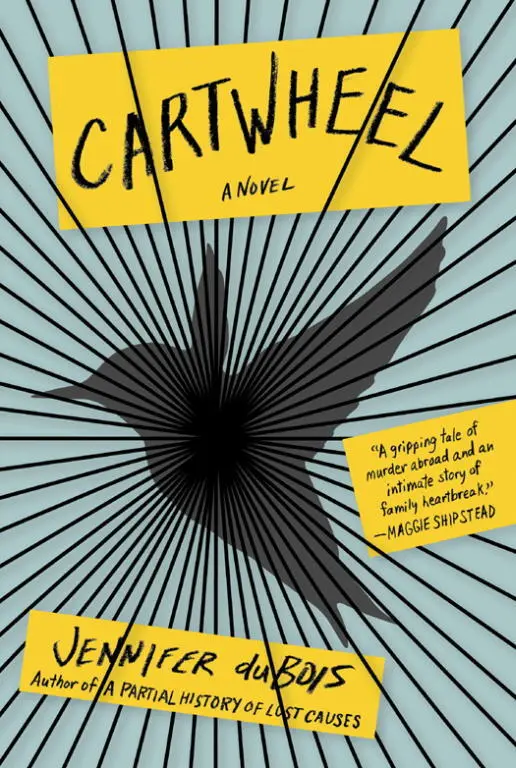
- Название:Cartwheel
- Автор:
- Издательство:Random House
- Жанр:
- Год:2013
- Город:New York
- ISBN:9780812995879
- Рейтинг книги:3 / 5. Голосов: 1
-
Избранное:Добавить в избранное
- Отзывы:
-
Ваша оценка:
Cartwheel: краткое содержание, описание и аннотация
Предлагаем к чтению аннотацию, описание, краткое содержание или предисловие (зависит от того, что написал сам автор книги «Cartwheel»). Если вы не нашли необходимую информацию о книге — напишите в комментариях, мы постараемся отыскать её.
is a suspenseful and haunting novel of an American foreign exchange student arrested for murder, and a father trying to hold his family together. Cartwheel When Lily Hayes arrives in Buenos Aires for her semester abroad, she is enchanted by everything she encounters: the colorful buildings, the street food, the handsome, elusive man next door. Her studious roommate Katy is a bit of a bore, but Lily didn’t come to Argentina to hang out with other Americans.
Five weeks later, Katy is found brutally murdered in their shared home, and Lily is the prime suspect. But who is Lily Hayes? It depends on who’s asking. As the case takes shape—revealing deceptions, secrets, and suspicious DNA—Lily appears alternately sinister and guileless through the eyes of those around her: the media, her family, the man who loves her and the man who seeks her conviction. With mordant wit and keen emotional insight,
offers a prismatic investigation of the ways we decide what to see—and to believe—in one another and ourselves.
In
, duBois delivers a novel of propulsive psychological suspense and rare moral nuance. No two readers will agree who Lily is and what happened to her roommate.
will keep you guessing until the final page, and its questions about how well we really know ourselves will linger well beyond.
Starred Review
A
Pick for Biggest Books of the Fall • A Pick for
’ Most Anticipated Books of 2013
From
“A tabloid tragedy elevated to high art.”
—
“[A] compelling, carefully crafted, and, most importantly, satisfying novel.”
—
Lily Hayes, 21, is a study-abroad student in Buenos Aires. Her life seems fairly unexceptional until her roommate, Katy, is brutally murdered, and Lily, charged with the crime, is remanded to prison pending her trial. But is she guilty, and who is Lily, really? To find answers to these questions, the novel is told from multiple points of view—not only that of Lily but also that of her family; of sardonic Sebastien, the boy with whom she has been having an affair; and of the prosecutor in the case. In the process, it raises even more questions. What possible motive could Lily have had? Why, left momentarily alone after her first interrogation, did she turn a cartwheel? And has she, as her sister asserts, always been weird? In her skillful examination of these matters, the author does an excellent job of creating and maintaining a pervasive feeling of foreboding and suspense.
Sometimes bleak, duBois’ ambitious second novel is an acute psychological study of character that rises to the level of the philosophical, specifically the existential. In this it may not be for every reader, but fans of character-driven literary fiction will welcome its challenges. Though inspired by the Amanda Knox case,
is very much its own individual work of the author’s creative imagination. —Michael Cart
Cartwheel — читать онлайн бесплатно полную книгу (весь текст) целиком
Ниже представлен текст книги, разбитый по страницам. Система сохранения места последней прочитанной страницы, позволяет с удобством читать онлайн бесплатно книгу «Cartwheel», без необходимости каждый раз заново искать на чём Вы остановились. Поставьте закладку, и сможете в любой момент перейти на страницу, на которой закончили чтение.
Интервал:
Закладка:
“Really, Anna,” Lily had said. She’d been trying to sound knowing and world-weary, but the truth was she hadn’t given the matter much thought. She hadn’t necessarily considered that sex was something she was going to keep doing; she’d been focused entirely on the hurdle of virginity loss, and being questioned about birth control now felt like being immediately grilled about postgraduation plans when you’d just come running into the room with a college acceptance letter. “If you are going to have any fun in college, Anna-Banana,” said Lily, “you are going to have to learn to relax.”
She and Anna had been closer when they were small—back then, at least, they had shared a serious interest. Like all children, Lily and Anna were generally bored by things that had happened before they were born—but the subject of Janie was, of course, the great exception, and it consumed them with a curiosity that was terrible and electric and shameful and insatiable. It was also, Lily realized now, probably normal, though they hadn’t known that then. All they’d known at the time was that their inquisitiveness came out as cruelty. Lily had learned this the hard way when, at the age of four or five, she’d asked Maureen something horrifically blunt about Janie—something about the fate of her dead body, she thought, though she was not totally sure now and shrank from trying very hard to remember. The visceral, involuntary pain on Maureen’s face in that moment had shocked Lily, as had the awful curdled quality of her voice as she answered, and Lily had suddenly realized that Maureen was very, very sad and was trying not to blame her for it. Lily could still remember the desolation of wondering—for the first of many, many times—if everything was more complicated than it seemed.
And so, because they loved their parents and did not want to hurt them, Lily and Anna had stopped asking questions. But their natural-born preadolescent morbidity—squashed and suppressed as it was—could not disappear entirely, and sometimes it came out in strange ways.
“We could die,” Lily had whispered to Anna late one night. She was seven and Anna was five. It was the summer Lily slept in her Mulan sleeping bag every single night and pretended to camp. “Either of us. Don’t you know that?”
“No, we couldn’t.”
“Janie died. We could die any time.”
“Janie was very sick,” said Anna sternly. This was the family’s compulsively repeated mantra—to this day, Lily could hear it recited in an eerie, almost singsong chorus: Janie was very sick, Janie was very sick— and Anna was prone to slavishly parroting whatever Maureen and Andrew said, which Lily found annoying even when they were very small.
“Either of us could get sick, though,” said Lily.
“Shut up,” said Anna, her voice quavery. Even when they were little, Lily hadn’t really known what would upset Anna. She had actually envied other girls who seemed to know exactly what would make their sisters sad, and what would make them angry, and what would make them tattle, and what would overwhelmingly gross them out. Lily didn’t know those things; Anna was like an egg on a spoon that she was always dropping, even when she didn’t mean to.
“We won’t get sick,” Anna had repeated fiercely, over and over, that night and many nights after. “We won’t. We won’t.”
And she was right. They had not.
Lily squinted at the phone. The basement’s artificial light was somehow shriller than usual, and she found herself dialing Andrew’s number. Her father was either in on a Saturday evening or he was out, and either possibility had vaguely gruesome implications. Lily waited. An interminable row of numbers would be popping up on her father’s caller ID. Lily could still feel dregs of the woman’s spit on her cheek, though, of course, that was impossible. Andrew picked up the phone.
“Lily!”
“Hello, Father.”
“To what do I owe the honor?”
“Just thought I’d check in on you.” Lily had called him, but now she had to pretend that the calling was for reasons of business, not pleasure. “Make sure you weren’t having too much fun without me.”
“Clearly you needn’t worry. What about you? Shouldn’t you be out with that guy?”
Sebastien. Lily had mentioned him in a postcard ten days ago, feeling the thrill of the unconventional spelling and capitalization, giddy with the sophisticated joy of sending little stamps of excitement into the dull slog of the lives of the people she’d left behind. Now she wished she hadn’t said anything.
“Do you think it’s morally problematic to be on study abroad in Argentina?” said Lily.
“Ah, talk to your mom about this,” said Andrew. “You know she’s the only real Marxist in the family.”
The fondness in Andrew’s voice as he said this made Lily wonder, for the trillionth time, why her parents had split up—though she had to marvel over their inability to do anything, even divorce, with any real verve. It was very hard to tell how bad their marriage had been, exactly, as it was staggering around its terminal lap. It was certainly true that, for all their espoused progressivism, the family seemed to adhere basically to the national statistics about labor divisions in housework: Andrew seemed to make everything marginally dingier and dirtier without really trying as he moved about the house; Maureen swept quietly along behind him with a similarly effortless-seeming tidiness and order. But Lily knew it couldn’t be that simple. There was a story that Maureen and Andrew told—sometimes separately, sometimes jointly, but always in a tone suggesting profound symbolic content—that Lily thought might contain some clues: Toward the end of Janie’s life, apparently, the next-door hippie neighbors had brought over some crystals, and had stood on the porch (in Maureen’s telling), smug, serene, beaming with the beautiful obviousness of the solution. Over the years, the crystals had become some strange and dark and utterly unfunny inside joke between Maureen and Andrew; whenever one of them turned to the other and said, emphatically, those crystals , it was clear that something tedious and adult was going to go sailing right over the heads of Lily and Anna, who knew better than to try to really probe the matter.
“I tried,” said Lily. “She wasn’t home. I’m stuck with you.”
“Go dig latrines in Mongolia after you graduate,” said Andrew. “What the hell else are you going to do anyway? You’re a philosophy major.”
“And women’s studies.”
“They’re still regarding that as an area of academic inquiry?”
“I feel so useless.”
“Well, you are useless, Lil. But the Peace Corps will still be there later. You might as well have fun now. Are you having fun?”
Lily felt deflated at the use of this word, “fun.” She hadn’t thought of Buenos Aires in terms of “fun”; she’d thought of it in terms of “transformative purity.” But she realized now with a minor shock that it had been fun—the exploring, the psychic revelation of language acquisition, the drinking, the literary preening, the growing sense of herself as a fashionable waif in a foreign film. It had all been very fun until, somehow, it wasn’t.
“Fun has been had,” she said sadly.
“Well. Don’t let mistakes get made. Listen, I’ve got to run. Garry Kasparov is on CNN in a minute.”
“You love that guy.”
“I love that guy. But listen—you’re doing all right? Everything’s fine?”
“Everything’s all right, everything’s fine. Blow Garry a kiss for me.”
Andrew was gone, but Lily kept holding the phone to her ear, listening to the particular silence of a concluded phone call, staring right into the light above her until she saw black striations in her vision. She thought about the shrieking woman in the doorway. She tried to play back in her head what the woman had said, tried to retroactively unravel and translate it, but it was no use. The woman had been indecipherable, and would be incomprehensible now, always. Lily hung up the phone.
Читать дальшеИнтервал:
Закладка:
Похожие книги на «Cartwheel»
Представляем Вашему вниманию похожие книги на «Cartwheel» списком для выбора. Мы отобрали схожую по названию и смыслу литературу в надежде предоставить читателям больше вариантов отыскать новые, интересные, ещё непрочитанные произведения.










Обсуждение, отзывы о книге «Cartwheel» и просто собственные мнения читателей. Оставьте ваши комментарии, напишите, что Вы думаете о произведении, его смысле или главных героях. Укажите что конкретно понравилось, а что нет, и почему Вы так считаете.