Kurt Vonnegut - Breakfast of Champions
Здесь есть возможность читать онлайн «Kurt Vonnegut - Breakfast of Champions» весь текст электронной книги совершенно бесплатно (целиком полную версию без сокращений). В некоторых случаях можно слушать аудио, скачать через торрент в формате fb2 и присутствует краткое содержание. Жанр: Современная проза, на английском языке. Описание произведения, (предисловие) а так же отзывы посетителей доступны на портале библиотеки ЛибКат.
- Название:Breakfast of Champions
- Автор:
- Жанр:
- Год:неизвестен
- ISBN:нет данных
- Рейтинг книги:4 / 5. Голосов: 1
-
Избранное:Добавить в избранное
- Отзывы:
-
Ваша оценка:
Breakfast of Champions: краткое содержание, описание и аннотация
Предлагаем к чтению аннотацию, описание, краткое содержание или предисловие (зависит от того, что написал сам автор книги «Breakfast of Champions»). Если вы не нашли необходимую информацию о книге — напишите в комментариях, мы постараемся отыскать её.
Breakfast of Champions — читать онлайн бесплатно полную книгу (весь текст) целиком
Ниже представлен текст книги, разбитый по страницам. Система сохранения места последней прочитанной страницы, позволяет с удобством читать онлайн бесплатно книгу «Breakfast of Champions», без необходимости каждый раз заново искать на чём Вы остановились. Поставьте закладку, и сможете в любой момент перейти на страницу, на которой закончили чтение.
Интервал:
Закладка:
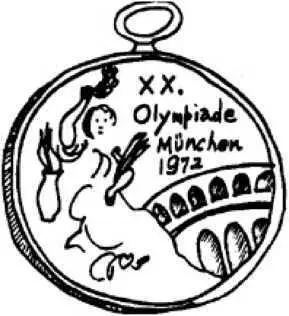
Mary Alice was also the Queen of the Festival of the Arts. The cover of the program showed her in a white bathing suit, with her Olympic Gold Medal hanging around her neck. The medal looked like this:
Mary Alice was smiling at a picture of Saint Sebastian, by the Spanish painter El Greco. It had been loaned to the Festival by Eliot Rosewater, the patron of Kilgore Trout. Saint Sebastian was a Roman soldier who had lived seventeen hundred years before me and Mary Alice Miller and Wayne and Dwayne and all the rest of us. He had secretly become a Christian when Christianity was against the law.
And somebody squealed on him. The Emperor Diocletian had him shot by archers. The picture Mary Alice smiled at with such uncritical bliss showed a human being who was so full of arrows that he looked like a porcupine.
Something almost nobody knew about Saint Sebastian, incidentally, since painters liked to put so many arrows into him, was that he survived the incident. He actually got well.
He walked around Rome praising Christianity and badmouthing the Emperor, so he was sentenced to death a second time. He was beaten to death by rods.
And so on.
And Bonnie MacMahon told Beatrice and Karabekian that Mary Alice’s father, who was a member of the Parole Board out at Shepherdstown, had taught Mary Alice to swim when she was eight months old, and that he had made her swim at least four hours a day, every day, since she was three.
Rabo Karabekian thought this over, and then he said loudly, so a lot of people could hear him, “What kind of a man would turn his daughter into an outboard motor?”
And now comes the spiritual climax of this book, for it is at this point that I, the author, am suddenly transformed by what I have done so far. This is why I had gone to Midland City: to be born again. And Chaos announced that it was about to give birth to a new me by putting these words in the mouth of Rabo Karabekian: “What kind of a man would turn his daughter into an outboard motor?”
Such a small remark was able to have such thundering consequences because the spiritual matrix of the cocktail lounge was in what I choose to call a pre-earthquake condition . Terrific forces were at work on our souls, but they could do no work, because they balanced one another so nicely.
But then a grain of sand crumbled. One force had a sudden advantage over another, and spiritual continents began to shrug and heave.
One force, surely, was the lust for money which infested so many people in the cocktail lounge. They knew what Rabo Karabekian had been paid for his painting, and they wanted fifty thousand dollars, too. They could have a lot of fun with fifty thousand dollars, or so they believed. But they had to earn money the hard way, just a few dollars at a time, instead. It wasn’t right.
Another force was the fear in these same people that their lives might be ridiculous, that their entire city might be ridiculous. Now the worst had happened: Mary Alice Miller, the one thing about their city which they had supposed was ridicule-proof had just been lazily ridiculed by a man from out-of-town.
And my own pre-earthquake condition must be taken into consideration, too, since I was the one who was being reborn. Nobody else in the cocktail lounge was reborn, as far as I know. The rest got their minds changed, some of them, about the value of modern art.
As for myself: I had come to the conclusion that there was nothing sacred about myself or about any human being, that we were all machines, doomed to collide and collide and collide. For want of anything better to do, we became fans of collisions. Sometimes I wrote well about collisions, which meant I was a writing machine in good repair. Sometimes I wrote badly, which meant I was a writing machine in bad repair. I no more harbored sacredness than did a Pontiac, a mousetrap, or a South Bend Lathe.
I did not expect Rabo Karabekian to rescue me. I had created him, and he was in my opinion a vain and weak and trashy man, no artist at
all. But it is Rabo Karabekian who made me the serene Earthling which I am this day.
Listen:
“What kind of a man would turn his daughter into an outboard motor?” he said to Bonnie MacMahon.
Bonnie MacMahon blew up. This was the first time she had blown up since she had come to work in the cocktail lounge. Her voice became as unpleasant as the noise of a bandsaw’s cutting galvanized tin. It was loud, too. “Oh yeah?” she said. “Oh yeah?”
Everybody froze. Bunny Hoover stopped playing the piano. Nobody wanted to miss a word.
“You don’t think much of Mary Alice Miller?” she said. “Well, we don’t think much of your painting. I’ve seen better pictures done by a five-year-old.”
Karabekian slid off his barstool so he could face all those enemies standing up. He certainly surprised me. I expected him to retreat in a hail of olives, maraschino cherries and lemon rinds. But he was majestic up there “Listen—” he said so calmly, “I have read the editorial against my painting in your wonderful newspaper. I have read every word of the hate mail you have been thoughtful enough to send to New York.”
This embarrassed people some.
“The painting did not exist until I made it,” Karabekian went on. “Now that it does exist, nothing would make me happier than to have it reproduced again and again, and vastly improved upon, by all the five- year-olds in town. I would love for your children to find pleasantly and playfully what it took me many angry years to find.
“I now give you my word of honor,” he went on, “that the picture your city owns shows everything about life which truly matters, with nothing left out. It is a picture of the awareness of every animal. It is the immaterial core of every animal—the ‘I am’ to which all messages are sent. It is all that is alive in any of us—in a mouse, in a deer, in a cocktail waitress. It is unwavering and pure, no matter what preposterous adventure may befall us. A sacred picture of Saint Anthony alone is one vertical, unwavering band of light. If a cockroach were near him, or a cocktail waitress, the picture would show two such bands of light. Our awareness is all that is alive and maybe sacred in any of us. Everything else about us is dead machinery.
“I have just heard from this cocktail waitress here, this vertical band of light, a story about her husband and an idiot who was about to be executed at Shepherdstown. Very well—let a five-year-old paint a sacred interpretation of that encounter. Let that five-year-old strip away the idiocy, the bars, the waiting electric chair, the uniform of the guard, the gun of the guard, the bones and meat of the guard. What is that perfect picture which any five-year-old can paint? Two unwavering bands of light.”
Ecstasy bloomed on the barbaric face of Rabo Karabekian.
“Citizens of Midland City, I salute you,” he said. “You have given a home to a masterpiece!”
Dwayne Hoover, incidentally, wasn’t taking any of this in. He was still hypnotized, turned inward. He was thinking about moving fingers writing and moving on, and so forth. He had bats in his bell tower. He was off his rocker. He wasn’t playing with a full deck of cards.
Chapter 20
While my life was being renewed by the words of Rabo Karabekian, Kilgore Trout found himself standing on the shoulder of the Interstate, gazing across Sugar Creek in its concrete trough at the new Holiday Inn. There were no bridges across the creek. He would have to wade.
So he sat down on a guardrail, removed his shoes and socks, rolled his pantlegs to his knees. His bared shins were rococo with varicose veins and scars. So were the shins of my father when he was an old, old man.
Читать дальшеИнтервал:
Закладка:
Похожие книги на «Breakfast of Champions»
Представляем Вашему вниманию похожие книги на «Breakfast of Champions» списком для выбора. Мы отобрали схожую по названию и смыслу литературу в надежде предоставить читателям больше вариантов отыскать новые, интересные, ещё непрочитанные произведения.


Обсуждение, отзывы о книге «Breakfast of Champions» и просто собственные мнения читателей. Оставьте ваши комментарии, напишите, что Вы думаете о произведении, его смысле или главных героях. Укажите что конкретно понравилось, а что нет, и почему Вы так считаете.